03 — ARTWORK
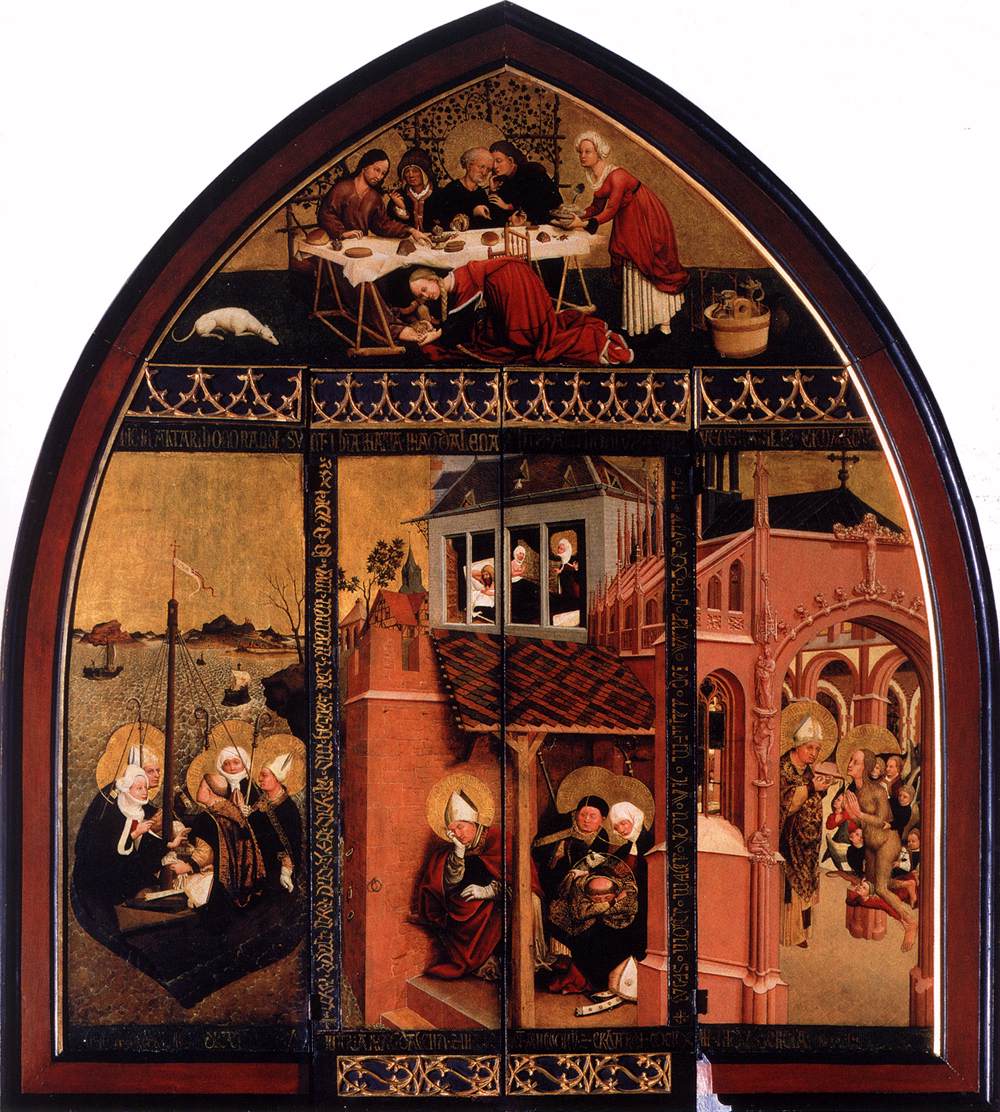
Magdalene Altar
- MEDIUM
- Mixed technique on wood, 300 x 240 cm
- TYPE
- Religious
PALETTE
HOVER OR TAP A SWATCH FOR NAME, SHARE AND HEX. SAMPLED FROM THE IMAGE — INDICATIVE, NOT A PIGMENT ANALYSIS.
DEVELOPMENT BUILD — NOT FOR PUBLIC USE. CONTRIBUTE ON GITHUB.
03 — ARTWORK
PALETTE
HOVER OR TAP A SWATCH FOR NAME, SHARE AND HEX. SAMPLED FROM THE IMAGE — INDICATIVE, NOT A PIGMENT ANALYSIS.
COMMENTARY
UNDERLINED TERMS ARE DEFINED IN THE GLOSSARY.
This altarpieceA picture or sculpture that stands on or is set up behind an altar. The term reredos is used for an ornamental screen or partition, not directly attached to the altar table but affixed to the wall behind it. A diptych is an altarpiece consisting of two panels, a triptych one of three panels, and a polyptych one of four or more panels. From the 14th to 16th century, the altarpiece was one of the most important commissions in European art; it was through the altarpiece that some of the most decisive developments in painting and sculpture came about. ranks among those exceptional works produced in Germany in the first half of the 15th century. It is as important to the art of German-speaking lands as van Eyck's <A onclick="return OpenOther('/html/e/eyck_van/jan/09ghent/index.html')" HREF="/html/e/eyck_van/jan/09ghent/index.html">Ghent Altarpiece</A> is to that of the Netherlands. Both were completed in 1432.
The main front of the Magdalene Altar is divided into three scenes, all obeying the same perspectiveThe method of representing three-dimensional objects on a flat surface. Perspective gives a picture a sense of depth. The most important form of perspective in the Renaissance was linear perspective (first formulated by the architect Brunelleschi in the early 15th century), in which the real or suggested lines of objects converge on a vanishing point on the horizon, often in the middle of the composition (centralized perspective). The first artist to make a systematic use of linear perspective was Masaccio, and its principles were set out by the architect Alberti in a book published in 1436. The use of linear perspective had a profound effect on the development of Western art and remained unchallenged until the 20th century. and lit from a single source. The pedimenta gable supported actually or apparently on columns. depicts the Feast in the house of Simon, while below we see the voyage of Saints Mary Magdalene, Martha, Lazarus, Maximinus and Sidonius (left); Saints Sidonius, Maximinus, Lazarus and Martha asleep (centre); St Mary Magdalene appearing to the prince and his wife in a dream (above); and the Last Communion of St Mary Magdalene (right).
The landscape and architecture create an astonishing impression of depth and are observed with a keen eye: the sea is partly underlaid with a sheet of metal foilin tracery, a lobe or leaf-shape formed by cusps; a trefoil is composed of three foils, a quatrefoil of four foils. to make it look more watery.
@online{wga-r9e3349fa56bb4c,
  author       = {Krén, Emil and Marx, Daniel},
  title        = {Magdalene Altar by MOSER, Lukas},
  organization = {{Web Gallery of Art}},
  date         = {2026-09-13},
  url          = {https://beta.wga.hu/artists/moser-lukas-rb3300574639a0e/magdalene-altar-r9e3349fa56bb4c},
  urldate      = {2026-09-13},
  langid       = {english}
}
ACCESSED 2026-09-13. REPLACE THE AUTHOR FIELD WITH THE COMMENTARY AUTHOR WHERE ONE IS NAMED.
The archive catalogues no further works by this artist.
TRY SAME COLLECTION →