03 — ARTWORK
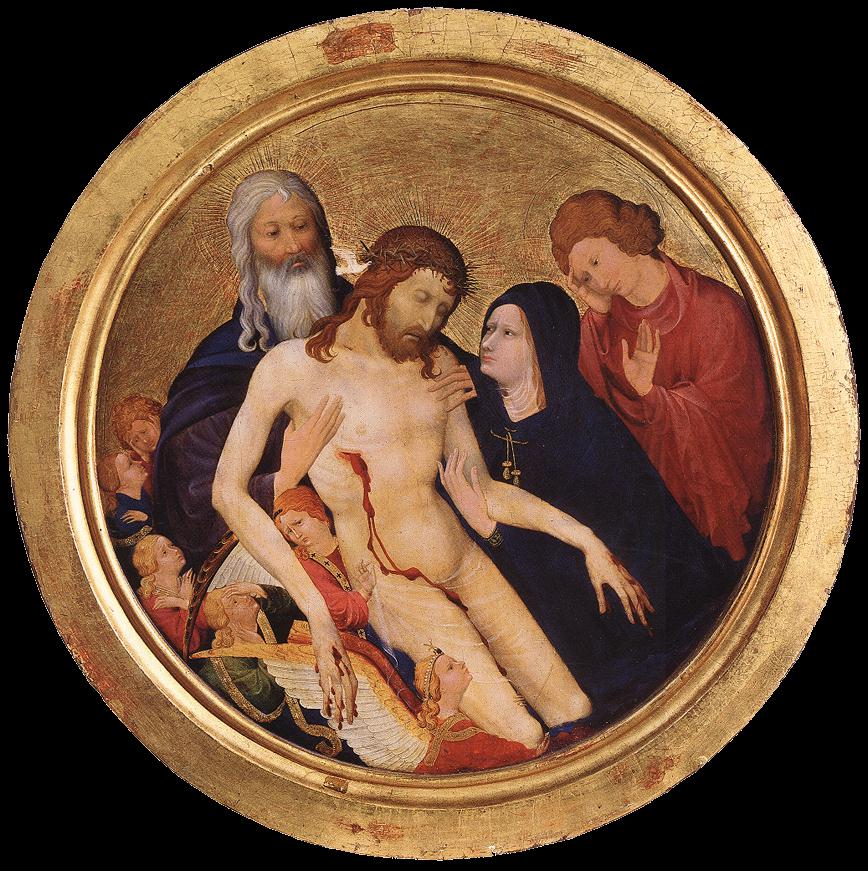
Large Round Pietà
- MEDIUM
- Wood, diameter 64 cm
- TYPE
- Religious
PALETTE
HOVER OR TAP A SWATCH FOR NAME, SHARE AND HEX. SAMPLED FROM THE IMAGE — INDICATIVE, NOT A PIGMENT ANALYSIS.
DEVELOPMENT BUILD — NOT FOR PUBLIC USE. CONTRIBUTE ON GITHUB.
CURRENT LOCATION · Musée du Louvre
03 — ARTWORK
PALETTE
HOVER OR TAP A SWATCH FOR NAME, SHARE AND HEX. SAMPLED FROM THE IMAGE — INDICATIVE, NOT A PIGMENT ANALYSIS.
COMMENTARY
UNDERLINED TERMS ARE DEFINED IN THE GLOSSARY.
Malouel was a Flemish artist who from 1397 was a court painter to Philip the Bold and John the Fearless, dukes of Burgundy. He was commissioned to paint 5 altarpieces for the Chartreuse of Champmol in 1398 and was one of the earliest panelTerm in painting for a support of wood, metal, or other rigid substance, as distinct from canvas. Until the adoption of canvas in the 15th century nearly all the movable paintings of Europe were executed on wood, and even up to the beginning of the 17th century it is probable that as much painting was done on the one support as on the other. Painters who worked on a small scale often used copper panels (Elsheimer is a leading example), and in the colonial art of South America copper and tin and even lead and zinc were used. On a larger scale, slate has occasionally been used as a support, notably by Rubens for his altarpiece for Sta Maria in Vallicella (the Chiesa Nuova) in Rome; the picture he originally painted was said to reflect the light unpleasantly and slate was used for the replacement to produce a more matt finish. For wood panels the Italian masters of the Renaissance preferred white poplar, while oak was the most common wood used in northern Europe. Many other types were used, however; analysis of the contents of art galleries has yielded a long list, including beech, cedar, chestnut, fir, larch, linden, mahogany, olive, and walnut. In the 20th century cedar, teak, and dark walnut are favourites, and modern painters have also used plywood, fibre-board, and other synthetic materials as supports. painters of North Europe.
This PietàA depiction of the Virgin Mary with the crucified body of Jesus across her lap. Developing in Germany in the 14th century, the Pietà became a familiar part of Renaissance religious imagery. One of the best-known examples is Michelangelo's "Pietà" (1497-1500) in St. Peter's, Rome. received its name due to the fact that the Louvre possesses a smaller Pietà of the same style.
Seated against a golden background God the Father supports the lifeless, bleeding body of the dead Christ in his arms. With yearning eyes the Virgin bids farewell to her Son, clasping his arm with both hands. Behind her the figure of St John the Evangelist in a red robe completes the composition, his fair head following the line of the circular frame. On the left of God the Father and the dead Christ small angels in blue and red robes express their sorrow. One of them embraces the knee of Christ, the other one holds the transparent white veil covering the lower part of his body. The pale and grey ivory of Christ's body is set off by the more vivid, richer colours of the other figures. The delicate interplay of the fingers and hands is particularly to be admired. The coat of arms of Burgundy appears on the reverse of the panel, and it can therefore be assumed that the picture was made for the court of Burgundy; perhaps for the Chartreuse de Champmol of Dijon.
The archive catalogues no further works by this artist.
TRY SAME COLLECTION →@online{wga-r28d582a73081e7,
author = {Krén, Emil and Marx, Daniel},
title = {Large Round Pietà by MALOUEL, Jean},
organization = {{Web Gallery of Art}},
date = {2026-09-14},
url = {https://beta.wga.hu/artists/malouel-jean-r8f13af782a9d23/large-round-piet-r28d582a73081e7},
urldate = {2026-09-14},
langid = {english}
}ACCESSED 2026-09-14. REPLACE THE AUTHOR FIELD WITH THE COMMENTARY AUTHOR WHERE ONE IS NAMED.


