03 — ARTWORK
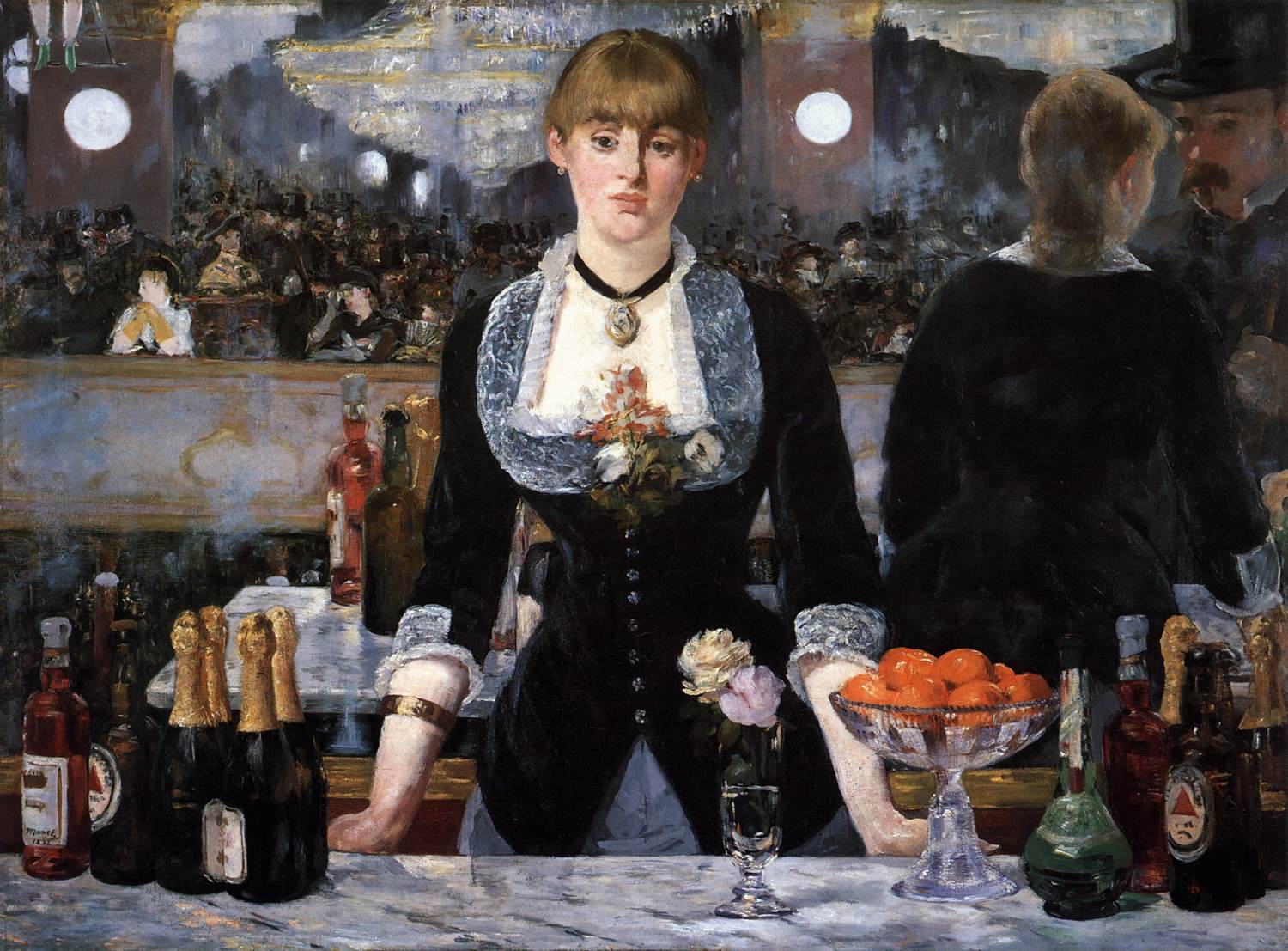
A Bar at the Folies-Bergère
- MEDIUM
- Oil on canvas, 96 x 130 cm
- TYPE
- Genre
PALETTE
HOVER OR TAP A SWATCH FOR NAME, SHARE AND HEX. SAMPLED FROM THE IMAGE — INDICATIVE, NOT A PIGMENT ANALYSIS.
DEVELOPMENT BUILD — NOT FOR PUBLIC USE. CONTRIBUTE ON GITHUB.
03 — ARTWORK
PALETTE
HOVER OR TAP A SWATCH FOR NAME, SHARE AND HEX. SAMPLED FROM THE IMAGE — INDICATIVE, NOT A PIGMENT ANALYSIS.
COMMENTARY
UNDERLINED TERMS ARE DEFINED IN THE GLOSSARY.
In the winter of 1881/82 Manet painted a picture that can stand as a summation of his art: A Bar at the Folies-Bergère. Now exempt (as an award winner) from the jury process, he exhibited it at the 1882 SalonIn the French language of the 18th and 19th centuries it designated an actual exhibition space, as well as the academic art exhibitions staged in the Salon d'Apollon of the Louvre since 1667. From 1737, the exhibitions took place biennially and, after the French Revolution, annually in the Salon Carré of the Louvre in Paris. Towards the end of the 19th century the official Salon jury was dissolved in order to make way for a committee of state-approved artists, i.e. former Salon members, who created the highly influential Société des Artistes Français.. Recent scholars have rightly been fascinated by the qualities of the painting and the intensity and diversity of Manet's renewed analysis of part of the society he lived in.
The colours are rather subdued (which may be intended to convey the smoky somnolence of the pleasure palace), but on the other hand Manet gives us first-rate proof of his still-life talent in the foreground. The hard, cold quality of the white light globes is perfectly caught, they are like buttons on the canvasA woven cloth used as a support for painting. The best-quality canvas is made of linen; other materials used are cotton, hemp, and jute. It is now so familiar a material that the word 'canvas' has become almost a synonym for an oil painting, but it was not until around 1500 that it began to rival the wooden panel (which was more expensive and took longer to prepare) as the standard support for movable paintings (the transition came later in Northern Europe than in Italy). Canvas is not suitable for painting on until it has been coated with a ground, which isolates the fabric from the paint; otherwise it will absorb too much paint, only very rough effects will be obtainable, and parts of the fabric may be rotted by the pigments. It must also be made taut on a stretcher or by some other means.. Manet's pastose brushwork creates a unified tapestryAs historical climatologists have not shown that Renaissance Italian winters and springs were warmer than they are now, it is puzzling that Italy did not fabricate tapestries to decorate and draught-proof the stony rooms of its palaces until 1545, when Cosimo I set up a manufactory in Florence. To hardiness or stinginess (tapestry was by far the most expensive form of wall decoration) we owe the existence of such secular frescoed decorative schemes as the labours of the months in the castle at Trent (c. 1407), the Arthurian scenes of Pisanello and the courtly ones of Mantegna in the Ducal Palace of Mantua, the delicious calendar fantasies of Cossa and others in the Palazzo Schifanoia in Ferrara - and, doubtless, many others that await liberation from whitewash or later panelling. These are all in situations where northern patrons would have used tapestries. These were imported, chiefly from Flanders, into Italy. The influence of their hunting and ceremonial scenes in particular registered on Italian 'gothic' painting or illumination and stained glass, and in literature. But the Italians did not make them. The most famous of all 'Italian' tapestries, those for the Sistine Chapel designed by Raphael, were made in Brussels from the full-scale coloured patterns, or cartoons, now in the Victoria and Albert Museum, London. Nor is it clear whether imported tapestries were used habitually or simply to add grandeur to special occasions. Even when Cosimo's manufactory was in being, and working from designs by court artists of the calibre of Bronzino, Salviati and Allori, his own headquarters, the Palace of the Signoria (now the Palazzo Vecchio), was being decorated with frescoes. The subject is underexplored. of colour correspondences and contrasts across the various spatial levels. Those levels themselves are intentionally confusing: most of what we see is a reflection in the bar mirror behind the woman. The laws of perspectiveThe method of representing three-dimensional objects on a flat surface. Perspective gives a picture a sense of depth. The most important form of perspective in the Renaissance was linear perspective (first formulated by the architect Brunelleschi in the early 15th century), in which the real or suggested lines of objects converge on a vanishing point on the horizon, often in the middle of the composition (centralized perspective). The first artist to make a systematic use of linear perspective was Masaccio, and its principles were set out by the architect Alberti in a book published in 1436. The use of linear perspective had a profound effect on the development of Western art and remained unchallenged until the 20th century. are broken in a fashion that was a radical departure at the time. The woman's back is reflected at an angle.
@online{wga-r8094e80ad1d9d5,
  author       = {Krén, Emil and Marx, Daniel},
  title        = {A Bar at the Folies-Bergère by MANET, Edouard},
  organization = {{Web Gallery of Art}},
  date         = {2026-09-09},
  url          = {https://beta.wga.hu/artists/manet-edouard-re54d09e075304b/a-bar-at-the-folies-bergre-r8094e80ad1d9d5},
  urldate      = {2026-09-09},
  langid       = {english}
}
ACCESSED 2026-09-09. REPLACE THE AUTHOR FIELD WITH THE COMMENTARY AUTHOR WHERE ONE IS NAMED.


