03 — ARTWORK
Palazzo Priuli Ruzzini: Façade
- MEDIUM
- Photo
- TYPE
- Other
PALETTE
HOVER OR TAP A SWATCH FOR NAME, SHARE AND HEX. SAMPLED FROM THE IMAGE — INDICATIVE, NOT A PIGMENT ANALYSIS.
DEVELOPMENT BUILD — NOT FOR PUBLIC USE. CONTRIBUTE ON GITHUB.
03 — ARTWORK
PALETTE
HOVER OR TAP A SWATCH FOR NAME, SHARE AND HEX. SAMPLED FROM THE IMAGE — INDICATIVE, NOT A PIGMENT ANALYSIS.
COMMENTARY
UNDERLINED TERMS ARE DEFINED IN THE GLOSSARY.
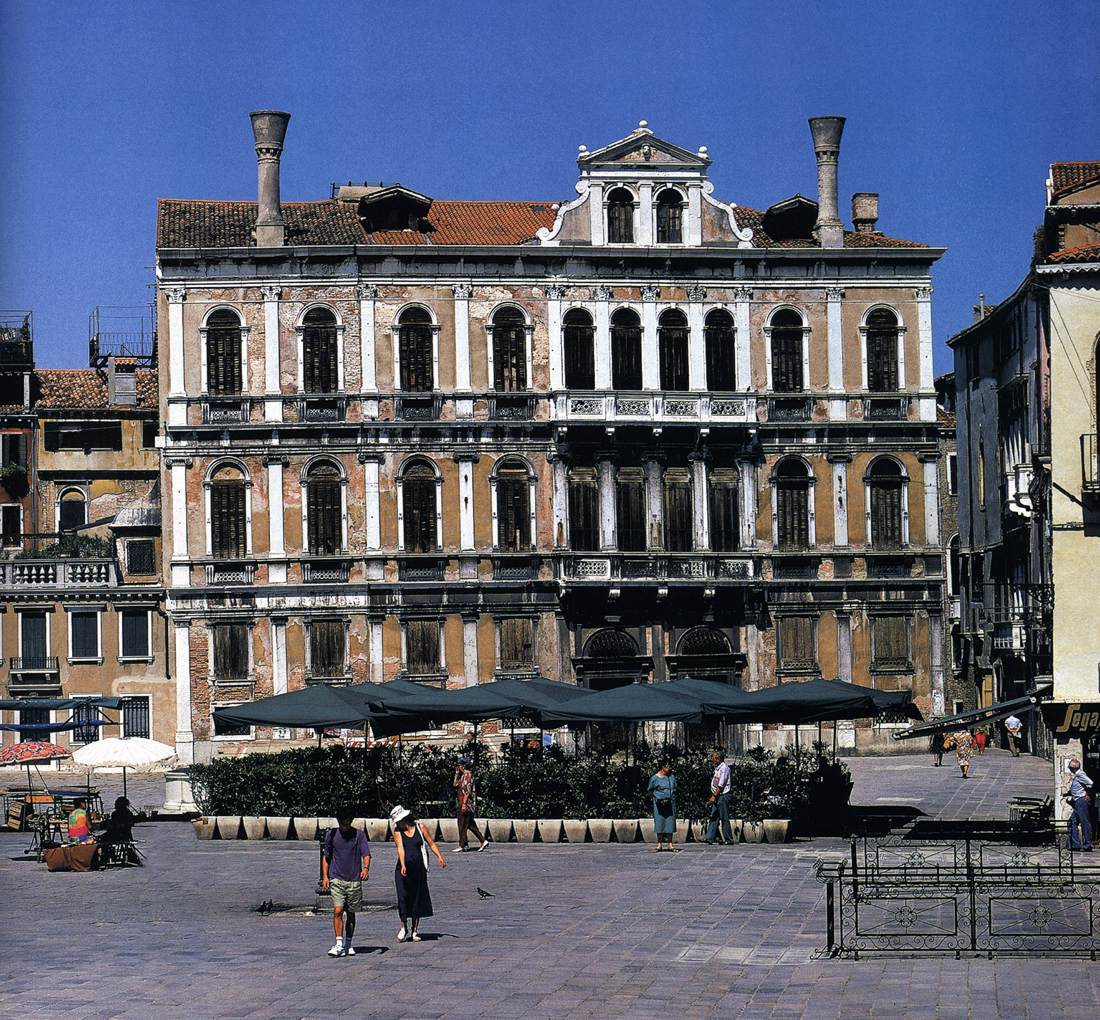
The construction of the present palace took place after a fire in 1586 which burned down some of the houses of the Ruzzini family. The palace overlooks Campo Santa Maria Formosa on one side, and Rio del Paradiso on the other, and still maintains a water entrance, which once was the main entry.
The façadethe front or principal face of a building, especially one elaborately constructed; a blind façade is a façade that is purely decorative and does not relate to the structure of the building. overlooking the campo preludes the BaroqueThe period in art history from about 1600 to about 1750. In this sense the term covers a wide range of styles and artists. In painting and sculpture there were three main forms of Baroque: (1) sumptuous display, a style associated with the Catholic Counter Reformation and the absolutist courts of Europe (Bernini, Rubens); (2) dramatic realism (Caravaggio); and (3) everyday realism, a development seen in particular in Holland (Rembrandt, Vermeer). In architecture, there was an emphasis on expressiveness and grandeur, achieved through scale, the dramatic use of light and shadow, and increasingly elaborate decoration. In a more limited sense the term Baroque often refers to the first of these categories. The development of the Baroque reflects the period's religious tensions (Catholic versus Protestant); a new and more expansive world view based on science and exploration; and the growth of absolutist monarchies. period. The architect paid more attention to the decorative details than to the structure. The short pilasters, the spare constructional elements, the attic window buttressed by scrolls demonstrate that Manopola studied the designs of Sebastiano Serlio (1475-c. 1554), the architect and theorist, whose highly influential "L'archittetura, " published posthumously in 1584, was one of the first architectural treatises in a modern language that was printed with illustrations in sixteenth-century Europe.
The façade facing onto the Paradiso canal is a typical example of a sixteenth-century façade.
The picture shows the façade of the palace, presently a luxury hotel, on the Campo Santa Maria Formosa.
@online{wga-rec29b827565174,
  author       = {Krén, Emil and Marx, Daniel},
  title        = {Palazzo Priuli Ruzzini: Façade by MANOPOLA, Bartolomeo},
  organization = {{Web Gallery of Art}},
  date         = {2026-09-09},
  url          = {https://beta.wga.hu/artists/manopola-bartolomeo-r170adae63c6341/palazzo-priuli-ruzzini-faade-rec29b827565174},
  urldate      = {2026-09-09},
  langid       = {english}
}
ACCESSED 2026-09-09. REPLACE THE AUTHOR FIELD WITH THE COMMENTARY AUTHOR WHERE ONE IS NAMED.
The archive catalogues no further works by this artist.
TRY SAME COLLECTION →