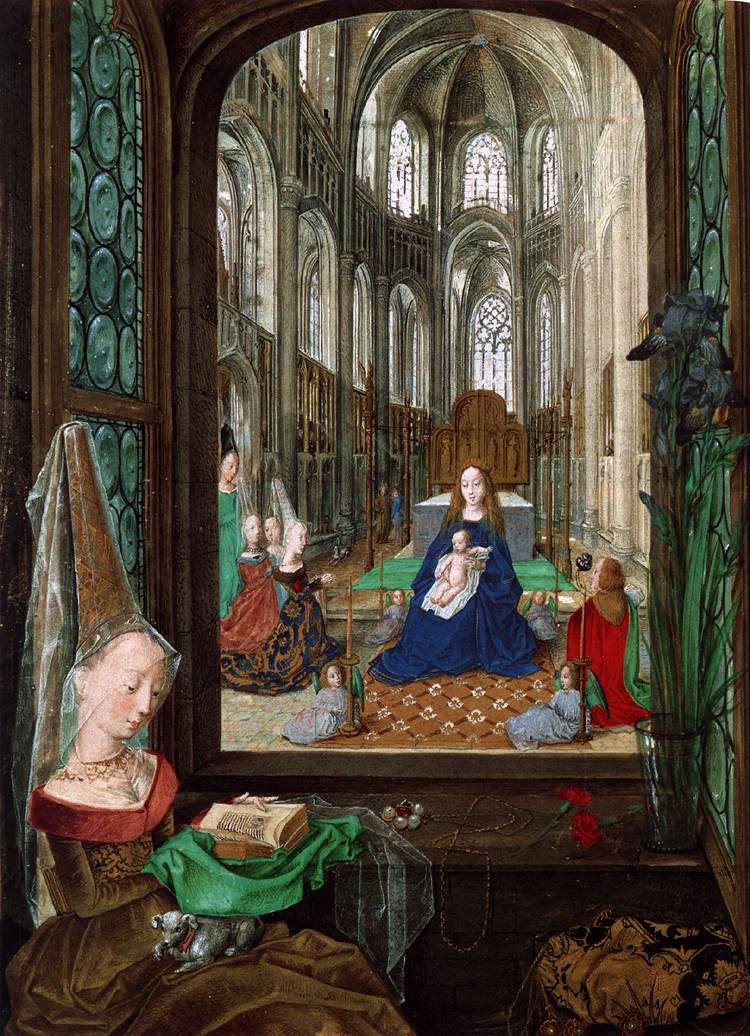
This manuscriptcollective term for books or other documents written by hand; in a specific sense, the hand-written medieval book, the Codex manuscriptus, often ornamented with decorative borders, illuminated initials and miniatures, and containing works of ancient philosophy or scholarly, ecclesiastical, and literary texts. Manuscripts were usually produced on commission. At first the scriptoria (writing rooms) of monasteries transcribed the contents of famous manuscripts and made copies. Monastic communities in the Netherlands and northern Germany began producing manuscripts around 1383/84. Flanders, Burgundy, and in particular Paris became major centres for the mass production of breviaries (prayer books) and Books of Hours. is a Book of HoursA prayer book used by laymen for private devotion, containing prayers or meditations appropriate to certain hours of the day, days of the week, months, or seasons. They became so popular in the 15th century that the Book of Hours outnumbers all other categories of illuminated manuscripts; from the late 15th century there were also printed versions illustrated by woodcuts. The most famous Book of Hours and one of the most beautiful of all illuminated manuscripts is the Très Riches Heures du duc de Berry (Musée Condé, Chantilly), illuminated by the Limburg Brothers for Jean de Berry. according to the use of Rome. It contains prayers and devotional texts for the private use and edification of the laity. It undoubtedly ranks among the most important works of art ever made in the late Middle Ages. It was originally designed for Charles the Bold, Duke of Burgundy, as a book of mourning, however, the copy in Vienna was conferred a totally different decorative character in 1477 when it was redesigned for Charles's daughter, Mary of Burgundy, on the occasion of her marriage to Maximilian of Austria.
Several illuminators worked on the 20 full-page and 16 small-format miniatures in the manuscript, among them the Master of Mary of Burgundy, Simon Marmion and Willem Vrelant.
The prayer book owes its fame mainly to the two so-called window miniatures. The first one on folio 14r depicts an elegant lady, perhaps representing Mary of Burgundy or her stepmother, Margaret of York, seated at a windowsill and reading a prayer book. On the ledge she has deposited her jewellery and two red carnations. A shimmering glass vase with blue iris flowers completes this still-life. The bull's eye panes of the window are open in order to direct the viewer's eye to the choirthe part of a church interior, usually raised and set apart from the rest of the church, reserved for the clergy to pray together, or for choral singing. Since Carolingian times, "choir" has been the word for the part of the central nave of the church extending over the crossing (the place where nave and transept intersect), and including the apse (a niche in the wall, roofed with a half dome) that often stands at the end of this area. of a GothicGothic, which may well have originated with Alberti as a derogatory term and which certainly corresponds to Vasari's 'maniera tedesca' ('German style'), is properly the descriptive term for an artistic style which achieved its first full flowering in the Ile de France and the surrounding areas in the period between c. 1200 and c. 1270, and which then spread throughout northern Europe. It is characterized by the hitherto unprecedented integration of the arts of sculpture, painting, stained glass and architecture which is epitomized in the great cathedrals of Chartres, Amiens, and Reims or in the Sainte Chapelle in Paris. In all the arts the predominantly planar forms of the Romanesque are replaced by an emphasis on line. There is a transcendental quality, whether in the soaring forms of the pointed arches or in the new stress on the humanity of Christ, which similarly distinguishes it from the preceding Romanesque style. In thinking of Nicola (d. c. 1284) or Giovanni Pisano (d. after 1314) there is same danger of forgetting what had happened in French sculpture half a century or more earlier, and likewise it is hard to remember that the spectacular achievements of early Renaissance art are a singularly localized eddy in the continuing stream of late gothic European art. By northern European standards few Italian works of art can be called gothic without qualification, and the story of 13th and 14th century Italian architecture is as much one of resistance to the new style as of its reception, whether directly from France or through German or central European intermediaries. In sculpture and in painting, the Italian reluctance to distort the human figure, conditioned by a never wholly submerged awareness of the omnipresent antique heritage, gives a special quality to the work of even those artists such as Giovanni Pisano or Simone Martini who most closely approached a pure gothic style. Nevertheless, the vitalizing role of Northern gothic art throughout the early Renaissance and the period leading up to it should never be underestimated. The artistic, like the cultural and commercial, interaction was continuous and much of the Italian achievement is incomprehensible if seen in isolation. It is not merely at the level of direct exchanges between one artist and another, or the influence of one building; painting, manuscript or piece of sculpture upon another, that the effects are to be felt. The streaming quality of line which is so characteristic of Brunelleschi's early Renaissance architecture surely reflects a sensitivity to the gothic contribution which is entirely independent of, and lies much deeper than, the superficial particularities of form. The counterflow of influence and inspiration from South to North must likewise not be underrated. In particular, the contribution of Italian painters from Duccio and Simone Martini onwards is central to the evolution of the so-called International Gothic style developing in Burgundy, Bohemia and north Italy in the late 14th and early 15th centuries. cathedralThe principal church of a province or diocese, where the throne of the bishop is placed. For reasons lost to time and tradition, a cathedral always faces west - toward the setting sun. The altar is placed at the east end. The main body, or nave, of the cathedral is usually divided into one main and two side aisles. These lead up to the north and south transepts, or arms of the cross, the shape in which a cathedral is usually formed. where the Virgin and Child are enthroned.