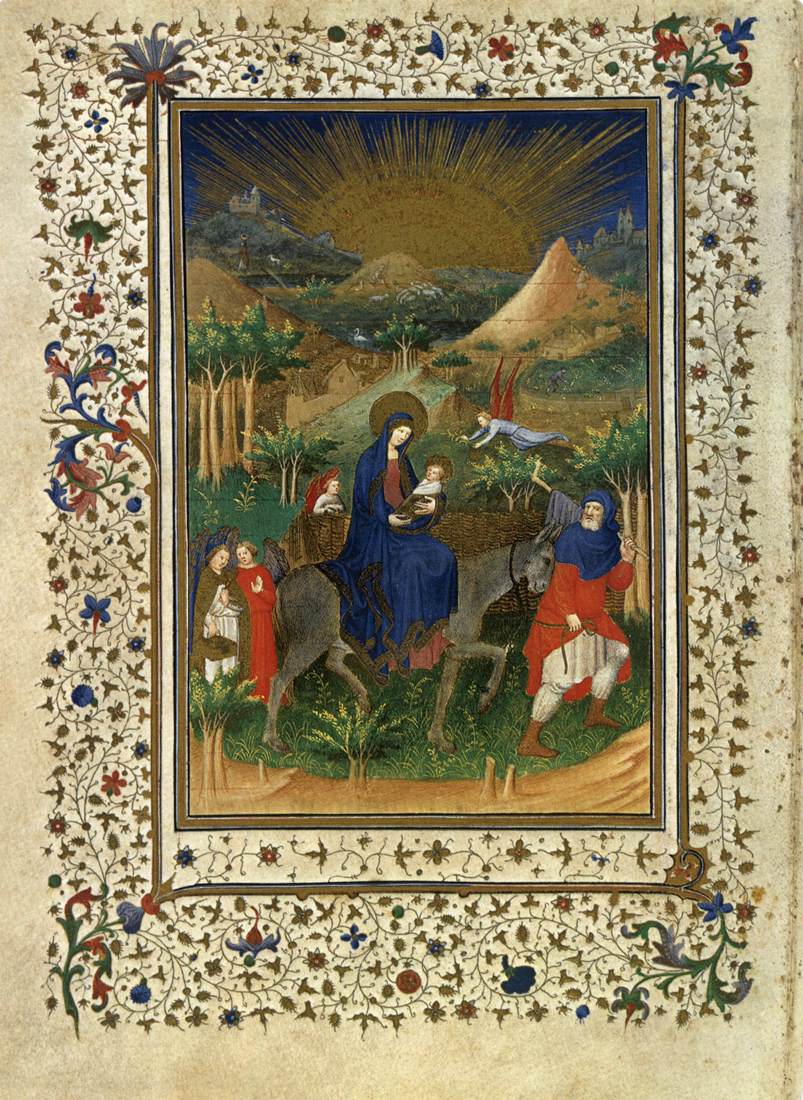
Book of HoursA prayer book used by laymen for private devotion, containing prayers or meditations appropriate to certain hours of the day, days of the week, months, or seasons. They became so popular in the 15th century that the Book of Hours outnumbers all other categories of illuminated manuscripts; from the late 15th century there were also printed versions illustrated by woodcuts. The most famous Book of Hours and one of the most beautiful of all illuminated manuscripts is the Très Riches Heures du duc de Berry (Musée Condé, Chantilly), illuminated by the Limburg Brothers for Jean de Berry. of Maréchal de Boucicaut 1405-08 Manuscriptcollective term for books or other documents written by hand; in a specific sense, the hand-written medieval book, the Codex manuscriptus, often ornamented with decorative borders, illuminated initials and miniatures, and containing works of ancient philosophy or scholarly, ecclesiastical, and literary texts. Manuscripts were usually produced on commission. At first the scriptoria (writing rooms) of monasteries transcribed the contents of famous manuscripts and made copies. Monastic communities in the Netherlands and northern Germany began producing manuscripts around 1383/84. Flanders, Burgundy, and in particular Paris became major centres for the mass production of breviaries (prayer books) and Books of Hours. (Ms. 2), 275 x 190 mm Musée Jacquemart-André, Paris
This manuscript was commissioned by Jean II La Meingre, Marshal Boucicaut (died 1421) and his wife Antoinette de Turenne. His biographers describe the marshal as a man of almost superhuman piety. This description fits in with his magnificent book of hours, which begins with 27 large miniatures of saints, who all have clear links with Boucicaut's life. The 46 miniatures in the manuscript show characteristics of the style of the Bedford Master who often worked with the artist responsible for the Boucicaut Hours. The wide borders around each miniatureTerm originally applied to the art of manuscript illumination but later used of paintings, usually portraits, executed on a very small scale. The earliest miniaturists (16th century) continued to use the materials of the illuminators, painting in gouache on vellum or card., with their delicate and elegant vegetal decoration, are also found in a Parisian missal manuscript dated 1412, suggesting a slightly later date of 1410-12 for the manuscript.
The miniature on folio 90v depicts the Flight into Egypt for the office of Our Lady. It provides a characteristic example of the outstanding artistry of the Boucicaut Master. The mountainous landscape and the luminosity of the colours, culminating in the brilliant sun on a background of deepest blue, are particularly fascinating.