03 — ARTWORK
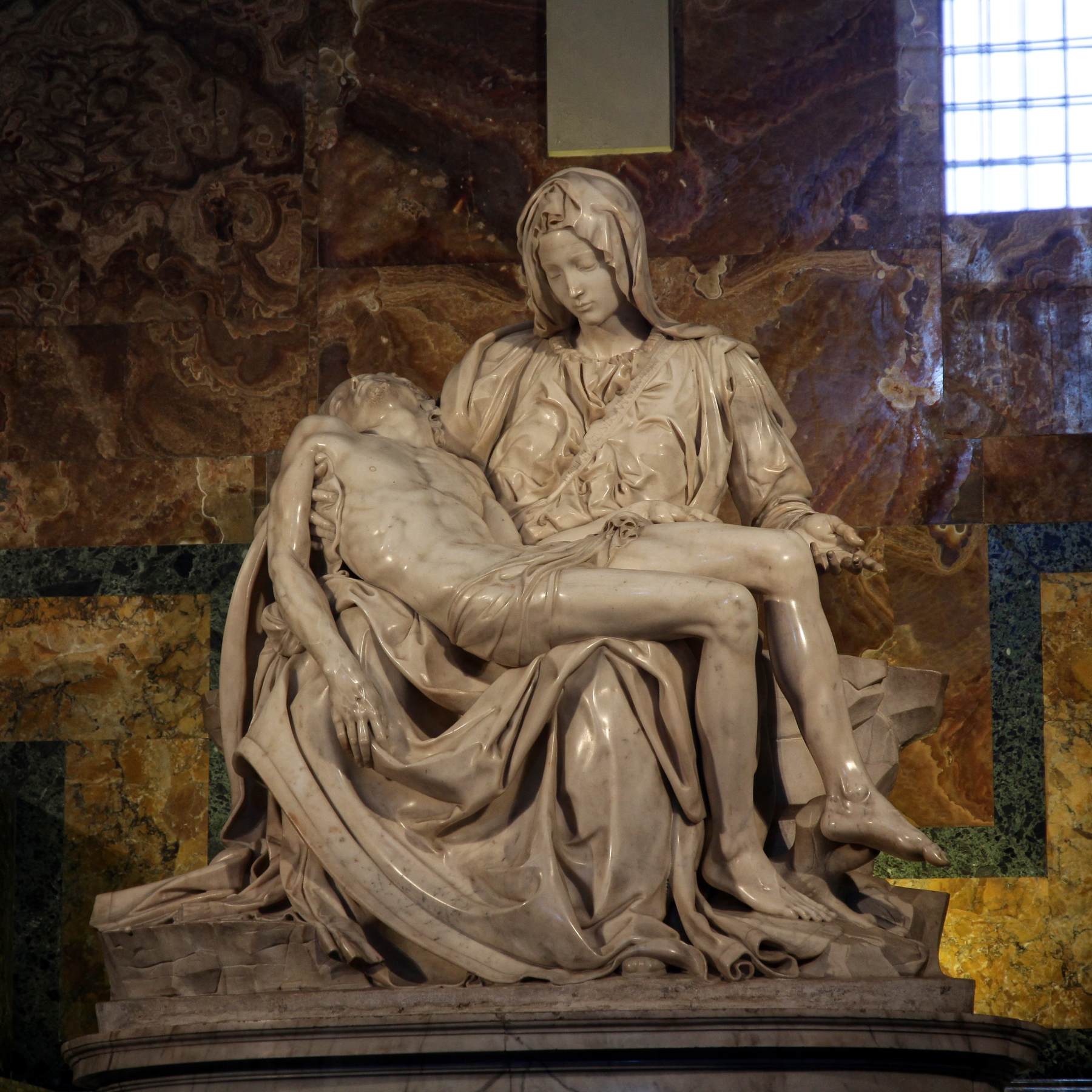
Pietà
MICHELANGELO Buonarroti · 1499 →
- MEDIUM
- Marble, height 174 cm, width at the base 195 cm
- TYPE
- Mythological
PALETTE
HOVER OR TAP A SWATCH FOR NAME, SHARE AND HEX. SAMPLED FROM THE IMAGE — INDICATIVE, NOT A PIGMENT ANALYSIS.
DEVELOPMENT BUILD — NOT FOR PUBLIC USE. CONTRIBUTE ON GITHUB.
03 — ARTWORK
MICHELANGELO Buonarroti · 1499 →
PALETTE
HOVER OR TAP A SWATCH FOR NAME, SHARE AND HEX. SAMPLED FROM THE IMAGE — INDICATIVE, NOT A PIGMENT ANALYSIS.
COMMENTARY
UNDERLINED TERMS ARE DEFINED IN THE GLOSSARY.
The PietàA depiction of the Virgin Mary with the crucified body of Jesus across her lap. Developing in Germany in the 14th century, the Pietà became a familiar part of Renaissance religious imagery. One of the best-known examples is Michelangelo's "Pietà" (1497-1500) in St. Peter's, Rome. in Rome marked the turning-point in Michelangelo's fortunes. Commissioned in 1497 by the French Cardinal Jean Villiers de La Grolais (c. 1430–1499) for his own tomb, it was begun the following year and was finished by 1500. It signals the beginning of Michelangelo's maturity as a sculptor. The style of the group does not differ radically from the practice represented by the BacchusIn Greek and Roman mythology, the god of wine and fertility. Bacchic rites were often orgiastic., however. Rather it shows even greater textural richness, a characteristic noted by Vasari in his description of the inert body of Christ. This sensitively carved surface is strongly contrasted with the unpolished textures of rock and tree stump.
Although the dazzling virtuosity of the carving is less appreciated now than it was in the 16th century, there is general agreement that the Pietà is a work of unprecedented elegance. Its grace of contoura line around a shape in a work of art, its nature depending on the artist's concept and intention. In medieval painting, contours were initially regular, flat outlines; in the course of the 14th century they acquired more sense of spatial effect, and appear to be alternately more and less emphatic. Later, the effect of contour in painting and graphic art became particularly important to artistic movements in which line and draughtsmanship was a prominent factor. is most apparent in the drapery: the tight, dampfold loincloth of Christ, the ruches and complex crinkles of Mary's robes and the controlled but generous sweep of the shroud, which both cradles and displays Christ's corpse. Much of the pathos of the group derives from this drapery. The Virgin shows no grief; her features are composed and the gesture of her left hand is designed to draw attention to her dead son.
The sculpture is signed on the ribbon across the breast: MICHAELAGELVS.BONAROTVS.FLORENTIN.FACIEBAT.
@online{wga-rc849e5f1fa7548,
  author       = {Krén, Emil and Marx, Daniel},
  title        = {Pietà by MICHELANGELO Buonarroti},
  organization = {{Web Gallery of Art}},
  date         = {2026-09-09},
  url          = {https://beta.wga.hu/artists/michelangelo-buonarroti-r3de9890382970b/piet-rc849e5f1fa7548},
  urldate      = {2026-09-09},
  langid       = {english}
}
ACCESSED 2026-09-09. REPLACE THE AUTHOR FIELD WITH THE COMMENTARY AUTHOR WHERE ONE IS NAMED.


