03 — ARTWORK
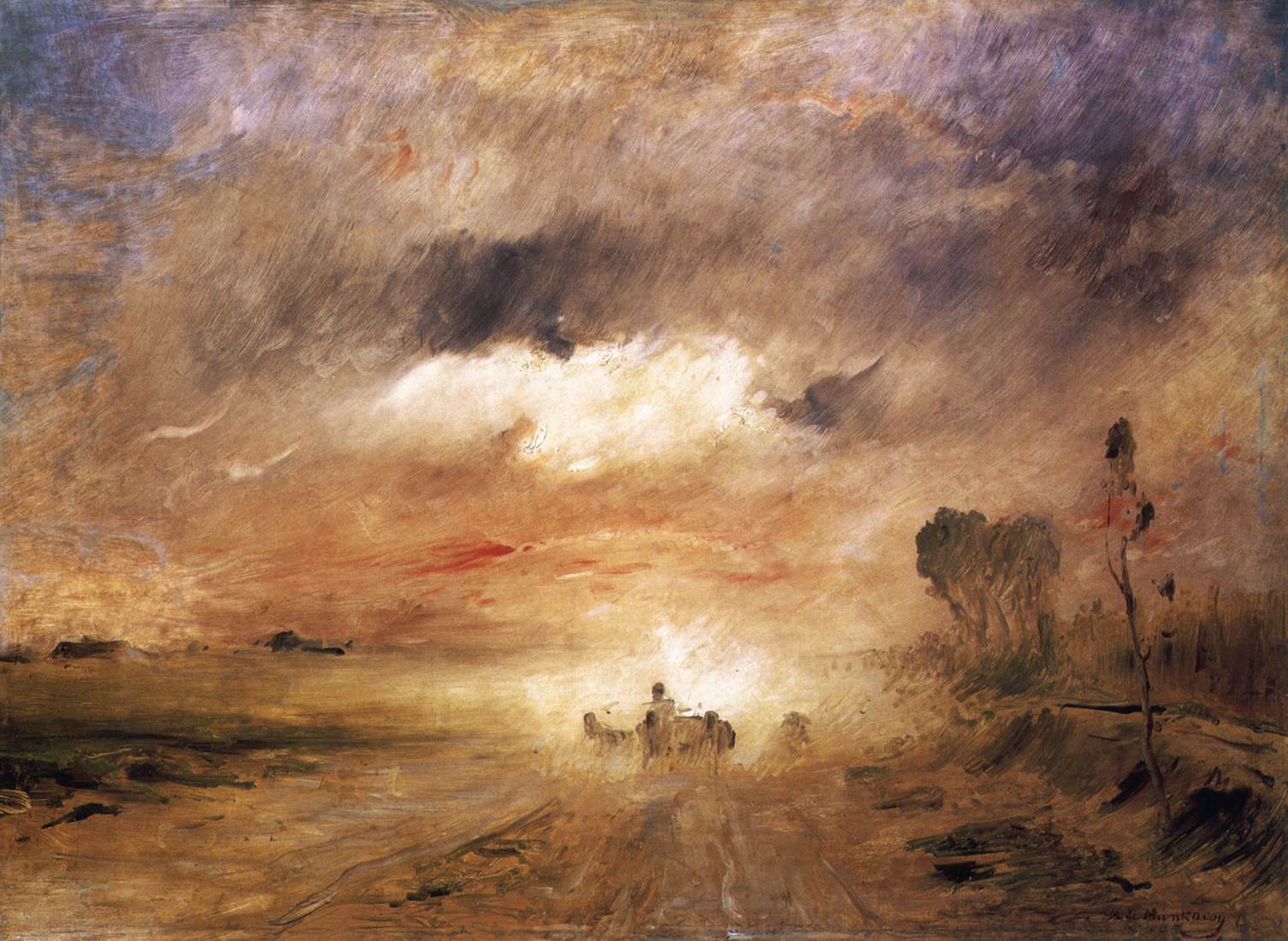
Dusty Country Road II
- MEDIUM
- Oil on wood, 96 x 130 cm
- TYPE
- Landscape
PALETTE
HOVER OR TAP A SWATCH FOR NAME, SHARE AND HEX. SAMPLED FROM THE IMAGE — INDICATIVE, NOT A PIGMENT ANALYSIS.
DEVELOPMENT BUILD — NOT FOR PUBLIC USE. CONTRIBUTE ON GITHUB.
03 — ARTWORK
PALETTE
HOVER OR TAP A SWATCH FOR NAME, SHARE AND HEX. SAMPLED FROM THE IMAGE — INDICATIVE, NOT A PIGMENT ANALYSIS.
COMMENTARY
UNDERLINED TERMS ARE DEFINED IN THE GLOSSARY.
In 1874 Munkácsy visited the town of his childhood in Hungary, Békéscsaba. The two versions (executed in 1874 and 1883) of the painting Dusty Country Road commemorate the painter's visit to his homeland.
A cart is moving on the road slowly, stirring up the dust painted pink by the beams of the sun. This canvasA woven cloth used as a support for painting. The best-quality canvas is made of linen; other materials used are cotton, hemp, and jute. It is now so familiar a material that the word 'canvas' has become almost a synonym for an oil painting, but it was not until around 1500 that it began to rival the wooden panel (which was more expensive and took longer to prepare) as the standard support for movable paintings (the transition came later in Northern Europe than in Italy). Canvas is not suitable for painting on until it has been coated with a ground, which isolates the fabric from the paint; otherwise it will absorb too much paint, only very rough effects will be obtainable, and parts of the fabric may be rotted by the pigments. It must also be made taut on a stretcher or by some other means. is a pink vision flooded with light, a snapshot almost approaching plein-air paintingIn contrast to painting in an atelier, this painting is done outdoors, under the sky, with the intention of realistically reproducing the natural features of a landscape, its atmosphere, and changes in light. Following the example set by English landscape painters such as Constable and Bonington, French painters, including members of the Barbizon School, began painting their pictures outdoors in the mid-19th century. The Impressionists made plein-air painting a fundamental principle of their painting.. It sheds light on Munkácsy's new approach to Nature, and it also reveals a potential path, which the painter, unfortunately, never pursued. Contemporary critiques often called this small masterpieceA term now loosely applied to the finest work by a particular artist or to any work of art of acknowledged greatness or of preeminence in its field. Originally it meant the piece of work by which a craftsman, having finished his training, gained the rank of'master' in his guild. impressionist: he himself, however, refused to have anything to do with this style. The only other painting in which such a painterly approach is evident is "Dusty Road I": in the paintings to come he returned to the style of realismRealism (with an upper case "R"), also known as the Realist school, denotes a mid-nineteenth century art movement and style in which artists discarded the formulas of Neoclassicism and the theatrical drama of Romanticism to paint familiar scenes and events as they actually looked. Typically it involved some sort of sociopolitical or moral message, in the depiction of ugly or commonplace subjects. One of the main representatives and spokesmen was the painter Gustave Courbet. In the dispute about ways to represent reality, Realism rebelled against the idealistic and classicist tendencies in painting..
@online{wga-rc89573414ec00b,
  author       = {Krén, Emil and Marx, Daniel},
  title        = {Dusty Country Road II by MUNKÁCSY, Mihály},
  organization = {{Web Gallery of Art}},
  date         = {2026-09-09},
  url          = {https://beta.wga.hu/artists/munkcsy-mihly-r9a9ad7461a6c03/dusty-country-road-ii-rc89573414ec00b},
  urldate      = {2026-09-09},
  langid       = {english}
}
ACCESSED 2026-09-09. REPLACE THE AUTHOR FIELD WITH THE COMMENTARY AUTHOR WHERE ONE IS NAMED.


