03 — ARTWORK
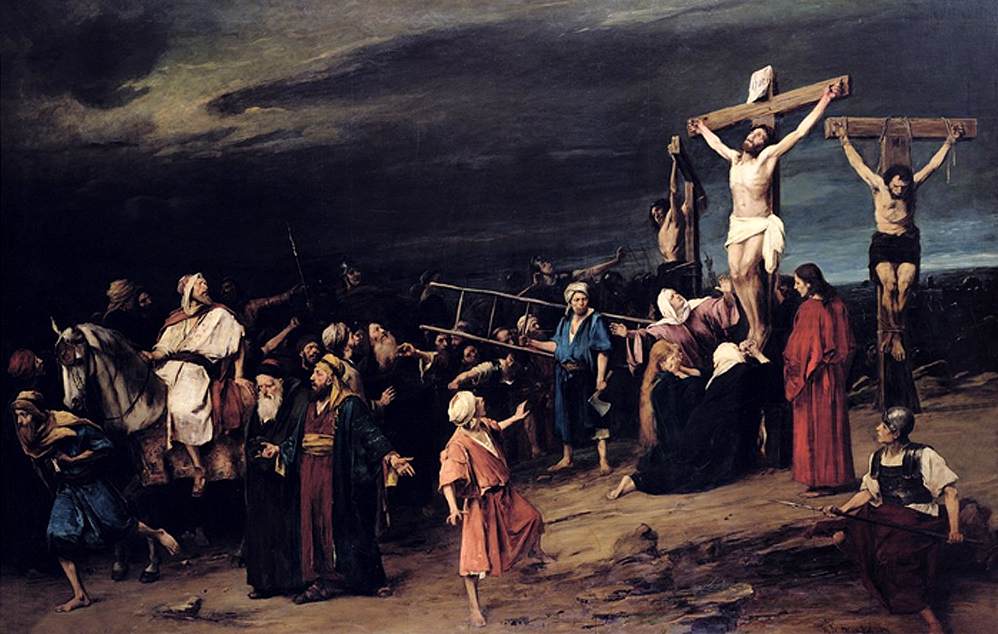
Golgotha
- MEDIUM
- Oil on canvas, 460 x 712 cm
- TYPE
- Religious
PALETTE
HOVER OR TAP A SWATCH FOR NAME, SHARE AND HEX. SAMPLED FROM THE IMAGE — INDICATIVE, NOT A PIGMENT ANALYSIS.
DEVELOPMENT BUILD — NOT FOR PUBLIC USE. CONTRIBUTE ON GITHUB.
03 — ARTWORK
PALETTE
HOVER OR TAP A SWATCH FOR NAME, SHARE AND HEX. SAMPLED FROM THE IMAGE — INDICATIVE, NOT A PIGMENT ANALYSIS.
COMMENTARY
UNDERLINED TERMS ARE DEFINED IN THE GLOSSARY.
Munkácsy had been working on the second picture of the trilogy for some time when he had himself put on the cross to feel the pain Christ must have felt. After 15 sketches and studies, the picture was ready by the Easter of 1884. Sedelmeyer had the picture "Christ before Pilate" brought back from Scotland and he showed both canvasses in the garden of his palace in Paris. The success was so frenetic that even Maupassant mentioned them in his novel "Bel Ami". The picture was first exhibited in the former Art Galleryan upper story, similar to a tribune, running along the side of a building and open on one side to the interior; in a church (basilica) above the side aisles, over the ambulatory (central-plan building) and also over the west end. The gallery was used to keep certain groups of worshippers apart (women, noblemen). (now Art School) in Budapest in September 1884. Munkácsy said that he had been thinking of painting a new picture on resurrection to make the trilogy complete. This plan could not be carried out because church leaders failed to raise enough money to keeptall, strong tower in medieval castles, used as an observation post and last refuge for those living in the castle, an, unlike the donjon, not designed for permanent habitation. both pictures in Hungary: Sedelmeyer required too high a sum for "Golgotha" so it was exhibited in Europe, then in New York, and then it was finally bought by John Wanamaker. Thus, it shared the fate of "Christ before Pilate" until 1988 when it was bought by Csaba Gyula Bereczki, a gallery owner of Hungarian origin. The picture is now exhibited with his permission. "Golgotha" was a much more difficult task for Munkácsy than the first or third picture of the trilogy. The latter ones showed scenes indoors, while that of "Golgota" in open air on the Hill of the Skulls. Limited space was amjor factor in composing both pictures, whereas the huge space of the landscape almost swallows both groups of people: in the one group, Christ and the mourners are portrayed, and in the other a group on-lookers and passers-by can be seen. The most interesting figures are portrayed in this delicately depicted group: an uninterested Jewish joiner, a Jew who is running away and beating his breast, and an Arab rider, a myterious, yet symbolic figure. The merits of the picture lie in expressive colours and the portrayal of landscape. The sky reflects the drama in a threatening way which cannot be helped and of which all evangelists reported briefly.
After 107 years, "Golgotha" arrived to Budapest in the autumn of 1991. After restoration by Miklós Szentkirályi, István Lente and Péter Menráth in 1992-93, it was exhibited in the Magyar Nemzeti Múzeum, Budapest at Easter 1993 and it has been on show in the Munkácsy Hall, Déri Museum, Debrecen, since 1993.
@online{wga-r93ab280ae2b2f5,
  author       = {Krén, Emil and Marx, Daniel},
  title        = {Golgotha by MUNKÁCSY, Mihály},
  organization = {{Web Gallery of Art}},
  date         = {2026-09-13},
  url          = {https://beta.wga.hu/artists/munkcsy-mihly-r9a9ad7461a6c03/golgotha-r93ab280ae2b2f5},
  urldate      = {2026-09-13},
  langid       = {english}
}
ACCESSED 2026-09-13. REPLACE THE AUTHOR FIELD WITH THE COMMENTARY AUTHOR WHERE ONE IS NAMED.


