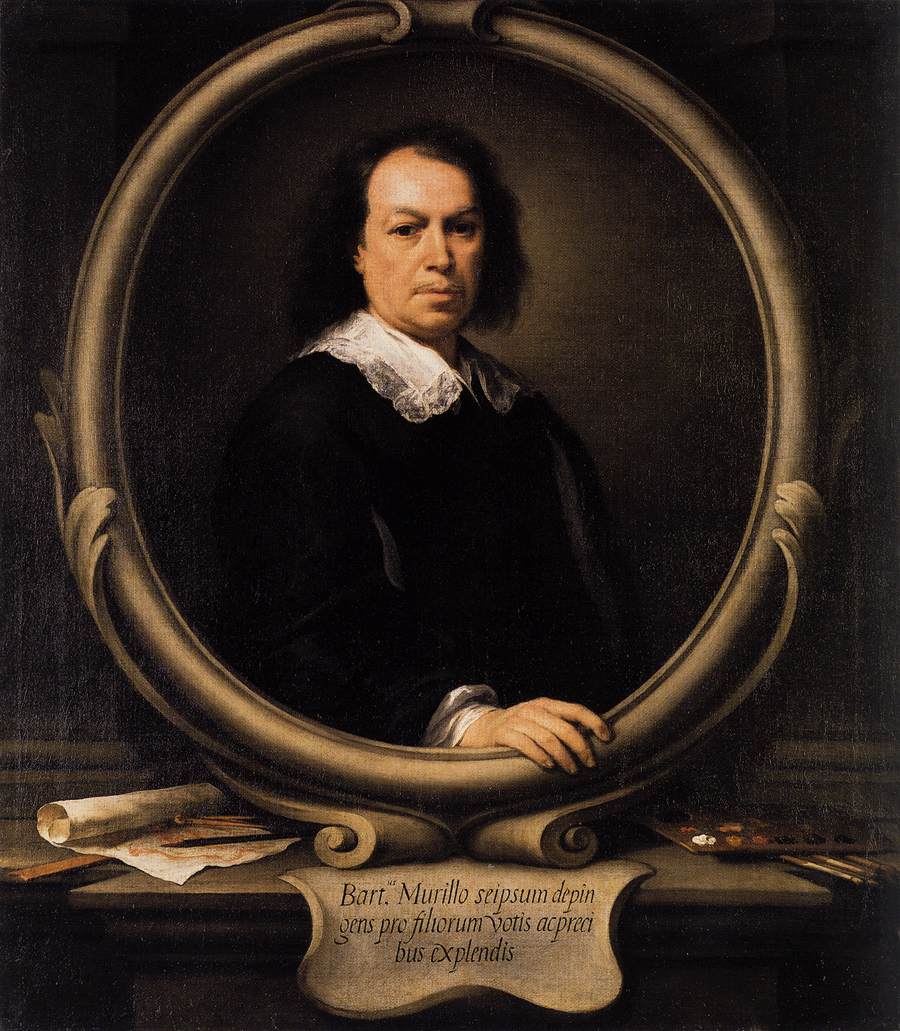
03 — ARTWORK
Self-Portrait
MURILLO, Bartolomé Esteban · 1672 →
- MEDIUM
- Oil on canvas, 122 x 127 cm
- TYPE
- Portrait
PALETTE
HOVER OR TAP A SWATCH FOR NAME, SHARE AND HEX. SAMPLED FROM THE IMAGE — INDICATIVE, NOT A PIGMENT ANALYSIS.
DEVELOPMENT BUILD — NOT FOR PUBLIC USE. CONTRIBUTE ON GITHUB.
03 — ARTWORK
MURILLO, Bartolomé Esteban · 1672 →
PALETTE
HOVER OR TAP A SWATCH FOR NAME, SHARE AND HEX. SAMPLED FROM THE IMAGE — INDICATIVE, NOT A PIGMENT ANALYSIS.
COMMENTARY
UNDERLINED TERMS ARE DEFINED IN THE GLOSSARY.
The tablet beneath the fictive frame of this self portraitThe Roman portrait bust survived in the form of life-sized reliquaries of saints, but it was in 15th century Florence that the individual features and character of a contemporary sitter were accurately recorded by sculptors such as Donatello, Desiderio da Settignano, Mino da Fiesole and the Rossellino. A similar degree of realism occurs in 15th century tomb sculpture. The equestrian portrait, based on antique statues such as the Marcus Aurelius monument (Rome, Campidoglio), was revived in the 14th century. Two examples in fresco are Simone Martini's Guidoriccio (c. 1328; Siena, Palazzo Pubblico) and the posthumous portrait of Sir John Hawkwood (1436; Florence, Cathedral) by Uccello, which gives the illusion of a 3-dimensional statue seen from below. The Venetian Republic ordered imposing monuments from Donatello (1447; Gattarnelata, Padua) and Verrocchio (14799; Colleoni, Venice), whilst other statesmen ordered their own images to be erected in public places, directly relating themselves to the military heroes of ancient Rome. Another form of political portraiture derived from antiquity was the commemorative portrait medal designed by artists such as Pisanello. The carved or painted profile portrait became popular in the 1450s. The realism of the clear, flattened image, painted under the influence of Flemish examples by the Pollaiuolo brothers, Piero della Francesca and Botticelli, was superseded by the three-quarter and frontal portrait, psychologically more complex, such as Leonardo's enigmatic Mona Lisa (Paris, Louvre) with her momentary smile or Andrea del Sarto's arresting Portrait of a Man (London, National Gallery). The 16th century portrait became generalized, Lotto's Andrea Odoni (1527; Royal Collection) being an idealized concept of a collector rather than an individual. Group portraits, decorating whole rooms, include the narrative scenes of the Gonzaga court painted by Mantegna (completed 1474; Mantua, Palazzo Ducale) and the elaborate schemes commissioned by the Farnese family in Rome from Vasari (1546; Palazzo della Cancelleria) and Salviati (after 1553; Palazzo Farnese). Portraits were also incorporated into religious narratives, as in Ghirlandaio's fresco cycle painted for Giovanni Tornabuoni in S. Maria Novella, Florence (1486-90). is inscribed in Latin: 'Bart [olo] mé Murillo portraying himself to fulfil the wishes and prayers of his children.' By 1670, when this portrait was probably painted, only four of Murillo's nine children were still living. His only daughter had entered a Dominican convent, and his youngest son was deciding on a career in the church; he was later to become a canon of Seville CathedralThe principal church of a province or diocese, where the throne of the bishop is placed. For reasons lost to time and tradition, a cathedral always faces west - toward the setting sun. The altar is placed at the east end. The main body, or nave, of the cathedral is usually divided into one main and two side aisles. These lead up to the north and south transepts, or arms of the cross, the shape in which a cathedral is usually formed..
After the artist's death, the painting was engraved in Antwerp at the request of Murillo's friend Nicolas de Omazur, a Flemish poet and silk merchant established in Seville. The portrait itself borrows a device from Netherlandish engravings, much used in the frontispiece of books. A gilded oval frame, set against a wall on a shelf or console table, encloses Murillo's half-length likeness. But in a feat of legerdemain only possible in art, it is the painter himself, not his image, who paradoxically extends his hand beyond the frame. Dressed in sober black, with a soft lace collar at his throat, he looks at the viewer with a dignified and slightly melancholy air. Nothing within this portrait betrays that he is anything other than a gentleman. Around the frame, however, are disposed the tools of his profession: a palette laid out with paint, brushes, a drawing in red chalk, the chalk itself, a pair of dividers and a ruler. The white on the palette is a real, three-dimensional swirl of white lead paint, not the image of one. The dividers and ruler tell us that he is a learned artist, creating pictures according to the rules and proportions of mathematical laws and not merely imitating appearances. A drawing - the academic basis of all the visual arts - recalls that in 1660 Murillo co-founded the Academy of Seville of which he was the first president.
As in all his portraits, in contrast to his other pictures, Murillo emphasises truthfulness above charm. Strong light, casting dark shadows, is used to model the forms, and his famous 'soft' brushwork is apparent only in the hair and lace. The sombre colour scheme of black, white and ochre is relieved only by red - as indicated on the palette, where its undiluted presence helps to clarify the spatial construction of the painting and enlivens its solemn play on the art of reality and the reality of art.
@online{wga-r45367d17466ea9,
  author       = {Krén, Emil and Marx, Daniel},
  title        = {Self-Portrait by MURILLO, Bartolomé Esteban},
  organization = {{Web Gallery of Art}},
  date         = {2026-09-13},
  url          = {https://beta.wga.hu/artists/murillo-bartolom-esteban-r2090ffefe35947/self-portrait-r45367d17466ea9},
  urldate      = {2026-09-13},
  langid       = {english}
}
ACCESSED 2026-09-13. REPLACE THE AUTHOR FIELD WITH THE COMMENTARY AUTHOR WHERE ONE IS NAMED.


