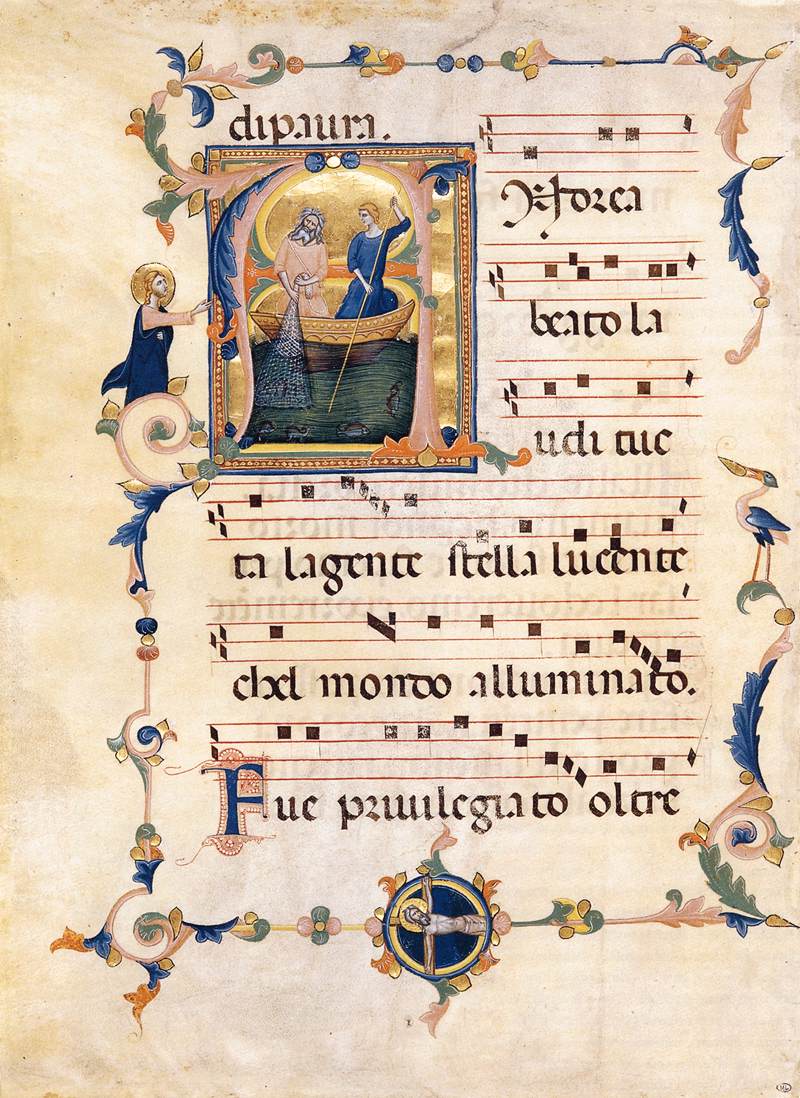
03 — ARTWORK
Laudario of the Compagnia di Sant'Agnese
- MEDIUM
- Tempera and gold on parchment, 466 x 339 mm
- TYPE
- Religious
PALETTE
HOVER OR TAP A SWATCH FOR NAME, SHARE AND HEX. SAMPLED FROM THE IMAGE — INDICATIVE, NOT A PIGMENT ANALYSIS.
DEVELOPMENT BUILD — NOT FOR PUBLIC USE. CONTRIBUTE ON GITHUB.
03 — ARTWORK
PALETTE
HOVER OR TAP A SWATCH FOR NAME, SHARE AND HEX. SAMPLED FROM THE IMAGE — INDICATIVE, NOT A PIGMENT ANALYSIS.
COMMENTARY
UNDERLINED TERMS ARE DEFINED IN THE GLOSSARY.
Dispersed today among a number of collections are nearly two dozen leaves and cuttings from a single laudario, or book of hymns to be sung in Italian by the members of a lay confraternity. This illustrated hymnal was one of the most ambitious and lavish manuscripts created in Florence in the first half of the fourteenth century. All but five of the surviving illuminations from the laudario were painted by Pacino di Bonaguida, the most prolific manuscriptcollective term for books or other documents written by hand; in a specific sense, the hand-written medieval book, the Codex manuscriptus, often ornamented with decorative borders, illuminated initials and miniatures, and containing works of ancient philosophy or scholarly, ecclesiastical, and literary texts. Manuscripts were usually produced on commission. At first the scriptoria (writing rooms) of monasteries transcribed the contents of famous manuscripts and made copies. Monastic communities in the Netherlands and northern Germany began producing manuscripts around 1383/84. Flanders, Burgundy, and in particular Paris became major centres for the mass production of breviaries (prayer books) and Books of Hours. painter in Florence in that period. The remaining leaves are by the Master of the Dominican Effigies.
On this leaf the miniatureTerm originally applied to the art of manuscript illumination but later used of paintings, usually portraits, executed on a very small scale. The earliest miniaturists (16th century) continued to use the materials of the illuminators, painting in gouache on vellum or card. in an initialthe first letter of the text in medieval manuscripts and early printed books, made to stand out emphatically by its colour, size, and ornamentation. A depicts the Calling of St Andrew, following the Gospel accounts of Matthew and Mark. It belonged to the hymn for the feast of St Andrew on November 30.
@online{wga-r396aa06534dc77,
  author       = {Krén, Emil and Marx, Daniel},
  title        = {Laudario of the Compagnia di Sant'Agnese by PACINO DI BONAGUIDA},
  organization = {{Web Gallery of Art}},
  date         = {2026-09-13},
  url          = {https://beta.wga.hu/artists/pacino-di-bonaguida-r197ed1c03f674c/laudario-of-the-compagnia-di-santagnese-r396aa06534dc77},
  urldate      = {2026-09-13},
  langid       = {english}
}
ACCESSED 2026-09-13. REPLACE THE AUTHOR FIELD WITH THE COMMENTARY AUTHOR WHERE ONE IS NAMED.


