03 — ARTWORK
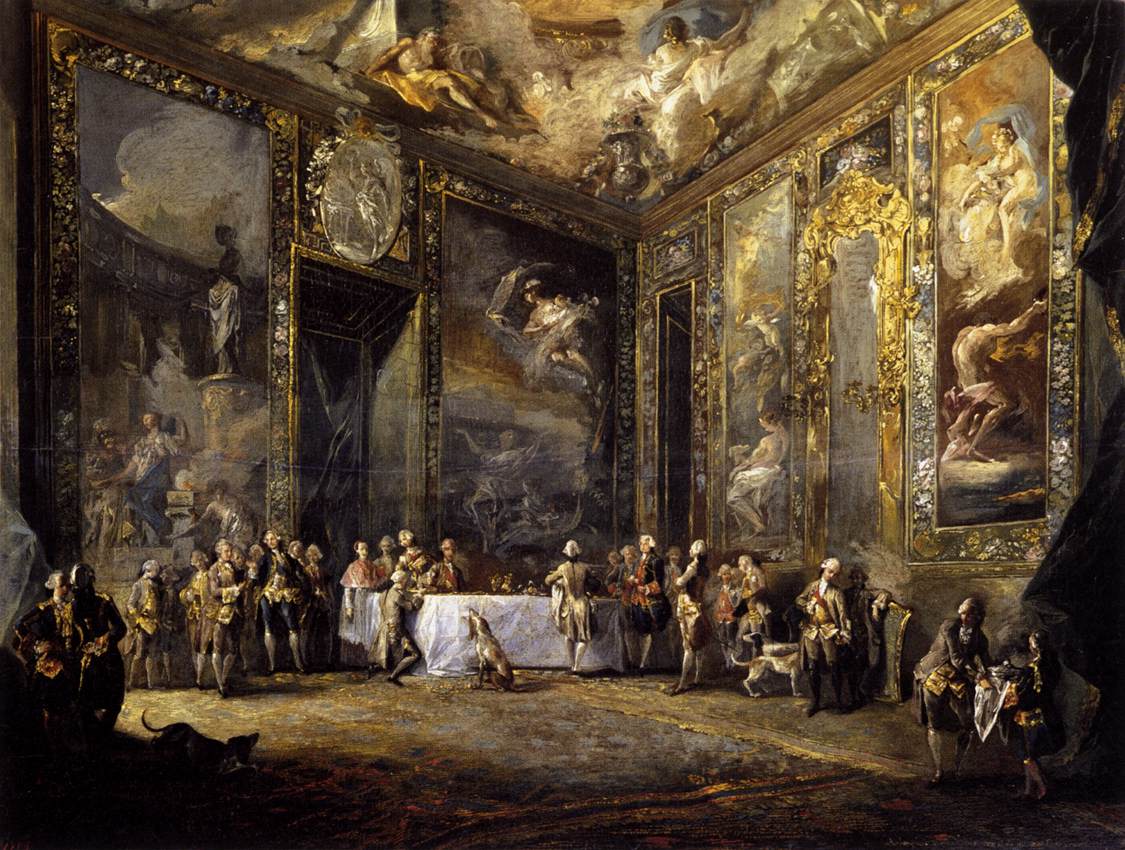
Charles III Dining before the Court
PARET Y ALCAZÁR, Luis · 1788 →
- MEDIUM
- Oil on wood, 50 x 64 cm
- TYPE
- Historical
PALETTE
HOVER OR TAP A SWATCH FOR NAME, SHARE AND HEX. SAMPLED FROM THE IMAGE — INDICATIVE, NOT A PIGMENT ANALYSIS.
DEVELOPMENT BUILD — NOT FOR PUBLIC USE. CONTRIBUTE ON GITHUB.
CURRENT LOCATION · Museo del Prado
03 — ARTWORK
PARET Y ALCAZÁR, Luis · 1788 →
PALETTE
HOVER OR TAP A SWATCH FOR NAME, SHARE AND HEX. SAMPLED FROM THE IMAGE — INDICATIVE, NOT A PIGMENT ANALYSIS.
COMMENTARY
UNDERLINED TERMS ARE DEFINED IN THE GLOSSARY.
Charles III Dining before the Court c. 1788 Oil on wood, 50 x 64 cm Museo del Prado, Madrid
Paret contributed to the restoration of the thematic element to its former importance, infusing it with new vitality by cultivating popular themes, scenes of everyday life set amid conventionally bucolic landscapes, in which, however, there are signs of a return to naturalismGeneric term for scientific positions supported by natural insights. In fine arts and literature between approximately 1870 and 1900, Naturalism tried to reproduce the reality comprehended through sensory experience as realistically as possible, i.e. without idealising the object, but with scientific precision. In contrast to Realism, which was also based on the accurate description of natural occurrences, Naturalism concerns itself with the sensual dimensions of observation, whereby questions of morality and social criticism come to the fore. The spokesman for literary Naturalism was Emile Zola, who believed the artistic methods provided evidence of human existence., as illustrated by this painting.
Charles III (1716-88) was king of Spain (1759-88) and of Naples and Sicily (1735-59). He was the son of Philip V and Elizabeth Farnese. Spain prospered under the rule of Charles, who is regarded as the greatest Bourbon king of Spain and one of the 'enlightened despots.' His reign is noted for economic and administrative reforms and for the expulsion of the JesuitsThe Society of Jesus, a Roman Catholic teaching order founded by St. Ignatius Loyola in 1534. The express purpose of the Jesuits was to fight heresy within the Church (they played a leading role in the Counter Reformation), and to spread the faith through missionary work in the many parts of the world recently discovered by Western explorers and colonists. (1767). He was succeeded by his son Charles IV.
@online{wga-r150291500295c0,
  author       = {Krén, Emil and Marx, Daniel},
  title        = {Charles III Dining before the Court by PARET Y ALCAZÁR, Luis},
  organization = {{Web Gallery of Art}},
  date         = {2026-09-14},
  url          = {https://beta.wga.hu/artists/paret-y-alcazr-luis-r7312749a4f4bfa/charles-iii-dining-before-the-court-r150291500295c0},
  urldate      = {2026-09-14},
  langid       = {english}
}
ACCESSED 2026-09-14. REPLACE THE AUTHOR FIELD WITH THE COMMENTARY AUTHOR WHERE ONE IS NAMED.


