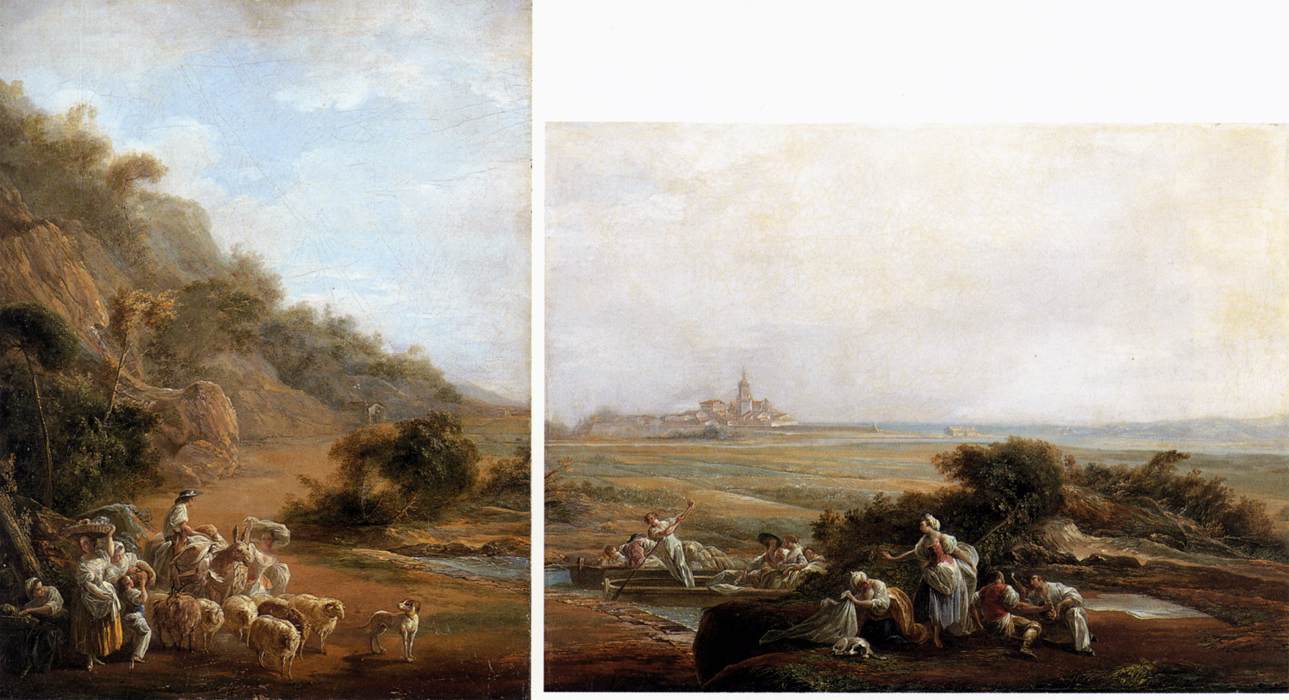
The original canvasA woven cloth used as a support for painting. The best-quality canvas is made of linen; other materials used are cotton, hemp, and jute. It is now so familiar a material that the word 'canvas' has become almost a synonym for an oil painting, but it was not until around 1500 that it began to rival the wooden panel (which was more expensive and took longer to prepare) as the standard support for movable paintings (the transition came later in Northern Europe than in Italy). Canvas is not suitable for painting on until it has been coated with a ground, which isolates the fabric from the paint; otherwise it will absorb too much paint, only very rough effects will be obtainable, and parts of the fabric may be rotted by the pigments. It must also be made taut on a stretcher or by some other means. was cut in two parts in an unknown date and the parts were sold independently. In order to avoid disproportion the View of Fuenterrabia was further truncated by cutting part of the sky. The two parts were united in 1996 when the Village Scene was donated to the Bilbao museum which owned the landscape part since 1986. The size of the original was probably 74 x 117 cm, according to a document related to the auction of the collection of Joseph Bonaparte who owned the painting.
This painting is part of a series representing the port cities at the Atlantic coast. Paret received the commission from King Charles III in 1786.