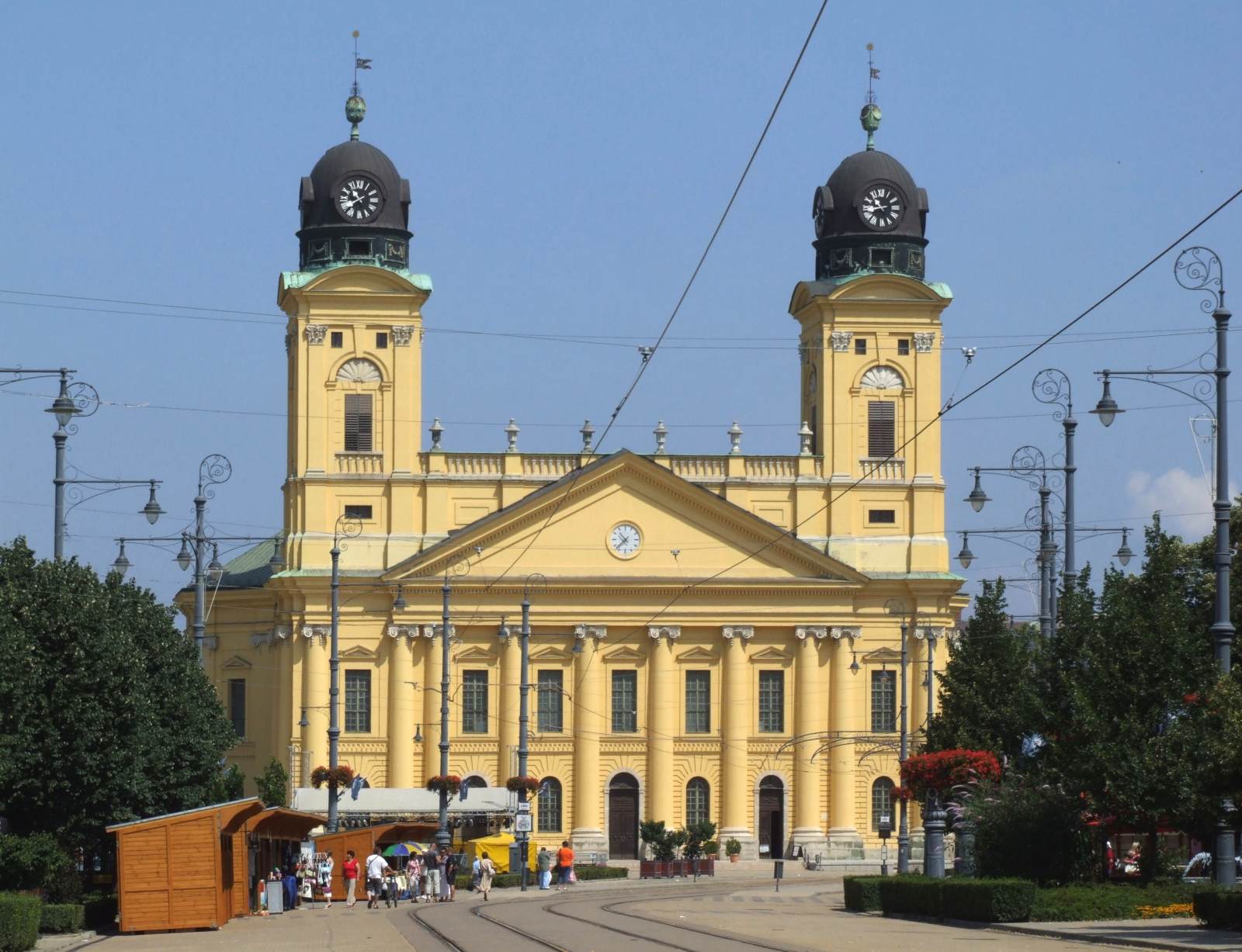
03 — ARTWORK
Exterior view
- MEDIUM
- Photo
- TYPE
- Other
PALETTE
HOVER OR TAP A SWATCH FOR NAME, SHARE AND HEX. SAMPLED FROM THE IMAGE — INDICATIVE, NOT A PIGMENT ANALYSIS.
DEVELOPMENT BUILD — NOT FOR PUBLIC USE. CONTRIBUTE ON GITHUB.
03 — ARTWORK
PALETTE
HOVER OR TAP A SWATCH FOR NAME, SHARE AND HEX. SAMPLED FROM THE IMAGE — INDICATIVE, NOT A PIGMENT ANALYSIS.
COMMENTARY
UNDERLINED TERMS ARE DEFINED IN THE GLOSSARY.
The cathedralThe principal church of a province or diocese, where the throne of the bishop is placed. For reasons lost to time and tradition, a cathedral always faces west - toward the setting sun. The altar is placed at the east end. The main body, or nave, of the cathedral is usually divided into one main and two side aisles. These lead up to the north and south transepts, or arms of the cross, the shape in which a cathedral is usually formed. at Vác built by Isidore Canevale, served as a model for other Hungarian churches, such as the cathedrals at Esztergom, Eger, and Szombathely, all of which eagerly sought to express a monumental Neoclassical style. The ideals of NeoclassicismA style in European art and architecture from the mid 18th century until the end of the 19th century. Based as it was on the use of ancient Greek and Roman models and motifs, its development was greatly influenced by the excavations at Pompeii and Herculaneum, and by the theories of the German art historian Johann Joachim Winckelmann (1717-1768). Intellectually and politically it was closely linked to the Enlightenment's rejection of the aristocratic frivolity of Rococo, the style of the Ancien Régime. Among Neoclassicism's leading figures were the French painter Jacques-Louis David (1744-1825), the German painter Anton Raffael Mengs (1728-1729), and the Italian sculptor Antonio Canova (1757-1822). were not exclusively used by the Catholic Church to show its reverence for Rome, the main Calvinist place of worship in Debrecen also employed a porticoUsually open porch supported by columns or pillars on the main entrance side of a buildings. Frequently supports a pediment. with columns and twin towers on its façadethe front or principal face of a building, especially one elaborately constructed; a blind façade is a façade that is purely decorative and does not relate to the structure of the building.. Because the body of church consists only of a transverse navethe main interior space of a church building. It may have parallel aisles on each side, often separated from it by pillars, and is intersected by the transept, which cuts across it at the point where the choir begins. adjoined by a flat choirthe part of a church interior, usually raised and set apart from the rest of the church, reserved for the clergy to pray together, or for choral singing. Since Carolingian times, "choir" has been the word for the part of the central nave of the church extending over the crossing (the place where nave and transept intersect), and including the apse (a niche in the wall, roofed with a half dome) that often stands at the end of this area., the twin towers on the façade seems strangely outsized - an effect which is heightened still further by the uncompleted domein architecture, hemispherical structure evolved from the arch, usually forming a ceiling or roof. over the "crossingthe area of a church where the nave is intersected by the transept.."
Built between 1805 and 1824, the Great Church is the symbol of Debrecen and Hungarian Reformation. The dethronement of the Habsburgs was declared here on the 14th April 1849.
Building work started under the supervision of architect Mihály Péchy, who also designed the Reformed College here, but was subsequently assumed by József Tallherr (1730-1807). The 55-meter long building's 15 meter-wide nave stands on medieval foundations.
@online{wga-r363374f34bb63b,
  author       = {Krén, Emil and Marx, Daniel},
  title        = {Exterior view by PÉCHY, Mihály},
  organization = {{Web Gallery of Art}},
  date         = {2026-09-13},
  url          = {https://beta.wga.hu/artists/pchy-mihly-r22c4cf8a049bec/exterior-view-r363374f34bb63b},
  urldate      = {2026-09-13},
  langid       = {english}
}
ACCESSED 2026-09-13. REPLACE THE AUTHOR FIELD WITH THE COMMENTARY AUTHOR WHERE ONE IS NAMED.
The archive catalogues no further works by this artist.
TRY SAME COLLECTION →