03 — ARTWORK
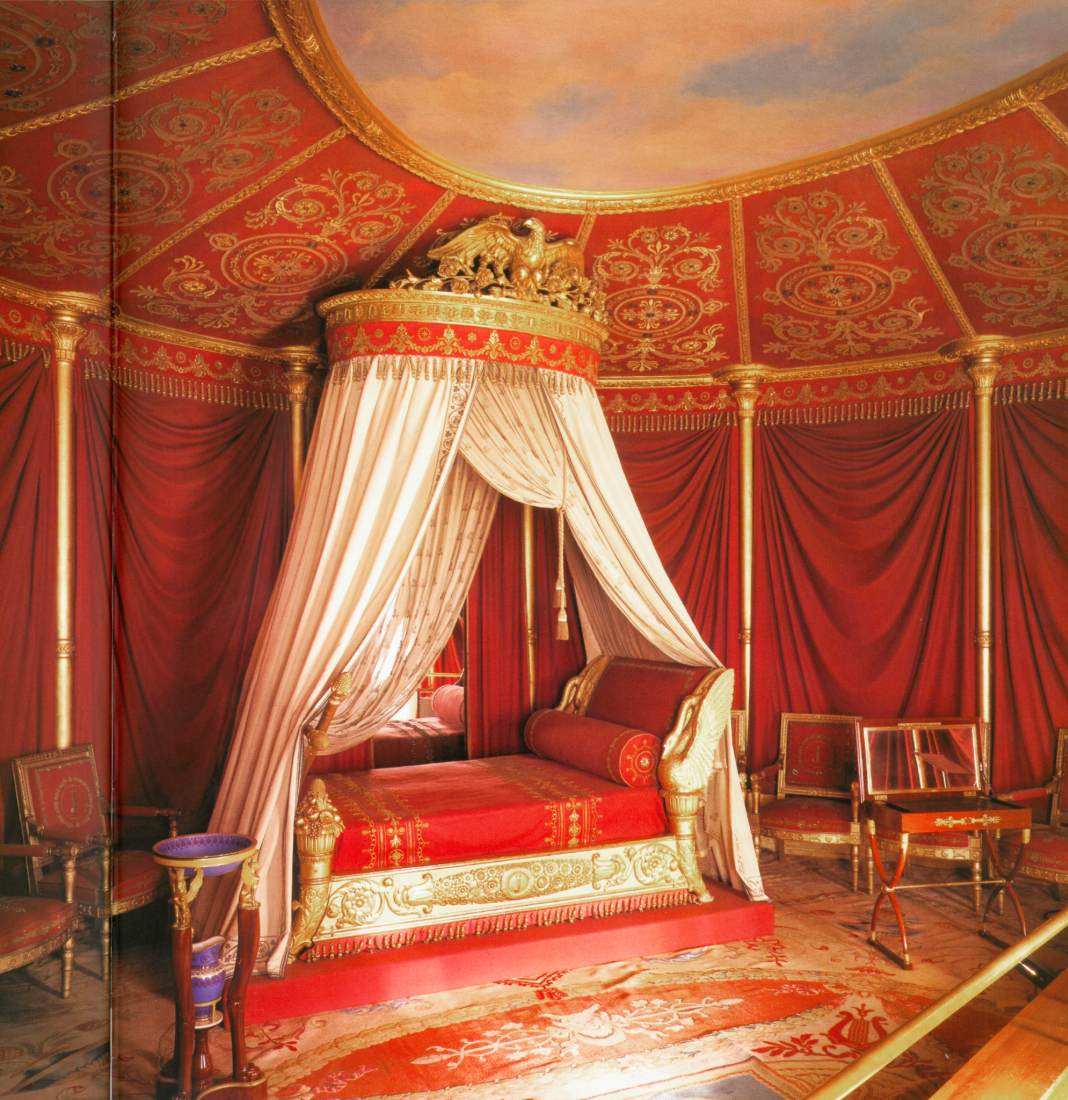
Bedroom of Napoleon's Wife, Josephine
- MEDIUM
- Photo
- TYPE
- Interior
PALETTE
HOVER OR TAP A SWATCH FOR NAME, SHARE AND HEX. SAMPLED FROM THE IMAGE — INDICATIVE, NOT A PIGMENT ANALYSIS.
DEVELOPMENT BUILD — NOT FOR PUBLIC USE. CONTRIBUTE ON GITHUB.
03 — ARTWORK
PALETTE
HOVER OR TAP A SWATCH FOR NAME, SHARE AND HEX. SAMPLED FROM THE IMAGE — INDICATIVE, NOT A PIGMENT ANALYSIS.
COMMENTARY
UNDERLINED TERMS ARE DEFINED IN THE GLOSSARY.
To satisfy his immediate need for display, Napoleon had alterations undertaken at the former royal palaces plundered by the revolutionaries, and this work was entrusted mainly to Percier and Fontaine. The main influence was Imperial Rome whose successor Napoleonic France claimed to be.
The work for furnishings of Château Malmaison, acquired for Napoleon's wife, Josephine, was carried out by Jean-Baptiste Lepère (1761-1844) to designs by Percier and Fontaine and completed in 1803. Displaying classicalRelating to the culture of ancient Greece and Rome (classical Antiquity). The classical world played a profoundly important role in the Renaissance, with Italian scholars, writers, and artists seeing their own period as the rebirth (the "renaissance") of classical values after the Middle Ages. The classical world was considered the golden age for the arts, literature, philosophy, and politics. Concepts of the classical, however, changed greatly from one period to the next. Roman literature provided the starting point in the 14th century, scholars patiently finding, editing and translating a wide range of texts. In the 15th century Greek literature, philosophy and art - together with the close study of the remains of Roman buildings and sculptures-expanded the concept of the classical and ensured it remained a vital source of ideas and inspiration. architectural forms, strong contrasting colours, mahogany paneling highlighted with gilt bronzeAn alloy of copper (usually about 90 per cent) and tin, often also containing small amounts of other metals such as lead or zinc. Since antiquity it has been the metal most commonly used in cast sculpture because of its strength, durability, and the fact that it is easily workable - both hot and cold - by a variety of processes. It is easier to cast than copper because it has a lower melting-point, and its great tensile strength makes possible the protrusion of unsupported parts - an advantage over marble sculpture. The colour of bronze is affected by the proportion of tin or other metals present, varying from silverish to a rich, coppery red, and its surface beauty can be enhanced when it acquires a patina. appliqués, and ceiling paintings in imitation of Pompeii and Herculaneum, the interiors exude luxury.
The archive catalogues no further works by this artist.
TRY SAME COLLECTION →@online{wga-re7ad60a418e688,
author = {Krén, Emil and Marx, Daniel},
title = {Bedroom of Napoleon's Wife, Josephine by PERCIER, Charles},
organization = {{Web Gallery of Art}},
date = {2026-09-13},
url = {https://beta.wga.hu/artists/percier-charles-re265082b2258b4/bedroom-of-napoleons-wife-josephine-re7ad60a418e688},
urldate = {2026-09-13},
langid = {english}
}ACCESSED 2026-09-13. REPLACE THE AUTHOR FIELD WITH THE COMMENTARY AUTHOR WHERE ONE IS NAMED.


