03 — ARTWORK
Exterior view
PÖPPELMANN, Matthäus Daniel · 1716 →
- MEDIUM
- Photo
- TYPE
- Other
PALETTE
HOVER OR TAP A SWATCH FOR NAME, SHARE AND HEX. SAMPLED FROM THE IMAGE — INDICATIVE, NOT A PIGMENT ANALYSIS.
DEVELOPMENT BUILD — NOT FOR PUBLIC USE. CONTRIBUTE ON GITHUB.
03 — ARTWORK
PÖPPELMANN, Matthäus Daniel · 1716 →
PALETTE
HOVER OR TAP A SWATCH FOR NAME, SHARE AND HEX. SAMPLED FROM THE IMAGE — INDICATIVE, NOT A PIGMENT ANALYSIS.
COMMENTARY
UNDERLINED TERMS ARE DEFINED IN THE GLOSSARY.
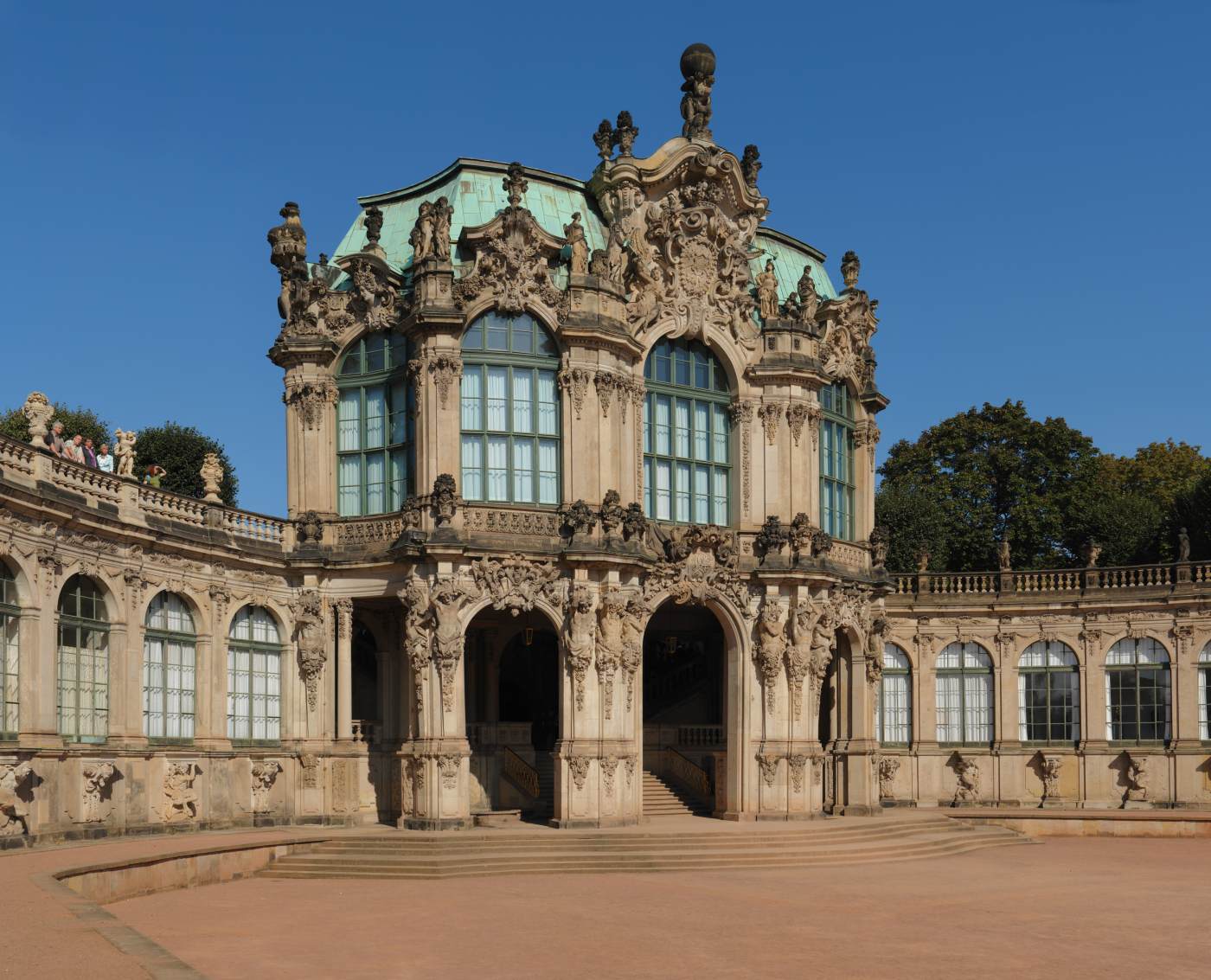
The Zwinger is a palace in Dresden, built in RococoA style of design, painting, and architecture dominating the 18th century, often considered the last stage of the Baroque. Developing in the Paris townhouses of the French aristocracy at the turn of the 18th century, Rococo was elegant and ornately decorative, its mood lighthearted and witty. Louis XV furniture, richly decorated with organic forms, is a typical product. Leading exponents of the Rococo sryle included the French painters Antoine Watteau (1684-1721) and Jean-Honoré Fragonard (1732-1806), and the German architect Johann Balthasar Neumann (1687-1753). Rococo gave way to Neo-classicism. style and designed by court architect Matthäus Daniel Pöppelmann. It served as the orangery, exhibition galleryan upper story, similar to a tribune, running along the side of a building and open on one side to the interior; in a church (basilica) above the side aisles, over the ambulatory (central-plan building) and also over the west end. The gallery was used to keep certain groups of worshippers apart (women, noblemen). and festival arena of the Dresden Court.
Frederick Augustus I (the Strong) (1670-1733) and his son Frederick Augustus II (1696-1763) together transformed Dresden and Saxony into a grandiose BaroqueThe period in art history from about 1600 to about 1750. In this sense the term covers a wide range of styles and artists. In painting and sculpture there were three main forms of Baroque: (1) sumptuous display, a style associated with the Catholic Counter Reformation and the absolutist courts of Europe (Bernini, Rubens); (2) dramatic realism (Caravaggio); and (3) everyday realism, a development seen in particular in Holland (Rembrandt, Vermeer). In architecture, there was an emphasis on expressiveness and grandeur, achieved through scale, the dramatic use of light and shadow, and increasingly elaborate decoration. In a more limited sense the term Baroque often refers to the first of these categories. The development of the Baroque reflects the period's religious tensions (Catholic versus Protestant); a new and more expansive world view based on science and exploration; and the growth of absolutist monarchies. treasure chest. Moreover, Saxony could claim a position at the centre of German music during this period.
Frederick Augustus I commissioned the sculptor and architect Marcus Conrad Dietze (1658-1704) from Ulm to plan a new royal seat. After Dietze's death Pöppelmann and Balthasar Permoser were appointed as his successors. In 1709 Pöppelmann began drawing up comprehensive plans. In 1716 the single-storey gallery buildings of the orangery formed an omega-shaped ground plan, with the Wallpavillon added over the stairs midway along the curved galleries.
The king wanted a spacious and unusual festival ground (the Zwinger garden) without any direct link to the architecture of the palace. Pöppelmann submitted a simple but inspired plan which included a new group of buildings that was a mirror image of the existing ones. Construction of the Zwinger was completed in 1728.
The picture shows the rampart pavilionA lightly constructed, ornamental building, such as a garden summerhouse; a small, ornamental structure built onto a palace or cháteau; a prominent section of a monumental façade, projecting either centrally or at both ends. (Wallpavillon) of the Zwinger.
View the <a href="#" onClick="w=window.open ('/support/plans/p/poppelma/zwinger.html', 'newWin', 'scrollbars=yes,status=no,dependent=yes,screenX=0,screenY=0,width=400,height=600');w.opener=this;w.focus();return false">plan</a> of the Zwinger, Dresden.
@online{wga-r3e410eec80402a,
  author       = {Krén, Emil and Marx, Daniel},
  title        = {Exterior view by PÖPPELMANN, Matthäus Daniel},
  organization = {{Web Gallery of Art}},
  date         = {2026-09-09},
  url          = {https://beta.wga.hu/artists/pppelmann-matthus-daniel-r0a2064d3a99483/exterior-view-r3e410eec80402a},
  urldate      = {2026-09-09},
  langid       = {english}
}
ACCESSED 2026-09-09. REPLACE THE AUTHOR FIELD WITH THE COMMENTARY AUTHOR WHERE ONE IS NAMED.


