03 — ARTWORK
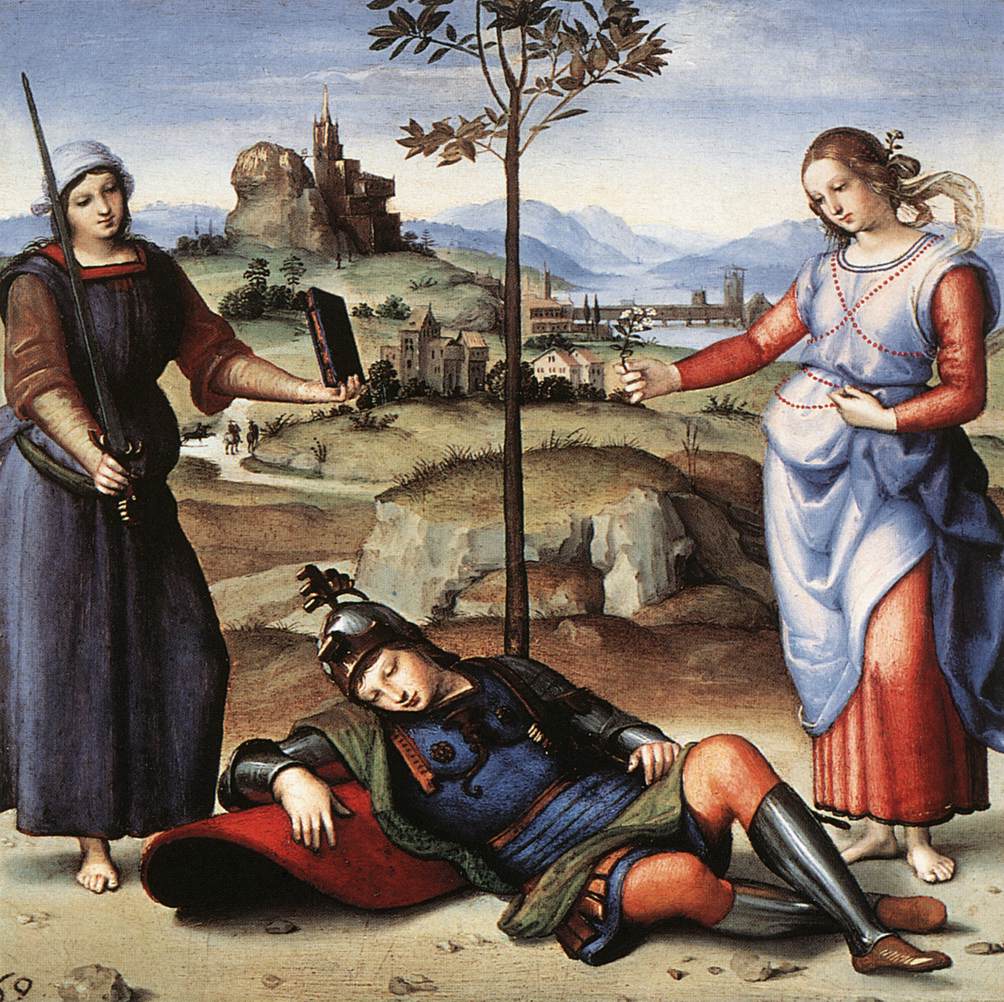
Allegory (The Knight's Dream)
- MEDIUM
- Oil on wood, 17 x 17 cm
- TYPE
- Mythological
PALETTE
HOVER OR TAP A SWATCH FOR NAME, SHARE AND HEX. SAMPLED FROM THE IMAGE — INDICATIVE, NOT A PIGMENT ANALYSIS.
DEVELOPMENT BUILD — NOT FOR PUBLIC USE. CONTRIBUTE ON GITHUB.
03 — ARTWORK
PALETTE
HOVER OR TAP A SWATCH FOR NAME, SHARE AND HEX. SAMPLED FROM THE IMAGE — INDICATIVE, NOT A PIGMENT ANALYSIS.
COMMENTARY
UNDERLINED TERMS ARE DEFINED IN THE GLOSSARY.
AllegoryA work of art which represents some abstract quality or idea, either by means of a single figure (personification) or by grouping objects and figures together. Renaissance allegories make frequent allusions both to both Greek and Roman legends and literature, and also to the wealth of Christian allegorical stories and symbols developed during the Middle Ages. (The Knight's Dream) c. 1504 Oil on wood, 17 x 17 cm National Galleryan upper story, similar to a tribune, running along the side of a building and open on one side to the interior; in a church (basilica) above the side aisles, over the ambulatory (central-plan building) and also over the west end. The gallery was used to keep certain groups of worshippers apart (women, noblemen)., London
The figurative powers which Raphael developed in Florence led to a more synthetic conception of form, a refinement of intellectual expression, which are visible in the Knight's Dream in the National Gallery, London, and the Three Graces of Chantilly. Critics believe that the two panels may have formed a single diptychin medieval art a picture, often an altarpiece, consisting of two folding wings without a fixed central area. presented to Scipione di Tommaso Borghese at his birth, in 1493. The theme of the paintings may by drawn from the poem, Punica, by Silius Italicus, which was well known in antiquity and which humanistic culture restored to fame. In the first panelTerm in painting for a support of wood, metal, or other rigid substance, as distinct from canvas. Until the adoption of canvas in the 15th century nearly all the movable paintings of Europe were executed on wood, and even up to the beginning of the 17th century it is probable that as much painting was done on the one support as on the other. Painters who worked on a small scale often used copper panels (Elsheimer is a leading example), and in the colonial art of South America copper and tin and even lead and zinc were used. On a larger scale, slate has occasionally been used as a support, notably by Rubens for his altarpiece for Sta Maria in Vallicella (the Chiesa Nuova) in Rome; the picture he originally painted was said to reflect the light unpleasantly and slate was used for the replacement to produce a more matt finish. For wood panels the Italian masters of the Renaissance preferred white poplar, while oak was the most common wood used in northern Europe. Many other types were used, however; analysis of the contents of art galleries has yielded a long list, including beech, cedar, chestnut, fir, larch, linden, mahogany, olive, and walnut. In the 20th century cedar, teak, and dark walnut are favourites, and modern painters have also used plywood, fibre-board, and other synthetic materials as supports., Scipio, the sleeping knight, must choose between Venus (pleasure) and Minerva (virtue); in the second, the Graces reward his choice of virtue with the Golden Apples of the Hesperides. The classicalRelating to the culture of ancient Greece and Rome (classical Antiquity). The classical world played a profoundly important role in the Renaissance, with Italian scholars, writers, and artists seeing their own period as the rebirth (the "renaissance") of classical values after the Middle Ages. The classical world was considered the golden age for the arts, literature, philosophy, and politics. Concepts of the classical, however, changed greatly from one period to the next. Roman literature provided the starting point in the 14th century, scholars patiently finding, editing and translating a wide range of texts. In the 15th century Greek literature, philosophy and art - together with the close study of the remains of Roman buildings and sculptures-expanded the concept of the classical and ensured it remained a vital source of ideas and inspiration. origin of this theme brings us back without doubt to the Florentine environment. The composition, which is dominated by a sense of great harmony, is a figurative consequence of the literary theme.
A young knight is asleep in front of a laurel tree that divides the picture into two equal parts. There is a figure of a beautiful young woman in each half on the left the personificationan imaginary person conceived as representing a thing, concept or deity. of Virtue is holding a book and a sword above the sleeping figure, while the figure on the right is presenting a flower as a symbol of sensual pleasure. The probable meaning of the allegory is that the young man's task is to bring both sides of life into harmony.
@online{wga-r6c9ba9cafbe37e,
  author       = {Krén, Emil and Marx, Daniel},
  title        = {Allegory (The Knight's Dream) by RAFFAELLO Sanzio},
  organization = {{Web Gallery of Art}},
  date         = {2026-09-09},
  url          = {https://beta.wga.hu/artists/raffaello-sanzio-r5e787e781f4a4c/allegory-the-knights-dream-r6c9ba9cafbe37e},
  urldate      = {2026-09-09},
  langid       = {english}
}
ACCESSED 2026-09-09. REPLACE THE AUTHOR FIELD WITH THE COMMENTARY AUTHOR WHERE ONE IS NAMED.


