03 — ARTWORK
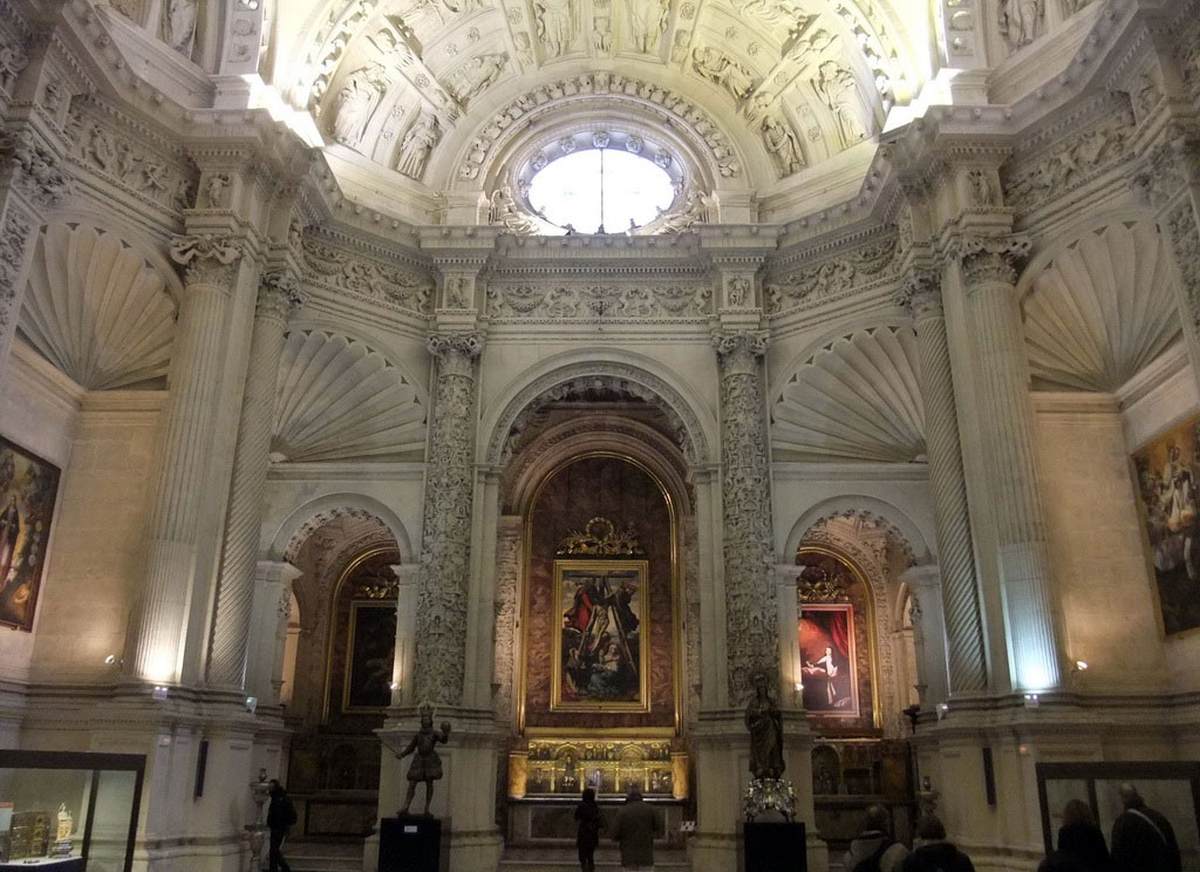
Interior view
- MEDIUM
- Photo
- TYPE
- Other
PALETTE
HOVER OR TAP A SWATCH FOR NAME, SHARE AND HEX. SAMPLED FROM THE IMAGE — INDICATIVE, NOT A PIGMENT ANALYSIS.
DEVELOPMENT BUILD — NOT FOR PUBLIC USE. CONTRIBUTE ON GITHUB.
03 — ARTWORK
PALETTE
HOVER OR TAP A SWATCH FOR NAME, SHARE AND HEX. SAMPLED FROM THE IMAGE — INDICATIVE, NOT A PIGMENT ANALYSIS.
COMMENTARY
UNDERLINED TERMS ARE DEFINED IN THE GLOSSARY.
As Master of the Works at Seville CathedralThe principal church of a province or diocese, where the throne of the bishop is placed. For reasons lost to time and tradition, a cathedral always faces west - toward the setting sun. The altar is placed at the east end. The main body, or nave, of the cathedral is usually divided into one main and two side aisles. These lead up to the north and south transepts, or arms of the cross, the shape in which a cathedral is usually formed. (1528), Riano designed the Sacristía de los Cálices in a completely GothicGothic, which may well have originated with Alberti as a derogatory term and which certainly corresponds to Vasari's 'maniera tedesca' ('German style'), is properly the descriptive term for an artistic style which achieved its first full flowering in the Ile de France and the surrounding areas in the period between c. 1200 and c. 1270, and which then spread throughout northern Europe. It is characterized by the hitherto unprecedented integration of the arts of sculpture, painting, stained glass and architecture which is epitomized in the great cathedrals of Chartres, Amiens, and Reims or in the Sainte Chapelle in Paris. In all the arts the predominantly planar forms of the Romanesque are replaced by an emphasis on line. There is a transcendental quality, whether in the soaring forms of the pointed arches or in the new stress on the humanity of Christ, which similarly distinguishes it from the preceding Romanesque style. In thinking of Nicola (d. c. 1284) or Giovanni Pisano (d. after 1314) there is same danger of forgetting what had happened in French sculpture half a century or more earlier, and likewise it is hard to remember that the spectacular achievements of early Renaissance art are a singularly localized eddy in the continuing stream of late gothic European art. By northern European standards few Italian works of art can be called gothic without qualification, and the story of 13th and 14th century Italian architecture is as much one of resistance to the new style as of its reception, whether directly from France or through German or central European intermediaries. In sculpture and in painting, the Italian reluctance to distort the human figure, conditioned by a never wholly submerged awareness of the omnipresent antique heritage, gives a special quality to the work of even those artists such as Giovanni Pisano or Simone Martini who most closely approached a pure gothic style. Nevertheless, the vitalizing role of Northern gothic art throughout the early Renaissance and the period leading up to it should never be underestimated. The artistic, like the cultural and commercial, interaction was continuous and much of the Italian achievement is incomprehensible if seen in isolation. It is not merely at the level of direct exchanges between one artist and another, or the influence of one building; painting, manuscript or piece of sculpture upon another, that the effects are to be felt. The streaming quality of line which is so characteristic of Brunelleschi's early Renaissance architecture surely reflects a sensitivity to the gothic contribution which is entirely independent of, and lies much deeper than, the superficial particularities of form. The counterflow of influence and inspiration from South to North must likewise not be underrated. In particular, the contribution of Italian painters from Duccio and Simone Martini onwards is central to the evolution of the so-called International Gothic style developing in Burgundy, Bohemia and north Italy in the late 14th and early 15th centuries. style, as well as the Capillas de los Alabastros (1532), in which he exhibits a fully PlateresqueSpanish Plateresco (Silversmith-like), main architectural style in Spain during the late 15th and the 16th centuries, also used in Spain's American colonies. Cristóbal de Villalón first used the term in 1539 while comparing the richly ornamented facade of the Cathedral of León to a silversmith's intricate work. Later the name came to be generally applied to late Gothic and early Renaissance Spanish architecture, since it was characterized by an intricate and minutely detailed relief ornament that is generally applied to the surface of buildings for extravagant decorative effect and without regard for structural articulation. Favourite motifs of this florid ornament include twisted columns, heraldic escutcheons, and sinuous scrolls. Clusters of this jewelry-like ornament contrast with broad expanses of flat wall surface. The Plateresque style went through two distinguishable phases. The first phase, termed the Isabelline style because it flourished during the reign of Isabella I, lasted from about 1480 to about 1540. In this phase (also known as the Gothic-Plateresque style), the forms of late Flamboyant Gothic still predominate, and Renaissance elements are used with only imperfect understanding. The first phase, like its successor, utilized Mudejar ornament -, i.e., the intricate and elegant decorative patterns used by Moorish artists working in Christian-ruled Spain. The Isabelline style is well represented in the buildings of Enrique de Egas and Diego de Riaño and is typified by the facade of the College of San Gregorio in Valladolid (1488), in which architectural ornamentation seems free from all external dictates and pursues its own life without regard to scale, composition, placement, or appropriateness. The second phase, the Renaissance-Plateresque, or simply the Plateresque, lasted from about 1525 to 1560. The architect and sculptor Diego de Siloé (d. 1563) helped inaugurate this phase, in which High Renaissance structural and decorative elements clearly predominated over late Gothic ones. In the Granada Cathedral (1528-43) and other buildings, Diego evolved a purer, more severe, harmonious, and unified style using massive geometric forms; correct classical orders became frequent, and nonstructural Gothic ribbing tended to disappear in favour of Italianate round arches and domical vaults. The buildings of Alonso de Covarrubias and of Rodrigo Gil de Hontañón, particularly the latter's facade of the University of Alcalá de Henares (1541-53), are the masterworks of the second style, which lasted only a few decades. Even the balance and correctness of the style seemed excessively rich to the sombre young man who became King Philip II in 1556 and supervised construction of the severe El Escorial. sense of style, characterized by a great richness both in the carvings and in the materials employed. He built the Sacristía Mayor (Main Sacristya side room of a church where a priest puts on his vestments and where the sacred vessels and vestments are kept.) in 1530 as a Greek crossA cross with four arms of equal length. inscribed in a square, articulated to the height of the cornicea molded horizontal ledge along the top of a building or wall; a decorative molding between wall and roof. by Corinthian pilasters and half columns in a Greco-Roman style that reflects the influence of Diego de Siloe at Granada Cathedral. Above, the square is transformed into an octagoneight-sided central plan building, or any building with eight sides; occurred frequently in the Middle Ages, not just in architecture, but also in the design of crowns, as eight was considered to be a perfect number. to support the domein architecture, hemispherical structure evolved from the arch, usually forming a ceiling or roof..
Both in structure and in decoration, Seville Cathedral is a striking example of the triumphWith growing interest from the early 14th century in the history of ancient Rome came a fascination with the city's conquests, the wars by which they were won - and the ceremony which marked their success: the victor's triumph. The knowledge that the privilege of being commemorated by one of these enormous and costly processions of warriors, loot and prisoners was given sparingly, only to the sole commander of a major victory over a foreign army of whom at least 5000 were slain, added to the glamour of the triumph. Its centrepiece was the chariot of the victor himself. Dante gave one to Beatrice in Purgatorio XXIX: 'Rome upon Africanus ne'er conferred / Nor on Augustus's self, a car so brave'. But it was tentatively with the relief carvings on the Triumphal Arch (1452-66) at Castelnuovo in Naples commemorating Alfonso the Magnanimous, and finally with Mantegna's superb Triumph of Caesar cartoons (Hampton Court), that the visual reconstruction of a Roman triumph became complete. Meanwhile, in an age which did not like the idea of large numbers of victory-flushed soldiers parading through its streets, the military triumph became sublimated, as it were, into a number of less controversial forms. This was largely under the influence of Petrarch's 'Trionfi' - poems describing the processions commemorating the triumphs of love, chastity, death; fame, time and eternity. Disseminated soon after his death, they soon appeared in illuminated manuscripts, and the triumph scene became a popular one for woodcuts, decorated marriage chests and other paintings, most beautifully of all on the backs of Piero della Francesca's portraits of Federigo da Montefeltro and his wife, Battista Sforza. Other 'triumphs' were invented: of the seasons, of virtues and of the arts. Nor was the theme allowed to be simply a profane one. Just before his death Savonarola published his 'Triumph of the Cross', in which the reader was invited to imagine 'a four-wheeled chariot on which is seated Christ as Conqueror.' Before it go the apostles, patriarchs and prophets, beside it the army of martyrs, behind it, after 'a countless number of virgins, of both sexes', come the prisoners: 'the serried ranks of the enemies of the Church of Christ.' This aspect of the theme was magnificently realized in Titian's great woodcut 'The Triumph of the Faith'. of Renaissance architecture in Spain.
The photo shows the interior of the main sacristy.
@online{wga-r1f4438a778793b,
  author       = {Krén, Emil and Marx, Daniel},
  title        = {Interior view by RIAÑO, Diego de},
  organization = {{Web Gallery of Art}},
  date         = {2026-09-13},
  url          = {https://beta.wga.hu/artists/riao-diego-de-r4fbb7348d9d9e8/interior-view-r1f4438a778793b},
  urldate      = {2026-09-13},
  langid       = {english}
}
ACCESSED 2026-09-13. REPLACE THE AUTHOR FIELD WITH THE COMMENTARY AUTHOR WHERE ONE IS NAMED.


