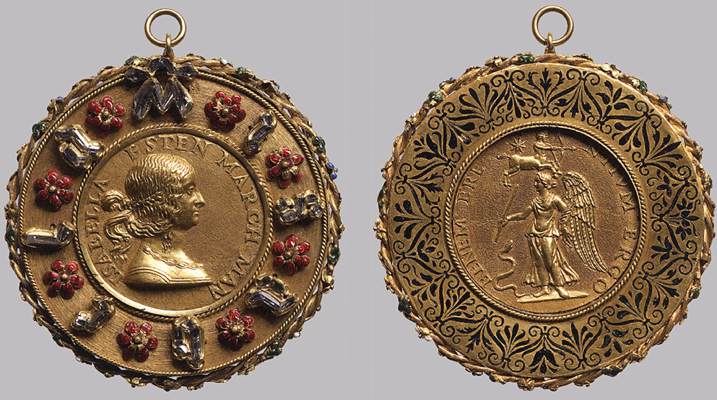
MedalsThe medal came to artistic maturity within a remarkably short time of its introduction in 15th century Italy. This was partly because ancient Roman coins, which were beginning to be reverently collected, suggested (on a smaller scale) its form: profile portrait bust on the obverse, a different design on the reverse, an inscription running round the rim. Like the finest Imperial coins, the medal's purpose was commemorative. Without monetary value, and of non-precious metal (bronze or lead), it was a way of circulating a likeness to a chosen few; it anticipated the use of miniatures and was indeed frequently worn round the neck. And while the reverse could record a historical event or make a propaganda point related to its subject's career, more commonly it bore a design that purported to convey the 'essence', as it were, of the person portrayed on the other side. Given the admiration for the men and artefacts of ancient Rome, the stress on individual character, the desire for fame and the penchant for summing up temperament in symbols and images, it is easy to understand how quickly the fashion for commissioning medals spread. Its pioneer executant was Pisanello. The precedents before he began to cast medals in 1438-39 had been few and excessively coin-like. Within 10 years he had established the form the medal was to retain until the influence was registered of the reverseless, hollow-cast and wafer-thin medals of the 1560s and 70s made by Bombarda (Andrea Cambi). Pisanello's approach was first echoed by the Veronese Matteo de' Pasti (d. 1467-688). It was, perhaps oddly, not until the works from 1485 of Niccolò Fiorentino (Niccolò di Forzore Spinelli, 1430-1514) that Florence produced a medallist of the highest calibre. Other specialists in the medium included Sperandio (Sperandio Savelli, c. 1425-1504), L'Antico (Pier Jacopo Alari Bonacolsi, c. 1460-1528), Caradosso (Cristoforo Caradosso Foppa, 1452-1526/27). The work of these men, and of the many, often anonymous, who reflected them, is still coveted because it avoided the two medallistic errors: making a medal look like either an enlarged piece of money or a small sculptured plaque. such as this one were commissioned by Renaissance rulers and others to be given as tokens of honour and respect. Isabella presented bronzeAn alloy of copper (usually about 90 per cent) and tin, often also containing small amounts of other metals such as lead or zinc. Since antiquity it has been the metal most commonly used in cast sculpture because of its strength, durability, and the fact that it is easily workable - both hot and cold - by a variety of processes. It is easier to cast than copper because it has a lower melting-point, and its great tensile strength makes possible the protrusion of unsupported parts - an advantage over marble sculpture. The colour of bronze is affected by the proportion of tin or other metals present, varying from silverish to a rich, coppery red, and its surface beauty can be enhanced when it acquires a patina. versions of this medal to poets, and the text on the back reads "For Those Who Serve Her."
Isabella d'Este (1474-1539) came to Mantua from Ferrara in 1490 as the wife of Marquis Francesco Gonzaga, a war captain who loved art but was even fonder of arms, dogs, and horses. She entered the city via five triumphal arches, in a wagon decorated by Ercole de' Roberti, one of the best Ferrarese painters of the day. She settled into Castello"castle", palace. di San Giorgio, where she had a private apartment only a few yards from the Camera degli Sposi. Her quarters contained the studioloA room in a Renaissance palace in which the rich or powerful could retire to study their rare books and contemplate their works of art. The studiolo became a symbol of a person's humanist learning and artistic refinement. Among the best known are those of Duke Federico da Montefeltro in Urbino, and Isabella D'Este in Mantua., a little studio, that would become one of her greatest sources of pride.
Isabella's features on the obverse of the medal are close to the <a onclick="return OpenOther('/html/l/leonardo/08heads/07isabel.html')" href="/html/l/leonardo/08heads/07isabel.html">famous portraitThe Roman portrait bust survived in the form of life-sized reliquaries of saints, but it was in 15th century Florence that the individual features and character of a contemporary sitter were accurately recorded by sculptors such as Donatello, Desiderio da Settignano, Mino da Fiesole and the Rossellino. A similar degree of realism occurs in 15th century tomb sculpture. The equestrian portrait, based on antique statues such as the Marcus Aurelius monument (Rome, Campidoglio), was revived in the 14th century. Two examples in fresco are Simone Martini's Guidoriccio (c. 1328; Siena, Palazzo Pubblico) and the posthumous portrait of Sir John Hawkwood (1436; Florence, Cathedral) by Uccello, which gives the illusion of a 3-dimensional statue seen from below. The Venetian Republic ordered imposing monuments from Donatello (1447; Gattarnelata, Padua) and Verrocchio (14799; Colleoni, Venice), whilst other statesmen ordered their own images to be erected in public places, directly relating themselves to the military heroes of ancient Rome. Another form of political portraiture derived from antiquity was the commemorative portrait medal designed by artists such as Pisanello. The carved or painted profile portrait became popular in the 1450s. The realism of the clear, flattened image, painted under the influence of Flemish examples by the Pollaiuolo brothers, Piero della Francesca and Botticelli, was superseded by the three-quarter and frontal portrait, psychologically more complex, such as Leonardo's enigmatic Mona Lisa (Paris, Louvre) with her momentary smile or Andrea del Sarto's arresting Portrait of a Man (London, National Gallery). The 16th century portrait became generalized, Lotto's Andrea Odoni (1527; Royal Collection) being an idealized concept of a collector rather than an individual. Group portraits, decorating whole rooms, include the narrative scenes of the Gonzaga court painted by Mantegna (completed 1474; Mantua, Palazzo Ducale) and the elaborate schemes commissioned by the Farnese family in Rome from Vasari (1546; Palazzo della Cancelleria) and Salviati (after 1553; Palazzo Farnese). Portraits were also incorporated into religious narratives, as in Ghirlandaio's fresco cycle painted for Giovanni Tornabuoni in S. Maria Novella, Florence (1486-90). drawing</a> of her by Leonardo da Vinci, but she wears a simpler, close-fitting, square-necked dress that reflects the fashion of the late 1490s. The elegantly swirling hairstyle is distinctive and may have been inspired by hair arrangements on Roman coins.
On the reverse, a winged figure in classicalRelating to the culture of ancient Greece and Rome (classical Antiquity). The classical world played a profoundly important role in the Renaissance, with Italian scholars, writers, and artists seeing their own period as the rebirth (the "renaissance") of classical values after the Middle Ages. The classical world was considered the golden age for the arts, literature, philosophy, and politics. Concepts of the classical, however, changed greatly from one period to the next. Roman literature provided the starting point in the 14th century, scholars patiently finding, editing and translating a wide range of texts. In the 15th century Greek literature, philosophy and art - together with the close study of the remains of Roman buildings and sculptures-expanded the concept of the classical and ensured it remained a vital source of ideas and inspiration. dress holds a palm branch in her left hand and a short staff or wand in her right, and a serpent rises up in front of her. In the field above, a representation of Sagittarius may refer to Isabella's horoscope.