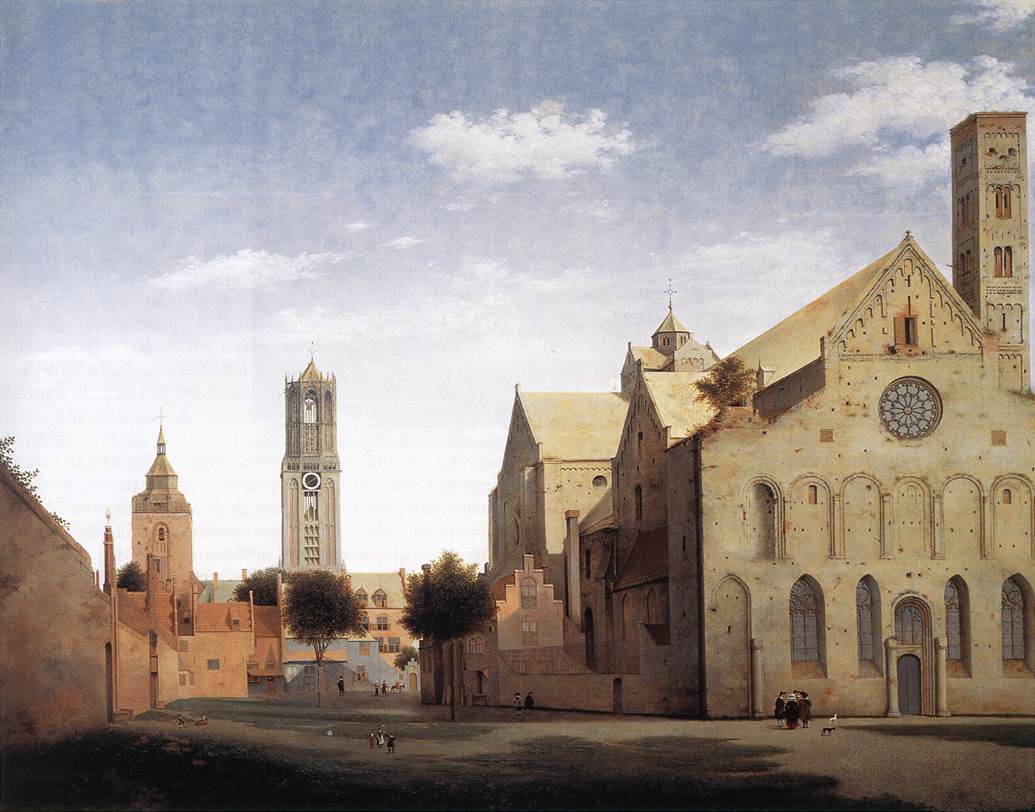
In this outstanding architectural view, painted three years before the artist's death and one of the masterpieces of his maturity, Saenredam shows the almost deserted Mariaplaats on a quiet summer's afternoon. The twelfth-century Mariakerk is on the right: in the middle of the GothicGothic, which may well have originated with Alberti as a derogatory term and which certainly corresponds to Vasari's 'maniera tedesca' ('German style'), is properly the descriptive term for an artistic style which achieved its first full flowering in the Ile de France and the surrounding areas in the period between c. 1200 and c. 1270, and which then spread throughout northern Europe. It is characterized by the hitherto unprecedented integration of the arts of sculpture, painting, stained glass and architecture which is epitomized in the great cathedrals of Chartres, Amiens, and Reims or in the Sainte Chapelle in Paris. In all the arts the predominantly planar forms of the Romanesque are replaced by an emphasis on line. There is a transcendental quality, whether in the soaring forms of the pointed arches or in the new stress on the humanity of Christ, which similarly distinguishes it from the preceding Romanesque style. In thinking of Nicola (d. c. 1284) or Giovanni Pisano (d. after 1314) there is same danger of forgetting what had happened in French sculpture half a century or more earlier, and likewise it is hard to remember that the spectacular achievements of early Renaissance art are a singularly localized eddy in the continuing stream of late gothic European art. By northern European standards few Italian works of art can be called gothic without qualification, and the story of 13th and 14th century Italian architecture is as much one of resistance to the new style as of its reception, whether directly from France or through German or central European intermediaries. In sculpture and in painting, the Italian reluctance to distort the human figure, conditioned by a never wholly submerged awareness of the omnipresent antique heritage, gives a special quality to the work of even those artists such as Giovanni Pisano or Simone Martini who most closely approached a pure gothic style. Nevertheless, the vitalizing role of Northern gothic art throughout the early Renaissance and the period leading up to it should never be underestimated. The artistic, like the cultural and commercial, interaction was continuous and much of the Italian achievement is incomprehensible if seen in isolation. It is not merely at the level of direct exchanges between one artist and another, or the influence of one building; painting, manuscript or piece of sculpture upon another, that the effects are to be felt. The streaming quality of line which is so characteristic of Brunelleschi's early Renaissance architecture surely reflects a sensitivity to the gothic contribution which is entirely independent of, and lies much deeper than, the superficial particularities of form. The counterflow of influence and inspiration from South to North must likewise not be underrated. In particular, the contribution of Italian painters from Duccio and Simone Martini onwards is central to the evolution of the so-called International Gothic style developing in Burgundy, Bohemia and north Italy in the late 14th and early 15th centuries. rose windowa circular window, usually large, filled with tracery. in the RomanesqueStyle of art and architecture prevailing throughout most of Europe in the 11th and 12th centuries, the first style to achieve such international currency. The dominant art of the Middle Ages was architecture, and 'Romanesque', like 'Gothic', is primarily an architectural term that has been extended to the other arts of the period. As the name suggests, it indicates a derivation from Roman art, and sometimes Romanesque is used to cover all the developments from Roman architecture in the period from the collapse of the Roman Empire until the flowering of the Gothic roughly AD 500-1200. More usually, however, it is applied to a distinctive style that emerged, almost simultaneously, in several countries - France, Germany, Italy, Spain - in the 11th century. It is characterized most obviously by a new massiveness of scale, reflecting the greater political and economic stability that followed a period when Christian civilization seemed in danger of extinction. Romanesque painting and sculpture are generally strongly stylized, with little of the naturalism and humanistic warmth of classical or later Gothic art. The forms of nature are freely translated into linear and sculptural designs which are sometimes majestically calm and severe and at others are agitated by a visionary excitement that can become almost delirious. Because of its expressionistic distortion of natural form, Romanesque art, as with other great non-naturalistic styles of the past, has had to wait for the revolution in sensibility brought about by the development of modern art in order to be widely appreciated. facade is the golden crown commemorating Emperor Hendrick IV (1050-1106). On the left is a high wall with gates which opened onto the gardens of houses belonging to the deans of the chapter of St Mary. In the background is a row of houses with stepped gables and rising above them are the towers of the Buurkerk on the left, with its wooden roof, and the CathedralThe principal church of a province or diocese, where the throne of the bishop is placed. For reasons lost to time and tradition, a cathedral always faces west - toward the setting sun. The altar is placed at the east end. The main body, or nave, of the cathedral is usually divided into one main and two side aisles. These lead up to the north and south transepts, or arms of the cross, the shape in which a cathedral is usually formed., with its slender octagonal lanterna windowed turret set on a dome or roof, used to provide light to the area below.. The painting is signed and dated above the door of the church.
Pieter Saenredam, the son of the distinguished engraver Jan Saenredam, was a painter of church interiors and topographical views. Born in Assendelft, he was taken as child to Haarlem and remained there for the rest of his life, entering the guildAn association of the masters of a particular craft, trade or profession (painters, goldsmiths, surgeons, and so on) set up to protect its members' rights and interests. Such guilds existed in virtually every European city in the 16th century. The guild also monitored standards of work, acted as a court for those who brought their trade into disrepute, and provided assistance to members in need. as a master in 1623. He made very precise architectural drawings which he then transferred to panelTerm in painting for a support of wood, metal, or other rigid substance, as distinct from canvas. Until the adoption of canvas in the 15th century nearly all the movable paintings of Europe were executed on wood, and even up to the beginning of the 17th century it is probable that as much painting was done on the one support as on the other. Painters who worked on a small scale often used copper panels (Elsheimer is a leading example), and in the colonial art of South America copper and tin and even lead and zinc were used. On a larger scale, slate has occasionally been used as a support, notably by Rubens for his altarpiece for Sta Maria in Vallicella (the Chiesa Nuova) in Rome; the picture he originally painted was said to reflect the light unpleasantly and slate was used for the replacement to produce a more matt finish. For wood panels the Italian masters of the Renaissance preferred white poplar, while oak was the most common wood used in northern Europe. Many other types were used, however; analysis of the contents of art galleries has yielded a long list, including beech, cedar, chestnut, fir, larch, linden, mahogany, olive, and walnut. In the 20th century cedar, teak, and dark walnut are favourites, and modern painters have also used plywood, fibre-board, and other synthetic materials as supports. or canvasA woven cloth used as a support for painting. The best-quality canvas is made of linen; other materials used are cotton, hemp, and jute. It is now so familiar a material that the word 'canvas' has become almost a synonym for an oil painting, but it was not until around 1500 that it began to rival the wooden panel (which was more expensive and took longer to prepare) as the standard support for movable paintings (the transition came later in Northern Europe than in Italy). Canvas is not suitable for painting on until it has been coated with a ground, which isolates the fabric from the paint; otherwise it will absorb too much paint, only very rough effects will be obtainable, and parts of the fabric may be rotted by the pigments. It must also be made taut on a stretcher or by some other means., sometimes making small modifications for compositional reasons. As was his usual method of work, Saenredam based this painting on a detailed drawing made (as he notes in a lengthy inscription) 'from life' on 18 September 1636, in brown inkColoured fluid used for writing, drawing, or printing. Inks usually have staining power without body, but printers' inks are pigments mixed with oil and varnish, and are opaque. The use of inks goes back in China and Egypt to at least 2500 BC. They were usually made from lampblack (a pigment made from soot) or a red ochre ground into a solution of glue or gums. These materials were moulded into dry sticks or blocks, which were then mixed with water for use. Ink brought from China or Japan in such dry form came to be known in the West as 'Chinese ink' or 'Indian ink'. The names are also given to a similar preparation made in Europe. and watercolourPigment ground in gum, usually gum arabic, and applied with brush and water to a painting surface, usually paper; the term also denotes a work of art executed in this medium. The pigment is ordinarily transparent but can be made opaque by mixing with a whiting and in this form is known as body colour, or gouache; it can also be mixed with casein, a phosphoprotein of milk. Watercolour compares in range and variety with any other painting method. Transparent watercolour allows for a freshness and luminosity in its washes and for a deft calligraphic brushwork that makes it a most alluring medium. There is one basic difference between transparent watercolour and all other heavy painting mediums - its transparency. The oil painter can paint one opaque colour over another until he has achieved his desired result. The whites are created with opaque white. The watercolourist's approach is the opposite. In essence, instead of building up he leaves out. The white paper creates the whites. The darkest accents may be placed on the paper with the pigment as it comes out of the tube or with very little water mixed with it. Otherwise the colours are diluted with water. The more water in the wash, the more the paper affects the colours; for example, vermilion, a warm red, will gradually turn into a cool pink as it is thinned with more water. The dry-brush technique - the use of the brush containing pigment but little water, dragged over the rough surface of the paper - creates various granular effects similar to those of crayon drawing. Whole compositions can be made in this way. This technique also may be used over dull washes to enliven them.. (The drawing is today in the Teylers Museum, Haarlem.) Saenredam, using the drawing twenty-six years after he had made it, drew a grid on the panel in order to transfer the composition from the drawing to scale. In some areas of the picture, for example beneath the rose window, the construction lines can be seen through a thin layer of transparent paint.