03 — ARTWORK
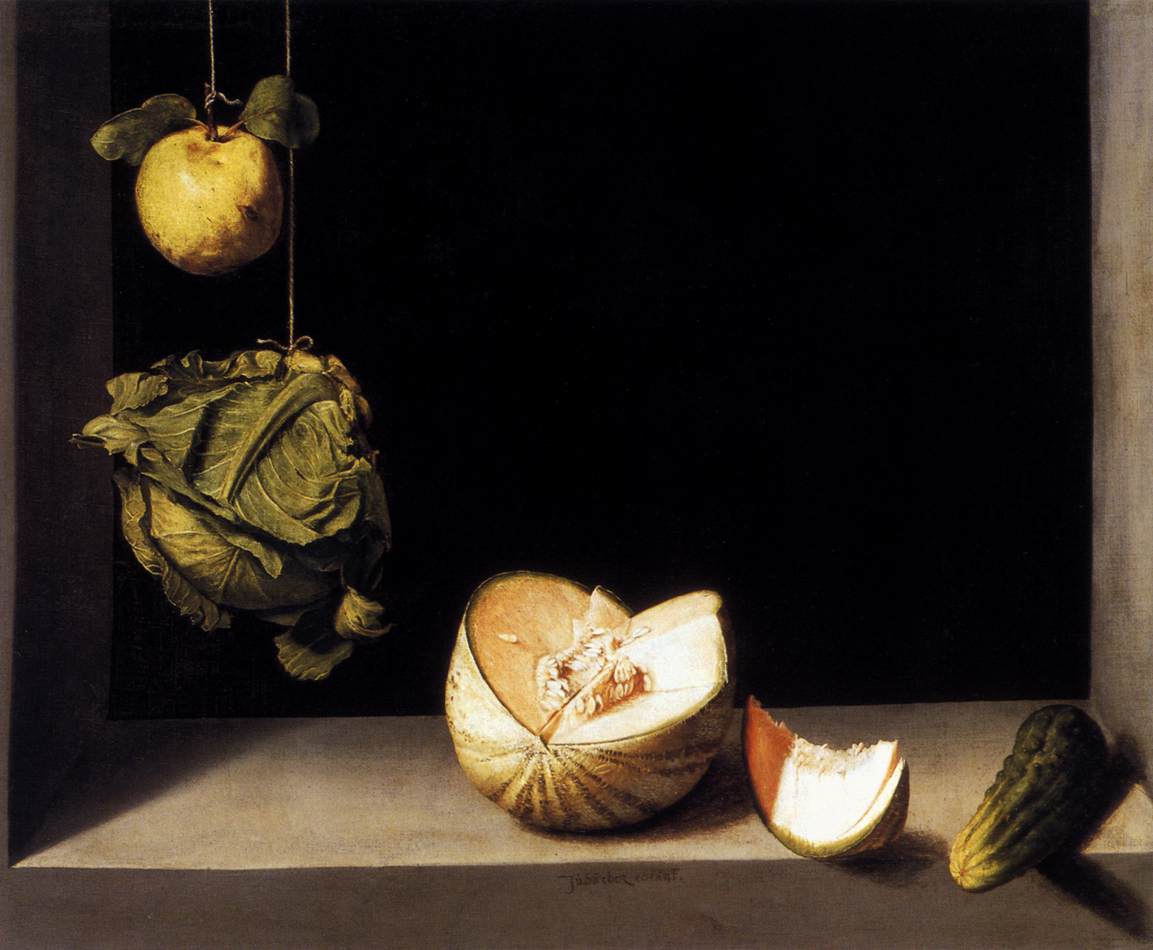
Still-life with Quince, Cabbage, Melon and Cucumber
- MEDIUM
- Oil on canvas, 69 x 85 cm
- TYPE
- Still-Life
PALETTE
HOVER OR TAP A SWATCH FOR NAME, SHARE AND HEX. SAMPLED FROM THE IMAGE — INDICATIVE, NOT A PIGMENT ANALYSIS.
DEVELOPMENT BUILD — NOT FOR PUBLIC USE. CONTRIBUTE ON GITHUB.
03 — ARTWORK
PALETTE
HOVER OR TAP A SWATCH FOR NAME, SHARE AND HEX. SAMPLED FROM THE IMAGE — INDICATIVE, NOT A PIGMENT ANALYSIS.
COMMENTARY
UNDERLINED TERMS ARE DEFINED IN THE GLOSSARY.
Still-life with Quince, Cabbage, Melon and Cucumber c. 1600 Oil on canvasA woven cloth used as a support for painting. The best-quality canvas is made of linen; other materials used are cotton, hemp, and jute. It is now so familiar a material that the word 'canvas' has become almost a synonym for an oil painting, but it was not until around 1500 that it began to rival the wooden panel (which was more expensive and took longer to prepare) as the standard support for movable paintings (the transition came later in Northern Europe than in Italy). Canvas is not suitable for painting on until it has been coated with a ground, which isolates the fabric from the paint; otherwise it will absorb too much paint, only very rough effects will be obtainable, and parts of the fabric may be rotted by the pigments. It must also be made taut on a stretcher or by some other means., 69 x 85 cm San Diego Museum of Art, San Diego
Sanchez Cotan studied in Toledo and here he established the prototype of the Spanish still-life composed mainly from vegetables.
Everyday objects: a melon, cut open to reveal its pale pink flesh, a knobby cucumber, a yellow quince that is past its best, a cabbage with thick leaves. Parallel to the picture planeIn the imaginary space of a picture, the plane occupied by the physical surface of the work. Perspective appears to recede from the picture plane, and objects painted in trompe-l'oeil may appear to project from it., a smooth frame delineates the opening for a window. From the direction of the spectator, light falls upon the parapet, on which the slice of melon and the cucumber are placed so that they jut over slightly and thereby they seem to be almost within reach - a trompe l'oeil effect that was particularly popular in Netherlandish painting in the 17th century. The head of cabbage and the quince, suspended on threads that presumably have been attached to the upper frame, are dangling over the gaping darkness.
Even if the objects are arranged so that they seem close enough to touch, they are nevertheless distanced. For all the naturalismGeneric term for scientific positions supported by natural insights. In fine arts and literature between approximately 1870 and 1900, Naturalism tried to reproduce the reality comprehended through sensory experience as realistically as possible, i.e. without idealising the object, but with scientific precision. In contrast to Realism, which was also based on the accurate description of natural occurrences, Naturalism concerns itself with the sensual dimensions of observation, whereby questions of morality and social criticism come to the fore. The spokesman for literary Naturalism was Emile Zola, who believed the artistic methods provided evidence of human existence. with which they are depicted, the isolation of each object, heightened further by the black background, makes each of them seem extremely artificial and lends them a monumental, almost sculptural gravity. The centre of the picture is empty and the arrangement seems coincidental; the dimension of the painted picture is denied. The disturbing evocation of the painted picture is the main theme.
@online{wga-r405318311b38a9,
  author       = {Krén, Emil and Marx, Daniel},
  title        = {Still-life with Quince, Cabbage, Melon and Cucumber by SANCHEZ COTÁN, Juan},
  organization = {{Web Gallery of Art}},
  date         = {2026-09-13},
  url          = {https://beta.wga.hu/artists/sanchez-cotn-juan-r419011d55dabea/still-life-with-quince-cabbage-melon-and-cucumber-r405318311b38a9},
  urldate      = {2026-09-13},
  langid       = {english}
}
ACCESSED 2026-09-13. REPLACE THE AUTHOR FIELD WITH THE COMMENTARY AUTHOR WHERE ONE IS NAMED.
The archive catalogues no further works by this artist.
TRY SAME COLLECTION →

