03 — ARTWORK
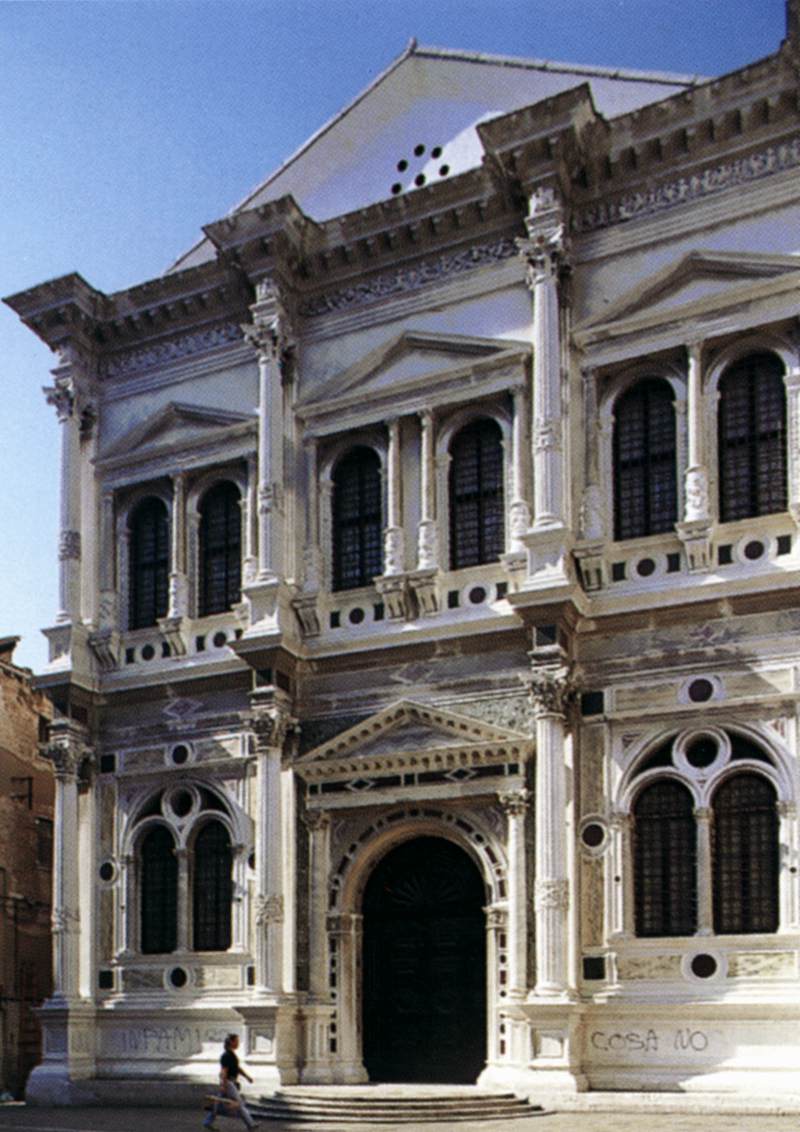
Scuola Grande di San Rocco: Façade
- MEDIUM
- Photo
- TYPE
- Other
PALETTE
HOVER OR TAP A SWATCH FOR NAME, SHARE AND HEX. SAMPLED FROM THE IMAGE — INDICATIVE, NOT A PIGMENT ANALYSIS.
DEVELOPMENT BUILD — NOT FOR PUBLIC USE. CONTRIBUTE ON GITHUB.
03 — ARTWORK
PALETTE
HOVER OR TAP A SWATCH FOR NAME, SHARE AND HEX. SAMPLED FROM THE IMAGE — INDICATIVE, NOT A PIGMENT ANALYSIS.
COMMENTARY
UNDERLINED TERMS ARE DEFINED IN THE GLOSSARY.
The Scuola Grande di San Rocco is the best preserved, as regards the architecture and fittings, of Venice's six Scuole Grandi (Major GuildsGuilds were essentially associations of masters in particular crafts, trades, or professions. In Italy they go back a long way; there is documentary evidence of guilds in 6th century Naples. In origin they were clubs which observed religious festivals together and attended the funerals of their members, but in time they acquired other functions. Their economic function was to control standards and to enforce the guild's monopoly of particular activities in a particular territory. Their political function was to participate in the government of the city-state. In some cities, notably Florence in the 14th century, only guildsmen were eligible for civic office, thus excluding both noblemen (unless they swallowed their pride and joined, as some did), and unskilled workers like the woolcombers and dyers. In Florence in 1378 these groups demanded the right to form their own guilds, and there were similar movements of protest in Siena and Bologna. Guilds were also patrons of art, commissioning paintings for guildhalls, contributing to the fabric fund of cathedrals and collaborating on collective projects like the statues for Orsanmichele at Florence. The guilds were not equal. In Florence, the 7 'Greater Guilds', including such prestigious occupations as judges and bankers, outranked the 14 'Lesser Guilds', and in general the guild hierarchy was reflected in the order of precedence in processions. The great age of the guilds was the 13th and 14th centuries. The economic recession after 1348 meant fewer opportunities for journeymen to become masters, and greater hostility between master and man. The shift from trade to land in the 15th and 16th centuries meant a decline in the social standing of the crafts. In some towns, such as Brescia and Vicenza, guild membership actually became a disqualification instead of a qualification for municipal office. The guilds lost their independence and became instruments of state control. In 16th century Venice, for example, they were made responsible for supplying oarsmen for the galleys of the state.) which for many centuries, together with the minor ConfraternitiesConfraternities, often called compagnie or, in Venice, scuole, were religious associations of lay persons devoted to specific pious practices or works of charity, often under the direction of, or with the spiritual assistance of, clergy. Guilds 'qua' religious associations had the character of confraternities. Several major historic waves of foundations can be distinguished. (1) Compagnie dei disciplinati or dei laudesi, i.e. flagellant confraternities, which were conformist offshoots of the partly heterodox flagellant movement of 1260. The Venetian scuole grandi were especially prestigious examples. By the 16th century, although flagellant practices were retained in some cases, these functioned more as mutual aid societies and as administrators of charitable funds. (2) Confraternite del Rosario, which spread in the 15th century, being primarily promoted by the Dominicans. (3) A group of confraternities which spread from the mid-15th century, commonly called either Compagnia di S. Girolamo or Compagnia del Divino Amore ('Company of Divine Love'; perhaps the first example was the Florentine Buonuomini di S. Martino), associated with certain specialized charitable enterprises, in the first place relief of the poveri vergognosi or 'shamefaced poor', i.e. respectable people who had to be aided discreetly. In the 16th century they also promoted hospitals of the incurabili, primarily for syphilitics, convents of convertite, i.e. reformed prostitutes, and refuges for maidens. To this movement belonged the famous Roman Company or Oratory of Divine Love, founded c. 1514 in S. Dorotea in Trastevere. This recruited some leading churchmen and papal officials (as a confraternity it was unusual in its heavy clerical membership), but many ascriptions of leading church reformers to it are without sound foundation and there is no basis for its reputation as a seminal body in the Catholic reform movement. The new congregation of the Clerks Regular called Theatines was, however, an offshoot and these took the lead in propagating Compagnie del Divino Amore in Italy. Other types of confraternity were those of the buona morte, which accompanied condemned prisoners, and those which aided imprisoned debtors, e.g. the Florentine Neri. Confraternities commonly had chapels in parish churches or in the churches of religious orders, but sometimes had their own premises, e.g. the splendid ones of the Venetian scuole grandi; in Florence, the hall of Orsanmichele housed a devotional and almsgiving confraternity as well as being a grain dispensary. Great confraternities might exercise public functions: certain Florentine ones concerned with welfare became effectively state magistracies, while the Venetian government, in addition to giving them a ceremonial role, relied upon the scuole grandi to distribute funds. Confraternities, notwithstanding their location, tended to be manifestations of lay piety independent of ecclesiastical institutions, or at least outside the framework of the parish and the diocese., formed the thick network of brotherhoods of a religious nature. These were set up to help the poor and the sick, or to protect the interests of individual professions, or to help the weak and needy members of non-Venetian communities living in the city.
The guildAn association of the masters of a particular craft, trade or profession (painters, goldsmiths, surgeons, and so on) set up to protect its members' rights and interests. Such guilds existed in virtually every European city in the 16th century. The guild also monitored standards of work, acted as a court for those who brought their trade into disrepute, and provided assistance to members in need. dedicated to San Rocco of Montpellier who died in Piacenza in 1327 and whose remains are thought to have been brought to Venice in 1485, was legally recognized in 1478. Its aim was to relieve the suffering of the sick, especially those stricken by the epidemics.
The present building of the Scuola was begun in 1517 by Bartolomeo Bon who designed it and supervised the work until 1524. In 1524 his work was continued by Sante Lombardo, who, in turn, three years later was replaced by Scarpagnino. Following his death in 1549, the last architect giving the final touches to the building was Giovanni Giacomo de' Grigi, finishing in September 1560.
@online{wga-rbf7cc719210e50,
  author       = {Krén, Emil and Marx, Daniel},
  title        = {Scuola Grande di San Rocco: Façade by SCARPAGNINO},
  organization = {{Web Gallery of Art}},
  date         = {2026-09-09},
  url          = {https://beta.wga.hu/artists/scarpagnino-ra5fcb0cd728f5d/scuola-grande-di-san-rocco-faade-rbf7cc719210e50},
  urldate      = {2026-09-09},
  langid       = {english}
}
ACCESSED 2026-09-09. REPLACE THE AUTHOR FIELD WITH THE COMMENTARY AUTHOR WHERE ONE IS NAMED.


The archive catalogues no further works by this artist.
TRY SAME COLLECTION →