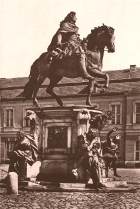
German sculptor and architect, active mainly in Berlin. Influenced by the Italian sculptors Michelangelo and Bernini, Schlüter worked in carved stone, cast bronzeGLOSSARYAn alloy of copper (usually about 90 per cent) and tin, often also containing small amounts of other metals such as lead or zinc. Since antiquity it has been the metal most commonly used in cast sculpture because of its strength, durability, and the fact that it is easily workable - both hot and cold - by a variety of processes. It is easier to cast than copper because it has a lower melting-point, and its great tensile strength makes possible the protrusion of unsupported parts - an advantage over marble sculpture. The colour of bronze is affected by the proportion of tin or other metals present, varying from silverish to a rich, coppery red, and its surface beauty can be enhanced when it acquires a patina., and stuccoGLOSSARYA type of light, malleable plaster made from dehydrated lime (calcium carbonate) mixed with powdered marble and glue and sometimes reinforced with hair. It is used for sculpture and architectural decoration, both external and internal. In a looser sense, the term is applied to a plaster coating applied to the exterior of buildings, but stucco is a different substance from plaster (which is calcium sulphate). Stucco in the more restricted sense has been known to virtually every civilization. In Europe it was exploited most fully from the 16th century to the 18th century, notable exponents being the artists of the School of Fontainebleau and Giacomo Serpotta. By adding large quantities of glue and colour to the stucco mixture stuccatori were able to produce a material that could take a high polish and assume the appearance of marble. Indeed, sometimes it is difficult to distinguish from real marble without touching it (stucco feels warmer). reliefGLOSSARYA sculptural work in which all or part projects from the flat surface. There are three basic forms: low relief (bas-relief, basso rilievo), in which figures project less than half their depth from the background; medium relief (mezzo-rilievo), in which figures are seen half round; and high relief (alto rilievo), in which figures are almost detached from their background.. He was the leading BaroqueGLOSSARYThe period in art history from about 1600 to about 1750. In this sense the term covers a wide range of styles and artists. In painting and sculpture there were three main forms of Baroque: (1) sumptuous display, a style associated with the Catholic Counter Reformation and the absolutist courts of Europe (Bernini, Rubens); (2) dramatic realism (Caravaggio); and (3) everyday realism, a development seen in particular in Holland (Rembrandt, Vermeer). In architecture, there was an emphasis on expressiveness and grandeur, achieved through scale, the dramatic use of light and shadow, and increasingly elaborate decoration. In a more limited sense the term Baroque often refers to the first of these categories. The development of the Baroque reflects the period's religious tensions (Catholic versus Protestant); a new and more expansive world view based on science and exploration; and the growth of absolutist monarchies. sculptor in northern Germany, and his masterpieceGLOSSARYA term now loosely applied to the finest work by a particular artist or to any work of art of acknowledged greatness or of preeminence in its field. Originally it meant the piece of work by which a craftsman, having finished his training, gained the rank of'master' in his guild. is the splendid equestrian monument to the Great ElectorGLOSSARYone of the German princes who elected the emperor of the Holy Roman Empire. From the middle of the 14th century there were seven Electors; the king of Bohemia, the duke of Saxony, the count Palatine of the Rhine, the margrave of Brandenburg, and the archbishops of Mainz, Trier and Cologne. Friedrich-Willem (Charlottenburg Castle, Berlin, 1696-1708). Schlüter's most successful architectural work was the New Palace in Berlin (1706, destroyed in World War II).
He fell under a cloud when some of his architectural work collapsed, and he moved to St Petersburg, where he died soon after arriving.