03 — ARTWORK
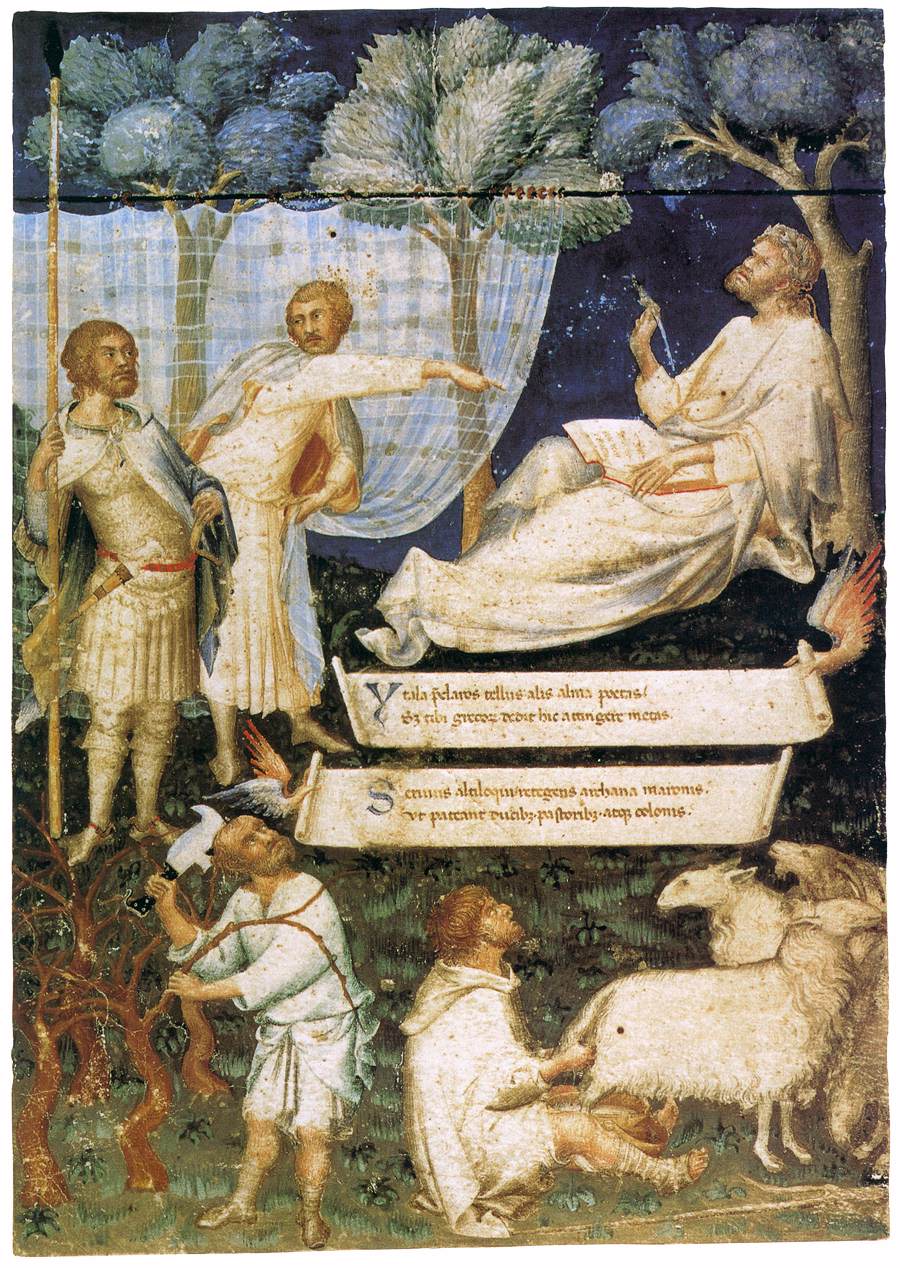
Petrarch's Virgil (title page)
- MEDIUM
- Manuscript (Ms. Sp. 10. N. 27), 295 x 200 mm
- TYPE
- Other
PALETTE
HOVER OR TAP A SWATCH FOR NAME, SHARE AND HEX. SAMPLED FROM THE IMAGE — INDICATIVE, NOT A PIGMENT ANALYSIS.
DEVELOPMENT BUILD — NOT FOR PUBLIC USE. CONTRIBUTE ON GITHUB.
03 — ARTWORK
PALETTE
HOVER OR TAP A SWATCH FOR NAME, SHARE AND HEX. SAMPLED FROM THE IMAGE — INDICATIVE, NOT A PIGMENT ANALYSIS.
COMMENTARY
UNDERLINED TERMS ARE DEFINED IN THE GLOSSARY.
Petrarch's Virgil (title page) c. 1336 Manuscriptcollective term for books or other documents written by hand; in a specific sense, the hand-written medieval book, the Codex manuscriptus, often ornamented with decorative borders, illuminated initials and miniatures, and containing works of ancient philosophy or scholarly, ecclesiastical, and literary texts. Manuscripts were usually produced on commission. At first the scriptoria (writing rooms) of monasteries transcribed the contents of famous manuscripts and made copies. Monastic communities in the Netherlands and northern Germany began producing manuscripts around 1383/84. Flanders, Burgundy, and in particular Paris became major centres for the mass production of breviaries (prayer books) and Books of Hours. (Ms. Sp. 10. N. 27), 295 x 200 mm Biblioteca Ambrosiana, Milan
Thanks to Petrarch's sonnets we know that the poet and the painter became very good friends. Simone must undoubtedly have been influenced by the proto-Humanist cultural world of Petrarch, and we can see clearly how the manuscript illuminationThe decoration of manuscripts, one of the most common forms of medieval art; because of its monastic origins, usually of religious texts. The practice extends from heavy decorations of initial letters and inter-woven margin patterns (as in Celtic examples) to miniatures and and full-page illuminations, often of a formal and grandiose kind (as in Byzantine manuscripts). Rich colors are a common feature, in particular a luxirious use of gold and silver. Illuminations survived the advent of printing for some time and only died out with the rise of printed illustration in the 16 century. of Petrarch's Virgil in the Biblioteca Ambrosiana in Milan (folio 1v), with its classicalRelating to the culture of ancient Greece and Rome (classical Antiquity). The classical world played a profoundly important role in the Renaissance, with Italian scholars, writers, and artists seeing their own period as the rebirth (the "renaissance") of classical values after the Middle Ages. The classical world was considered the golden age for the arts, literature, philosophy, and politics. Concepts of the classical, however, changed greatly from one period to the next. Roman literature provided the starting point in the 14th century, scholars patiently finding, editing and translating a wide range of texts. In the 15th century Greek literature, philosophy and art - together with the close study of the remains of Roman buildings and sculptures-expanded the concept of the classical and ensured it remained a vital source of ideas and inspiration. and naturalistic overtones (sophisticated gestures, white cloth drapery, the delicate figures of the shepherd and the peasant), anticipates the typical style of early 15th-century French manuscript illumination.
@online{wga-ra09ffe8eb35788,
  author       = {Krén, Emil and Marx, Daniel},
  title        = {Petrarch's Virgil (title page) by SIMONE MARTINI},
  organization = {{Web Gallery of Art}},
  date         = {2026-09-13},
  url          = {https://beta.wga.hu/artists/simone-martini-r98befbdf9e7c79/petrarchs-virgil-title-page-ra09ffe8eb35788},
  urldate      = {2026-09-13},
  langid       = {english}
}
ACCESSED 2026-09-13. REPLACE THE AUTHOR FIELD WITH THE COMMENTARY AUTHOR WHERE ONE IS NAMED.


