03 — ARTWORK
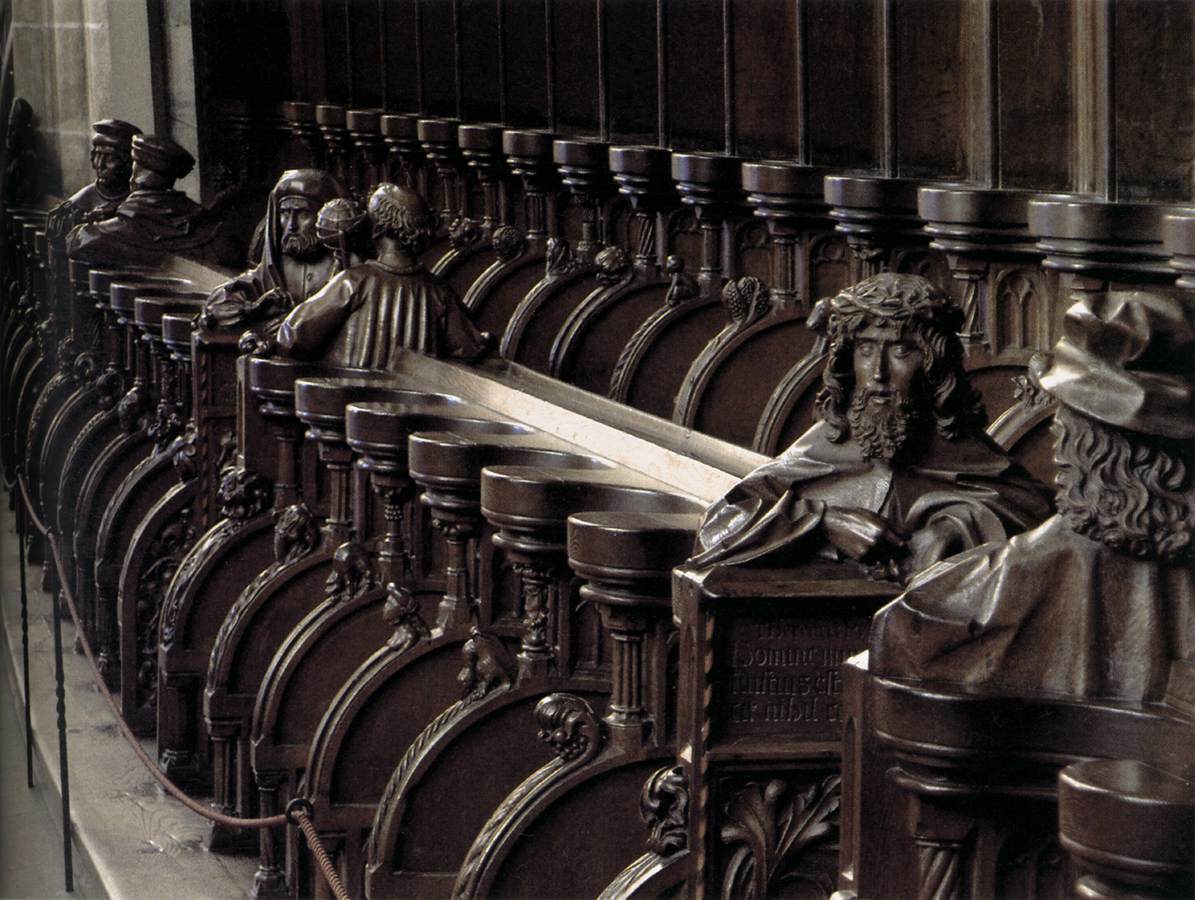
Choir stalls
SYRLIN, Jörg the Elder · 1474 →
- MEDIUM
- Oak
- TYPE
- Religious
PALETTE
HOVER OR TAP A SWATCH FOR NAME, SHARE AND HEX. SAMPLED FROM THE IMAGE — INDICATIVE, NOT A PIGMENT ANALYSIS.
DEVELOPMENT BUILD — NOT FOR PUBLIC USE. CONTRIBUTE ON GITHUB.
03 — ARTWORK
SYRLIN, Jörg the Elder · 1474 →
PALETTE
HOVER OR TAP A SWATCH FOR NAME, SHARE AND HEX. SAMPLED FROM THE IMAGE — INDICATIVE, NOT A PIGMENT ANALYSIS.
COMMENTARY
UNDERLINED TERMS ARE DEFINED IN THE GLOSSARY.
In the years preceding his work on the high altar of Ulm's Münster, Jörg Syrlin the Elder lined its choirthe part of a church interior, usually raised and set apart from the rest of the church, reserved for the clergy to pray together, or for choral singing. Since Carolingian times, "choir" has been the word for the part of the central nave of the church extending over the crossing (the place where nave and transept intersect), and including the apse (a niche in the wall, roofed with a half dome) that often stands at the end of this area. with an elaborate set of wooden stalls. Eighty-nine seats are arranged in two rows on the north and south sides. Beyond the typical drolleries and ornamentation of the chairs, ninety busts of male and female saints, sibylsIn antiquity, women who could prophesy. The many Sibylline prophecies were kept in Rome and consulted by the Senate. In Christian legend, Sibyls foretold the Birth, Passion and Resurrection of Christ, just as the male prophets of the Bible did. Originally, in the period of classical antiquity, there was only one Sibyl; the number gradually rose to ten. In early Christianity it was further raised to 12, in analogy to the 12 prophets of the Old Testament., Old Testament figures and classicalRelating to the culture of ancient Greece and Rome (classical Antiquity). The classical world played a profoundly important role in the Renaissance, with Italian scholars, writers, and artists seeing their own period as the rebirth (the "renaissance") of classical values after the Middle Ages. The classical world was considered the golden age for the arts, literature, philosophy, and politics. Concepts of the classical, however, changed greatly from one period to the next. Roman literature provided the starting point in the 14th century, scholars patiently finding, editing and translating a wide range of texts. In the 15th century Greek literature, philosophy and art - together with the close study of the remains of Roman buildings and sculptures-expanded the concept of the classical and ensured it remained a vital source of ideas and inspiration. thinkers adorn the benches , the wall revetments and the overhanging canopies. The north side depicts men, while women (plus Sts Luke and Cosmas) occupy the south wall. For such a vast undertaking, Syrlin was aided by a team of sculptors and joiners. At the end of each group of stalls are fully carved busts of sibyls (south) and scholars (north).
The choir stallsthe rows of stepped seats on either side of the choir, facing inwards, for the use of the clergy. embody the collective wisdom and faith of classical, Jewish and Christian people.
@online{wga-rac99f4ce557b7b,
  author       = {Krén, Emil and Marx, Daniel},
  title        = {Choir stalls by SYRLIN, Jörg the Elder},
  organization = {{Web Gallery of Art}},
  date         = {2026-09-13},
  url          = {https://beta.wga.hu/artists/syrlin-jrg-the-elder-r55e247050a7e9d/choir-stalls-rac99f4ce557b7b},
  urldate      = {2026-09-13},
  langid       = {english}
}
ACCESSED 2026-09-13. REPLACE THE AUTHOR FIELD WITH THE COMMENTARY AUTHOR WHERE ONE IS NAMED.
The archive catalogues no further works by this artist.
TRY SAME COLLECTION →