03 — ARTWORK
Danaë
- MEDIUM
- Oil on canvas, 117 x 69 cm
- TYPE
- Mythological
PALETTE
HOVER OR TAP A SWATCH FOR NAME, SHARE AND HEX. SAMPLED FROM THE IMAGE — INDICATIVE, NOT A PIGMENT ANALYSIS.
DEVELOPMENT BUILD — NOT FOR PUBLIC USE. CONTRIBUTE ON GITHUB.
03 — ARTWORK
PALETTE
HOVER OR TAP A SWATCH FOR NAME, SHARE AND HEX. SAMPLED FROM THE IMAGE — INDICATIVE, NOT A PIGMENT ANALYSIS.
COMMENTARY
UNDERLINED TERMS ARE DEFINED IN THE GLOSSARY.
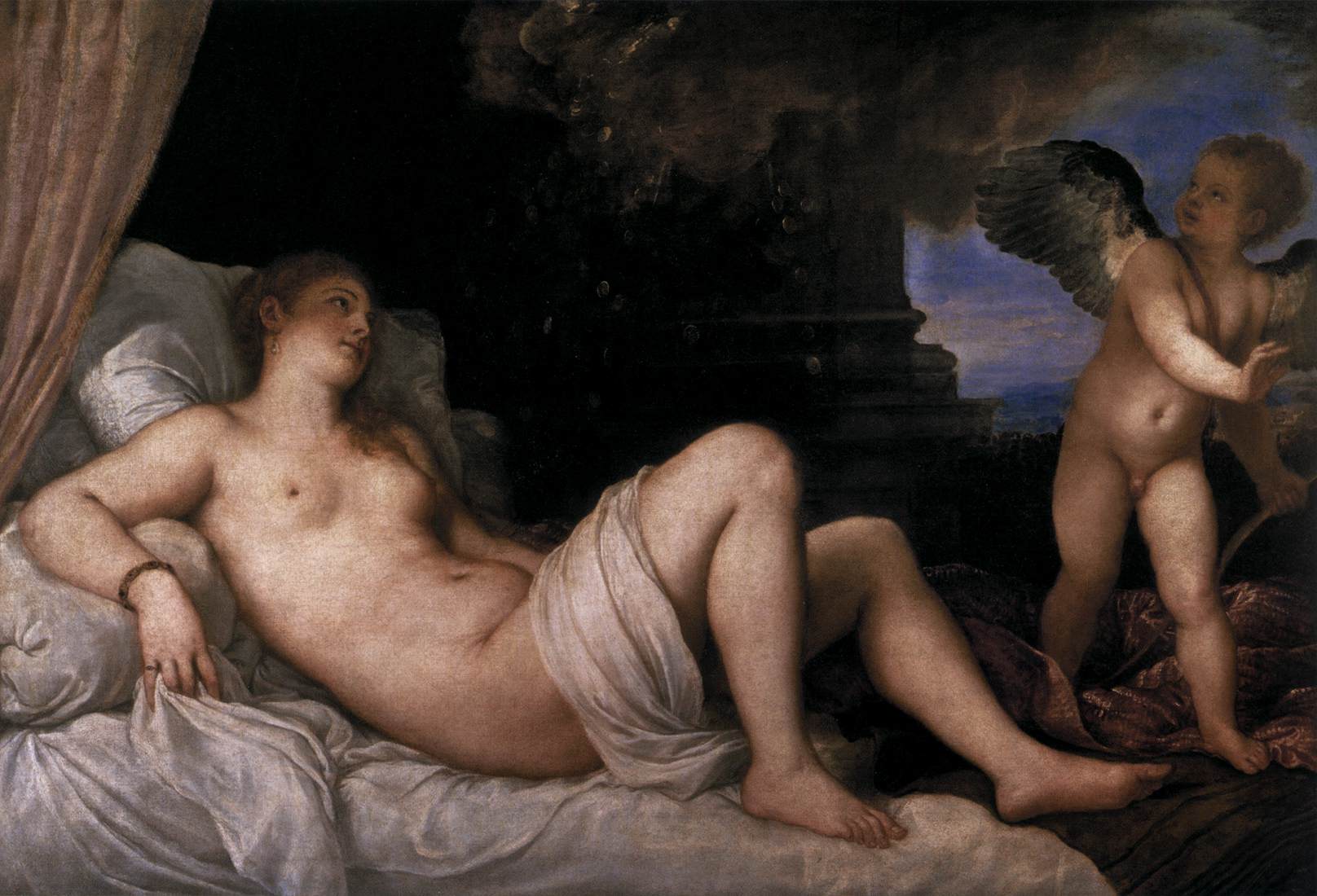
It was through Aretino in 1539 that Titian first offered his services to the family of the Farnese Pope Paul III. After painting the Pope's grandson Ranuccio in 1542, Titian's next commission for the family was a Danaë seduced by Jupiter in the guise of a shower of gold coin. He began the canvasA woven cloth used as a support for painting. The best-quality canvas is made of linen; other materials used are cotton, hemp, and jute. It is now so familiar a material that the word 'canvas' has become almost a synonym for an oil painting, but it was not until around 1500 that it began to rival the wooden panel (which was more expensive and took longer to prepare) as the standard support for movable paintings (the transition came later in Northern Europe than in Italy). Canvas is not suitable for painting on until it has been coated with a ground, which isolates the fabric from the paint; otherwise it will absorb too much paint, only very rough effects will be obtainable, and parts of the fabric may be rotted by the pigments. It must also be made taut on a stretcher or by some other means. in Venice in 1544 for Ranuccio's elder brother, Cardinal Alessandro Farnese, and when he left for Rome the following year, he took it with him to finish. Giorgio Vasari, the biographer and protege of Michelangelo, brought the Master to see it. The latter was full of compliments in Titian's presence, but according to Vasari later complained that, though he liked the colouring and style, "it was a pity that in Venice they never learned to draw and that their painters did not have a better method of study."
The pose is obviously Michelangelesque while the cupid is based on a statue in the style of Lysippus, which Titian would have known since it was already in Venice in the collection of Cardinal Grimani.
X-rays reveal an underlying composition close to the Venus of Urbino, but as a papal legate remarked to Cardinal Alessandro, the erotic Danaë made the Venus of Urbino look like "a Theatine nun". The model was reputedly the Cardinal's mistress, a courtesan named Angela.
@online{wga-r23514dfb333aac,
  author       = {Krén, Emil and Marx, Daniel},
  title        = {Danaë by TIZIANO Vecellio},
  organization = {{Web Gallery of Art}},
  date         = {2026-09-09},
  url          = {https://beta.wga.hu/artists/tiziano-vecellio-rf16f53052a933d/dana-r23514dfb333aac},
  urldate      = {2026-09-09},
  langid       = {english}
}
ACCESSED 2026-09-09. REPLACE THE AUTHOR FIELD WITH THE COMMENTARY AUTHOR WHERE ONE IS NAMED.


