03 — ARTWORK
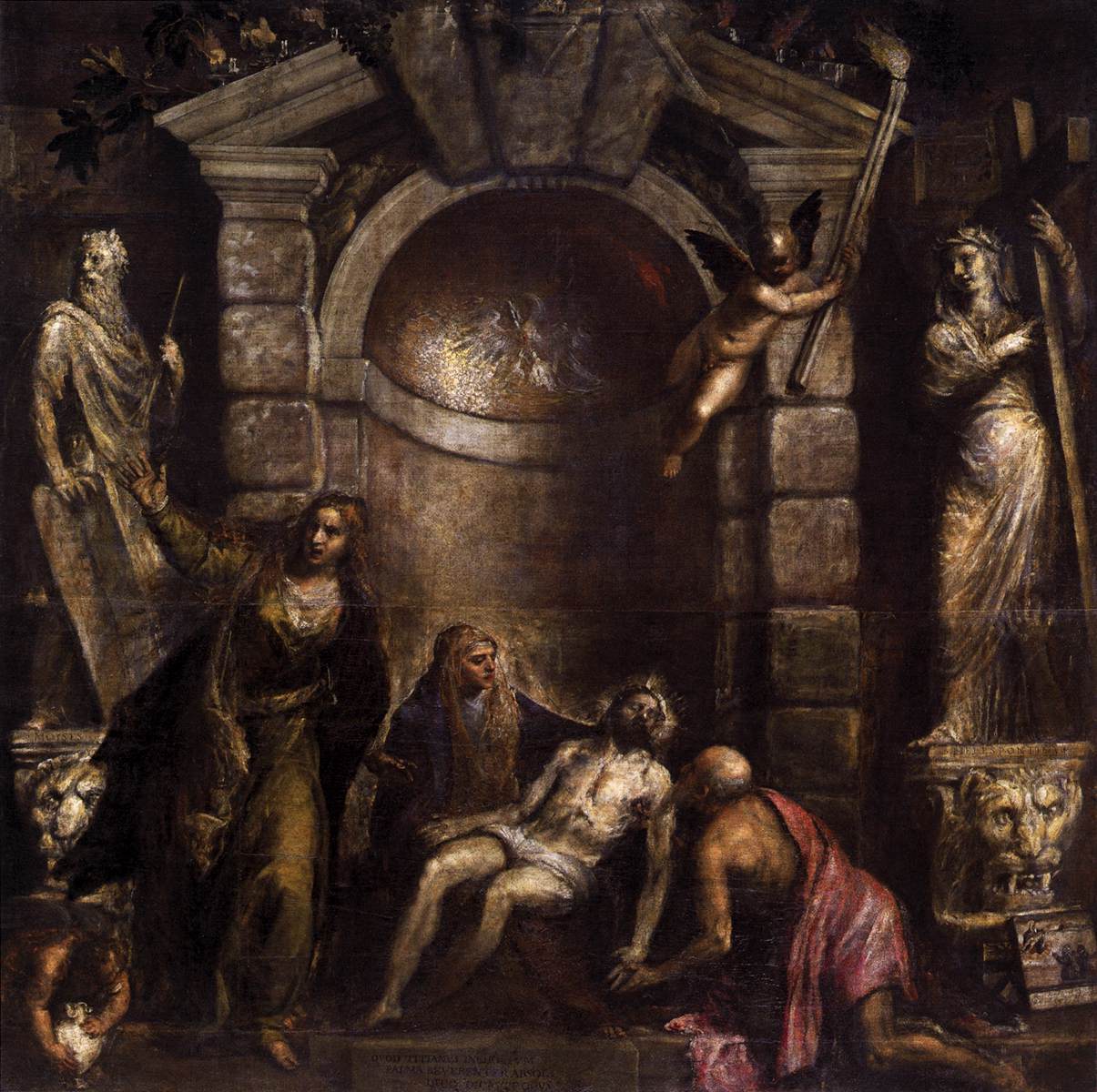
Pietà
- MEDIUM
- Oil on canvas, 352 x 349 cm
- TYPE
- Religious
PALETTE
HOVER OR TAP A SWATCH FOR NAME, SHARE AND HEX. SAMPLED FROM THE IMAGE — INDICATIVE, NOT A PIGMENT ANALYSIS.
DEVELOPMENT BUILD — NOT FOR PUBLIC USE. CONTRIBUTE ON GITHUB.
03 — ARTWORK
PALETTE
HOVER OR TAP A SWATCH FOR NAME, SHARE AND HEX. SAMPLED FROM THE IMAGE — INDICATIVE, NOT A PIGMENT ANALYSIS.
COMMENTARY
UNDERLINED TERMS ARE DEFINED IN THE GLOSSARY.
In the second half of the 16th century Titian was continually overburdened with commissions for work - from Charles V and Philip II, from the Republic and from many churches. Overcoming the crisis of MannerismA movement in Italian art from about 1520 to 1600. Developing out of the Renaissance, Mannerism rejected Renaissance balance and harmony in favor of emotional intensity and ambiguity. In Mannerist painting, this was expressed mainly through severe distortions of perspective and scale; complex and crowded compositions; strong, sometimes harsh or discordant colors; and elongated figures in exaggerated poses. In architecture, there was a playful exaggeration of Renaissance forms (largely in scale and proportion) and the greater use of bizarre decoration. Mannerism gave way to the Baroque. Leading Mannerists include Pontormo, Bronzino, Parmigianino, El Greco and Tintoretto. shortly before his stay in Rome at the Papal court (1545/6), Titian's work now took on a new incomparable coherence of vision and creative force. We witness the triumphWith growing interest from the early 14th century in the history of ancient Rome came a fascination with the city's conquests, the wars by which they were won - and the ceremony which marked their success: the victor's triumph. The knowledge that the privilege of being commemorated by one of these enormous and costly processions of warriors, loot and prisoners was given sparingly, only to the sole commander of a major victory over a foreign army of whom at least 5000 were slain, added to the glamour of the triumph. Its centrepiece was the chariot of the victor himself. Dante gave one to Beatrice in Purgatorio XXIX: 'Rome upon Africanus ne'er conferred / Nor on Augustus's self, a car so brave'. But it was tentatively with the relief carvings on the Triumphal Arch (1452-66) at Castelnuovo in Naples commemorating Alfonso the Magnanimous, and finally with Mantegna's superb Triumph of Caesar cartoons (Hampton Court), that the visual reconstruction of a Roman triumph became complete. Meanwhile, in an age which did not like the idea of large numbers of victory-flushed soldiers parading through its streets, the military triumph became sublimated, as it were, into a number of less controversial forms. This was largely under the influence of Petrarch's 'Trionfi' - poems describing the processions commemorating the triumphs of love, chastity, death; fame, time and eternity. Disseminated soon after his death, they soon appeared in illuminated manuscripts, and the triumph scene became a popular one for woodcuts, decorated marriage chests and other paintings, most beautifully of all on the backs of Piero della Francesca's portraits of Federigo da Montefeltro and his wife, Battista Sforza. Other 'triumphs' were invented: of the seasons, of virtues and of the arts. Nor was the theme allowed to be simply a profane one. Just before his death Savonarola published his 'Triumph of the Cross', in which the reader was invited to imagine 'a four-wheeled chariot on which is seated Christ as Conqueror.' Before it go the apostles, patriarchs and prophets, beside it the army of martyrs, behind it, after 'a countless number of virgins, of both sexes', come the prisoners: 'the serried ranks of the enemies of the Church of Christ.' This aspect of the theme was magnificently realized in Titian's great woodcut 'The Triumph of the Faith'. of colour and light over the Renaissance notions of sculptural form. In his later works Titian's handling of colour is suffused with spirituality; his youthful themes lose their Phidian serenity and from the burning rhythm of interwoven tones which melt slowly into the glowing tints images emerge, at times dramatic, at times full of emotion for lost earthly happiness.
In his PietàA depiction of the Virgin Mary with the crucified body of Jesus across her lap. Developing in Germany in the 14th century, the Pietà became a familiar part of Renaissance religious imagery. One of the best-known examples is Michelangelo's "Pietà" (1497-1500) in St. Peter's, Rome., originally planned for his tomb at the Frari and left unfinished at his death Titian achieves the high point of the expressive possibilities of his 'alchimia cromatica'. The work was completed by Palma il Giovane who added the torch-bearing cherubIn Jewish, Christian, and Islamic literature, a celestial winged being with human, animal, or birdlike characteristics; a throne bearer of the deity. Derived from ancient Near Eastern mythology and iconography, these celestial beings serve important liturgical and intercessory functions in the hierarchy of angels. Old Testament descriptions of the cherubim emphasize their supernatural mobility and their cultic role as throne bearers of God, rather than intercessory functions. In Christianity the cherubim are ranked among the higher orders of angels and, as celestial attendants of God, continually praise him.. The opaque density of this detail contrasts with the 'magical impressionismA style of painting that became prominent in the last quarter of the 19th century as a reaction to the ossified doctrine of the Academy and the content-oriented atelier, historical, and genre painting. The name is derived from the 1872 painting Impression, Sunrise by Claude Monet, and first was used by art critics as a mocking description for a group of artists excluded from the official Salon, but who had their own first group exhibition in 1874 at the salon of the Parisian photographer Nadar. Impressionism, as a new type of naturalism, negated classical pictorial methods; based on contemporary theories of physics, it indicated the natural object in a revolutionary fashion - entirely as a manifestation of colour. Their supreme principle was "plein-air" or open-air painting, through which the painters tried to capture a direct, spontaneous impression of what they saw.' of Titian's tonal harmonies. In the shimmering nocturnal scene figures of flesh and marbleloosely applied to any hard limestone that can be sawn into thin slabs and will take a good polish so that it is suitable for decorative work; more strictly, it refers to metamorphosed limestones whose structure has been recrystallized by heat or pressure. Marbles are widely disseminated and occur in a great variety of colours and patterns, but certain types have been particularly prized by sculptors. The most famous of Greek white marbles in the ancient world was the close-grained Pentelic, which was quarried at Mount Pentelicon in Attica. The Elgin Marbles are carved in Pentelic. Widely used also were the somewhat coarser-grained translucent white marbles from the Aegean islands of Paros and Naxos. Parian marble was used for the celebrated Mausoleum at Halicarnassus. The pure white Carrara marble, quarried at Massa, Carrara, and Pietra Santa in Tuscany from the 3rd century BC, is the most famous of all sculptors' stones. It was used for the Apollo Belvedere, and was much favoured in the Renaissance, particularly by Michelangelo, who often visited the quarries to select material for his work. Neoclassical sculptors also favoured Carrara marble because of its ability to take a smooth, sleek surface, but it can look rather 'dead' compared with some of the finest Greek marbles. are evoked by a suffusion of glowing colour. And along the diagonal formed by the figures we are witness to an outpouring of human passionThe events leading up to Good Friday, beginning with Christ's arrest and ending with his burial. Portrayals of the Passion, which focus on the Suffering Christ, include depictions of Judas betraying Christ with a kiss, Peter cutting off Malchus's ear, the crown of thorns, and so on.: Mary Magdalene turns in a cry of uncontrollable grief, the Virgin appears frozen in contemplation of her dead son and St Jerome leans forward to catch the last breath of Christ.
@online{wga-r220fe216d63263,
  author       = {Krén, Emil and Marx, Daniel},
  title        = {Pietà by TIZIANO Vecellio},
  organization = {{Web Gallery of Art}},
  date         = {2026-09-13},
  url          = {https://beta.wga.hu/artists/tiziano-vecellio-rf16f53052a933d/piet-r220fe216d63263},
  urldate      = {2026-09-13},
  langid       = {english}
}
ACCESSED 2026-09-13. REPLACE THE AUTHOR FIELD WITH THE COMMENTARY AUTHOR WHERE ONE IS NAMED.


