03 — ARTWORK
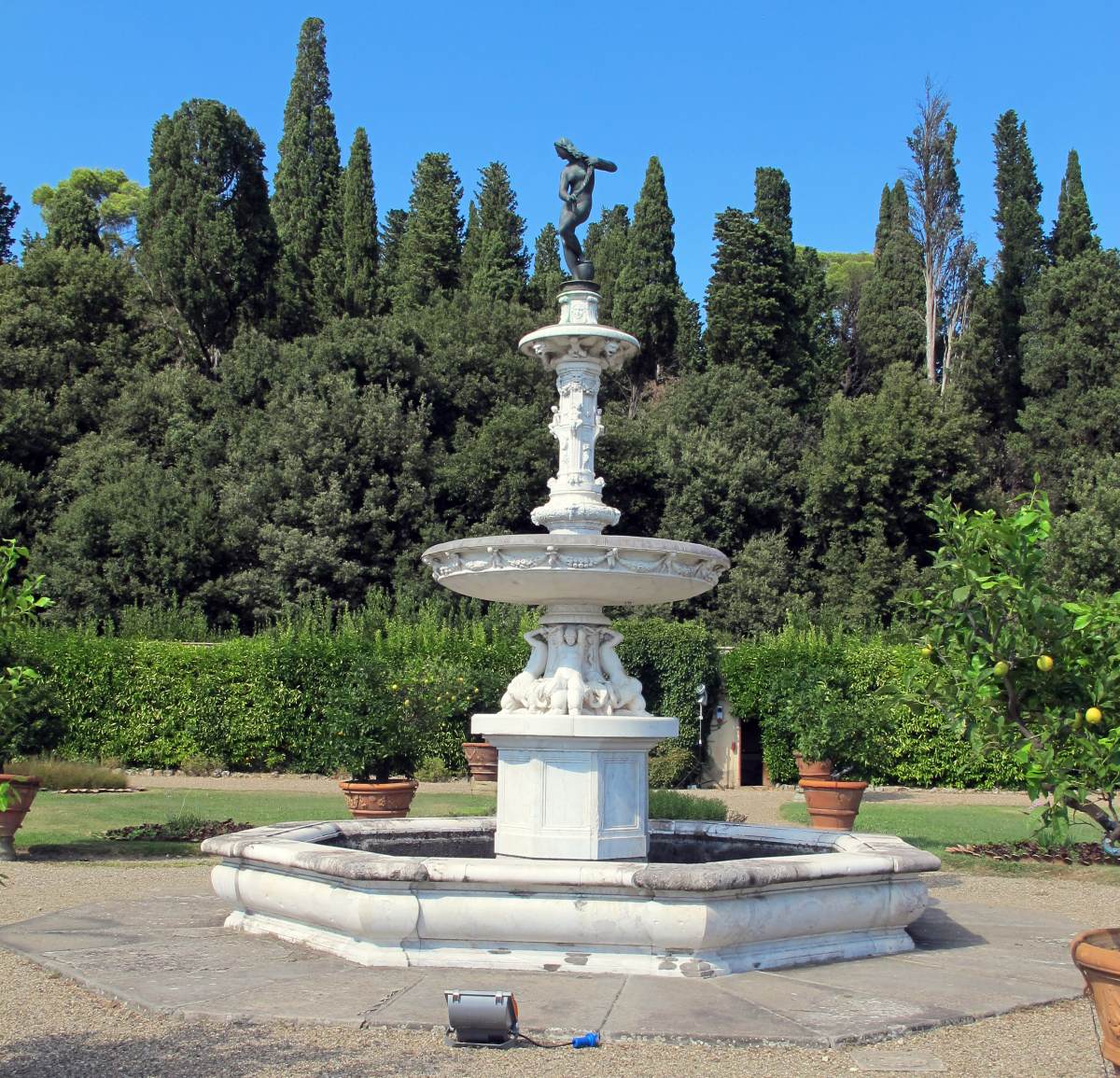
Fountain of the Labyrinth
- MEDIUM
- Marble, height of bronze figure 125 cm
- TYPE
- Other
PALETTE
HOVER OR TAP A SWATCH FOR NAME, SHARE AND HEX. SAMPLED FROM THE IMAGE — INDICATIVE, NOT A PIGMENT ANALYSIS.
DEVELOPMENT BUILD — NOT FOR PUBLIC USE. CONTRIBUTE ON GITHUB.
03 — ARTWORK
PALETTE
HOVER OR TAP A SWATCH FOR NAME, SHARE AND HEX. SAMPLED FROM THE IMAGE — INDICATIVE, NOT A PIGMENT ANALYSIS.
COMMENTARY
UNDERLINED TERMS ARE DEFINED IN THE GLOSSARY.
At his mother's villaa residence in the country (in Italy); villas acquired palace-like characteristics from the Renaissance onwards., where Grand Duke Cosimo had spent his youth, the Villa di Castello"castle", palace. at Rifredi near Florence, Cosimo entrusted Tribolo from 1536 with the layout of a garden that was to illustrate, with an elaborate iconological program worked out by one of Cosimo's court humanists: the beneficent influence of the recently-ennobled Medici, watering Tuscany as a source of water fertilizes a garden. With the aid of hydraulic engineer Piero da San Casciano, Tribolo engineered a sequence of terraces with fountains that began at the upper end in the "wild" garden - where the civilizing Medici touch had not yet been felt - with a sculpture of The Apennines by Ammanati; once in the formal terraces the tamed water passed in formal canals to two sculptural fountains placed on the central axis. The marbleloosely applied to any hard limestone that can be sawn into thin slabs and will take a good polish so that it is suitable for decorative work; more strictly, it refers to metamorphosed limestones whose structure has been recrystallized by heat or pressure. Marbles are widely disseminated and occur in a great variety of colours and patterns, but certain types have been particularly prized by sculptors. The most famous of Greek white marbles in the ancient world was the close-grained Pentelic, which was quarried at Mount Pentelicon in Attica. The Elgin Marbles are carved in Pentelic. Widely used also were the somewhat coarser-grained translucent white marbles from the Aegean islands of Paros and Naxos. Parian marble was used for the celebrated Mausoleum at Halicarnassus. The pure white Carrara marble, quarried at Massa, Carrara, and Pietra Santa in Tuscany from the 3rd century BC, is the most famous of all sculptors' stones. It was used for the Apollo Belvedere, and was much favoured in the Renaissance, particularly by Michelangelo, who often visited the quarries to select material for his work. Neoclassical sculptors also favoured Carrara marble because of its ability to take a smooth, sleek surface, but it can look rather 'dead' compared with some of the finest Greek marbles. bases of both were sculpted by Tribolo and his assistant Pierino da Vinci. The figure of Fiorenza was executed by Giambologna.
The fountains were the earliest fully sculptural fountain complexes set at the centre of garden spaces, and they set the example for the seamless development of fountains as major settings for figure sculpture, in a sequence that extended unbroken into the early 20th century.
As taste changed in the seventeenth and eighteenth centuries, a fashion grew up for moving fountains about, and as a result of this the smaller and earlier of the Castello fountains, the Fountain of the Labyrinth (Fontana di Fiorenza), was moved to the terrace of the Medici villa of Petraia only a short walk away.
@online{wga-rf617844b9505eb,
  author       = {Krén, Emil and Marx, Daniel},
  title        = {Fountain of the Labyrinth by TRIBOLO, Niccolò},
  organization = {{Web Gallery of Art}},
  date         = {2026-09-09},
  url          = {https://beta.wga.hu/artists/tribolo-niccol-r36caddc5632ed0/fountain-of-the-labyrinth-rf617844b9505eb},
  urldate      = {2026-09-09},
  langid       = {english}
}
ACCESSED 2026-09-09. REPLACE THE AUTHOR FIELD WITH THE COMMENTARY AUTHOR WHERE ONE IS NAMED.


