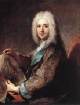
French painter, part of a family of painters. Antoine de Troy (1608-1684) was a painter of modest renown in the Languedoc region. His elder son Jean de Troy (1638-1691) established an academy of art in Montpellier. He was long known only as an academic history painter, but 20th-century research has identified several fine portraits by him on the basis of style, of which the most remarkable is that of Jeanne de Juliard, Dame de Mondonville (c. 1675–80; private collection). Antoine's younger son François de Troy became a fashionable portraitGLOSSARYThe Roman portrait bust survived in the form of life-sized reliquaries of saints, but it was in 15th century Florence that the individual features and character of a contemporary sitter were accurately recorded by sculptors such as Donatello, Desiderio da Settignano, Mino da Fiesole and the Rossellino. A similar degree of realism occurs in 15th century tomb sculpture. The equestrian portrait, based on antique statues such as the Marcus Aurelius monument (Rome, Campidoglio), was revived in the 14th century. Two examples in fresco are Simone Martini's Guidoriccio (c. 1328; Siena, Palazzo Pubblico) and the posthumous portrait of Sir John Hawkwood (1436; Florence, Cathedral) by Uccello, which gives the illusion of a 3-dimensional statue seen from below. The Venetian Republic ordered imposing monuments from Donatello (1447; Gattarnelata, Padua) and Verrocchio (14799; Colleoni, Venice), whilst other statesmen ordered their own images to be erected in public places, directly relating themselves to the military heroes of ancient Rome. Another form of political portraiture derived from antiquity was the commemorative portrait medal designed by artists such as Pisanello. The carved or painted profile portrait became popular in the 1450s. The realism of the clear, flattened image, painted under the influence of Flemish examples by the Pollaiuolo brothers, Piero della Francesca and Botticelli, was superseded by the three-quarter and frontal portrait, psychologically more complex, such as Leonardo's enigmatic Mona Lisa (Paris, Louvre) with her momentary smile or Andrea del Sarto's arresting Portrait of a Man (London, National Gallery). The 16th century portrait became generalized, Lotto's Andrea Odoni (1527; Royal Collection) being an idealized concept of a collector rather than an individual. Group portraits, decorating whole rooms, include the narrative scenes of the Gonzaga court painted by Mantegna (completed 1474; Mantua, Palazzo Ducale) and the elaborate schemes commissioned by the Farnese family in Rome from Vasari (1546; Palazzo della Cancelleria) and Salviati (after 1553; Palazzo Farnese). Portraits were also incorporated into religious narratives, as in Ghirlandaio's fresco cycle painted for Giovanni Tornabuoni in S. Maria Novella, Florence (1486-90). painter in Paris, with a style of portraiture based on Flemish and Dutch models that included van Dyck and Rembrandt. The son of François, Jean-François de Troy, made his name as a painter of portraits, history subjects and tapestryGLOSSARYAs historical climatologists have not shown that Renaissance Italian winters and springs were warmer than they are now, it is puzzling that Italy did not fabricate tapestries to decorate and draught-proof the stony rooms of its palaces until 1545, when Cosimo I set up a manufactory in Florence. To hardiness or stinginess (tapestry was by far the most expensive form of wall decoration) we owe the existence of such secular frescoed decorative schemes as the labours of the months in the castle at Trent (c. 1407), the Arthurian scenes of Pisanello and the courtly ones of Mantegna in the Ducal Palace of Mantua, the delicious calendar fantasies of Cossa and others in the Palazzo Schifanoia in Ferrara - and, doubtless, many others that await liberation from whitewash or later panelling. These are all in situations where northern patrons would have used tapestries. These were imported, chiefly from Flanders, into Italy. The influence of their hunting and ceremonial scenes in particular registered on Italian 'gothic' painting or illumination and stained glass, and in literature. But the Italians did not make them. The most famous of all 'Italian' tapestries, those for the Sistine Chapel designed by Raphael, were made in Brussels from the full-scale coloured patterns, or cartoons, now in the Victoria and Albert Museum, London. Nor is it clear whether imported tapestries were used habitually or simply to add grandeur to special occasions. Even when Cosimo's manufactory was in being, and working from designs by court artists of the calibre of Bronzino, Salviati and Allori, his own headquarters, the Palace of the Signoria (now the Palazzo Vecchio), was being decorated with frescoes. The subject is underexplored. designs, but he is known chiefly for his RococoGLOSSARYA style of design, painting, and architecture dominating the 18th century, often considered the last stage of the Baroque. Developing in the Paris townhouses of the French aristocracy at the turn of the 18th century, Rococo was elegant and ornately decorative, its mood lighthearted and witty. Louis XV furniture, richly decorated with organic forms, is a typical product. Leading exponents of the Rococo sryle included the French painters Antoine Watteau (1684-1721) and Jean-Honoré Fragonard (1732-1806), and the German architect Johann Balthasar Neumann (1687-1753). Rococo gave way to Neo-classicism. 'tableaux de modes', representing fashionable life and amorous encounters.
François de Troy was taught the rudiments of painting by his father, and probably also by the more accomplished regional painter Antoine Durand. Some time after 1662 he moved to Paris to study with the portrait painter Claude Lefebvre and with Nicolas-Pierre Loir, whose sister-in-law, Jeanne Cotelle, he married in 1669. Two years later he was approved (agréé) by the Académie Royale and in 1674 was received (reçu) as a history painter with a morceau de réception that depicted Mercury and Argus (Paris, Ecole Nationale Supérieur des Beaux-Arts). His known works of this period include tapestry designs for Mme de Montespan, mistress of Louis XIV, and several unexceptional religious and mythological paintings (e.g. Susanna and the Elders and Lot and his Daughters, both St Petersburg, Hermitage).
Early in his career he became friendly with Roger de Piles, who first introduced him to Dutch and Flemish painting. After Lefebvre's death in 1675 de Troy dedicated himself to portraiture in the hope of attracting the same clientele as his late teacher. In 1679 he received his first important commission, for a portrait of the Swedish ambassador Nils Bielke, and a year later was commissioned for the portrait of Anne-Marie of Bavaria, the bride of the Grand Dauphin. Following these successes, his clients included Mme de Montespan and her descendants, especially her son by Louis XIV, Louis-Auguste de Bourbon, Duc du Maine, and his wife (e.g. Louise-Bénédicte de Bourbon, Duchesse du Maine; 1694; Sceaux, Château, Musée de l'Ile-de-France). Henceforward de Troy worked continuously in court circles for nearly five decades and was highly praised for his ability to capture the nobility's preoccupation with manners, sartorial modes and social position.