03 — ARTWORK
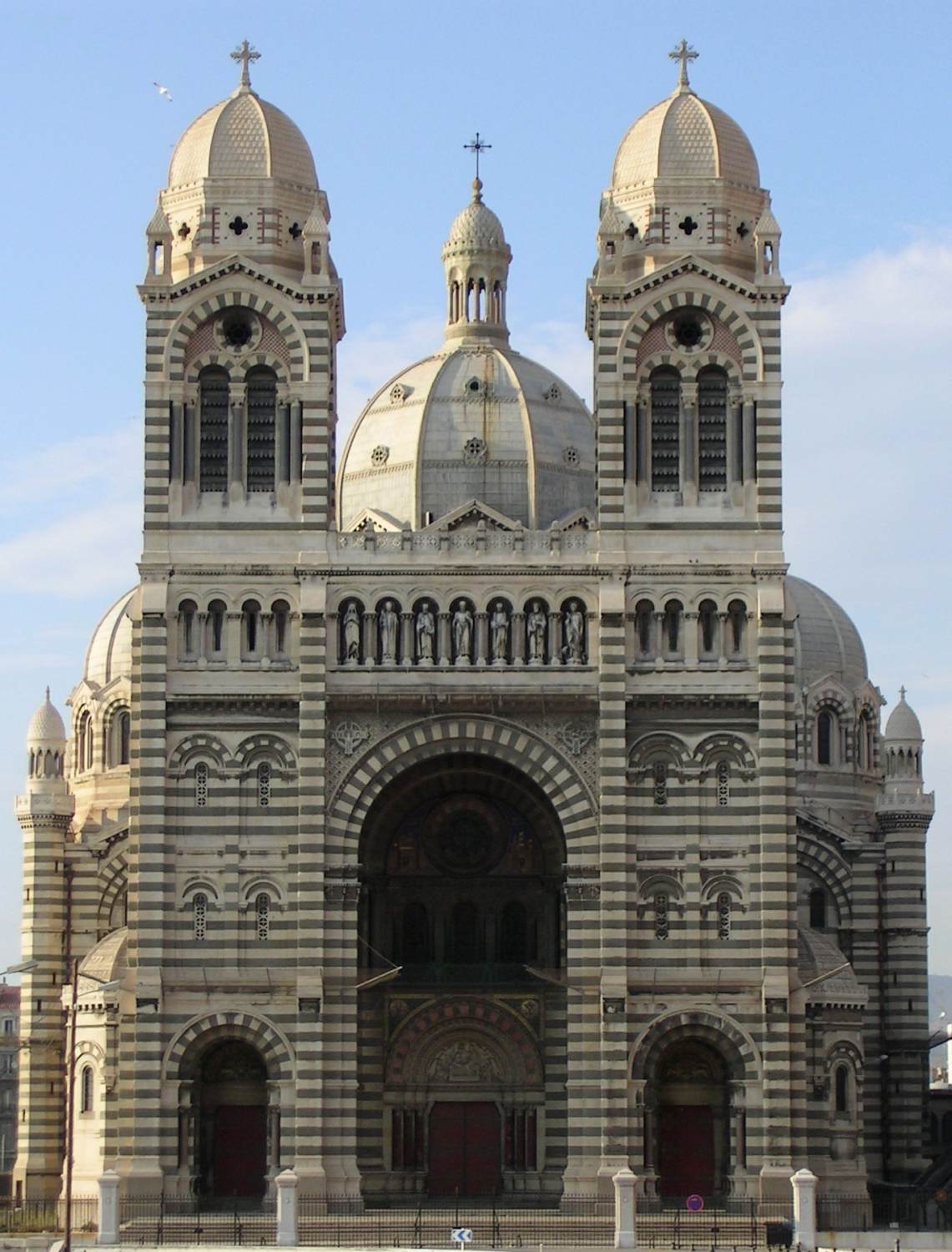
Exterior view
- MEDIUM
- Photo
- TYPE
- Other
PALETTE
HOVER OR TAP A SWATCH FOR NAME, SHARE AND HEX. SAMPLED FROM THE IMAGE — INDICATIVE, NOT A PIGMENT ANALYSIS.
DEVELOPMENT BUILD — NOT FOR PUBLIC USE. CONTRIBUTE ON GITHUB.
03 — ARTWORK
PALETTE
HOVER OR TAP A SWATCH FOR NAME, SHARE AND HEX. SAMPLED FROM THE IMAGE — INDICATIVE, NOT A PIGMENT ANALYSIS.
COMMENTARY
UNDERLINED TERMS ARE DEFINED IN THE GLOSSARY.
Vaudoyer's rise to prominence was assured when Hippolyt Fortoul (1811-1856) became Ministre de l'Instruction Publique et des Cultes (1851). The two men worked together for the next five years until Fortoul's death, and Vaudoyer was one of three inspecteurs in the Service des Edifices Diocésains, formed in 1853 to oversee all construction and restoration in France's ecclesiastical buildings. Their most extravagant project was the construction of a monumental new cathedralThe principal church of a province or diocese, where the throne of the bishop is placed. For reasons lost to time and tradition, a cathedral always faces west - toward the setting sun. The altar is placed at the east end. The main body, or nave, of the cathedral is usually divided into one main and two side aisles. These lead up to the north and south transepts, or arms of the cross, the shape in which a cathedral is usually formed. for Marseille, dramatically poised over the new ports and docks.
Vaudoyer was first involved in 1845 in the selection of a site; he then presented a design in 1852, which was considerably modified before construction began (1855). Vaudoyer's project, its green-and-white marbleloosely applied to any hard limestone that can be sawn into thin slabs and will take a good polish so that it is suitable for decorative work; more strictly, it refers to metamorphosed limestones whose structure has been recrystallized by heat or pressure. Marbles are widely disseminated and occur in a great variety of colours and patterns, but certain types have been particularly prized by sculptors. The most famous of Greek white marbles in the ancient world was the close-grained Pentelic, which was quarried at Mount Pentelicon in Attica. The Elgin Marbles are carved in Pentelic. Widely used also were the somewhat coarser-grained translucent white marbles from the Aegean islands of Paros and Naxos. Parian marble was used for the celebrated Mausoleum at Halicarnassus. The pure white Carrara marble, quarried at Massa, Carrara, and Pietra Santa in Tuscany from the 3rd century BC, is the most famous of all sculptors' stones. It was used for the Apollo Belvedere, and was much favoured in the Renaissance, particularly by Michelangelo, who often visited the quarries to select material for his work. Neoclassical sculptors also favoured Carrara marble because of its ability to take a smooth, sleek surface, but it can look rather 'dead' compared with some of the finest Greek marbles. banding one of the first major exercises in structural polychromy in 19th-century France, was a demonstration of his historicist theory of architecture as 'an unbroken chain of continual progress'. In the cathedral, a synthesis of Roman, Byzantine, medieval and Renaissance forms, he wove together spatial, structural and decorative elements from the succession of architectural styles that had superseded each other both in Marseille and in the development of the French cathedral; its plan combined the basilicaa church building, usually facing east, with a tall main nave and two or four side aisles of lesser height. There may also be a transept between the nave and the choir, which is reserved for the clergy. Originally, the basilica was an ancient Greek administrative building, and the Romans used this form for markets and law courts; it then became a place of assembly for the early Christians, and thus a church., a domed Greek crossA cross with four arms of equal length. and an ambulatorySemicircular or polygonal circulation space enclosing an apse or a straight-ended sanctuary. with radiating chapelschapels leading off from the ambulatory, and arranged in a semi-circular fashion. reminiscent of a medieval pilgrimage church.
Vaudoyer died before his great project was completed. The cathedral was completed by Vaudoyer's most loyal pupil Henri-Jacques Espérandieu (1829-1874) and by Henri-Antoine Révoil (1820-1900), who drew up revised schemes for the sculptural and mosaic decoration of both the façadethe front or principal face of a building, especially one elaborately constructed; a blind façade is a façade that is purely decorative and does not relate to the structure of the building. and the interior, left incomplete when the cathedral was belatedly consecrated in 1893. Much of the furnishings of the chapels and sacristies was completed after 1900 by his son Alfred Vaudoyer (1846-1917).
This Lombard-Roman (or Byzantine?) cathedral is an example of the <a href="#" onClick="w=window.open ('/database/glossary/glossar5.html#rundbogenstilTerm used to describe an architectural style that began and flourished in Germany in the second quarter of the 19th century, with parallels, mostly later, in other northern European countries and the USA, and which survived much longer as a utilitarian style. Based on the structural unit of the round arch, or Rundbogen, it has frequently been confused with Romanesque Revival architecture. The Rundbogenstil, however, was not a historical revival; instead, it was among the first architectural movements to insist that form be derived not from history but according to abstract notions of utility and objectivity. By placing issues of planning and construction above those of formal composition and ornament, the Rundbogenstil was an important forerunner to 20th-century architecture, bringing Germany for the first time to a position of international prominence in architectural theory.', 'newWin', 'scrollbars=yes,status=no,dependent=yes,screenX=0,screenY=0,width=300,height=300');w.opener=this;w.focus();return false">Rundbogenstil</a> in France.
@online{wga-r15d185b3e4eed6,
  author       = {Krén, Emil and Marx, Daniel},
  title        = {Exterior view by VAUDOYER, Léon},
  organization = {{Web Gallery of Art}},
  date         = {2026-09-13},
  url          = {https://beta.wga.hu/artists/vaudoyer-lon-r207b070d0bc154/exterior-view-r15d185b3e4eed6},
  urldate      = {2026-09-13},
  langid       = {english}
}
ACCESSED 2026-09-13. REPLACE THE AUTHOR FIELD WITH THE COMMENTARY AUTHOR WHERE ONE IS NAMED.
The archive catalogues no further works by this artist.
TRY SAME COLLECTION →
