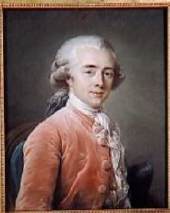
French painter and draughtsman. He was one of the principal innovators in French art of the 1770s and 1780s, in the field of both Neoclassical subjects and themes from national history. After studying with Joseph-Marie Vien in Paris Vincent had won the much-coveted Prix de RomeGLOSSARYA scholarship, founded concurrently with the French Academy in Rome (1666), that enabled prize-winning students at the Academie Royale de Peinture et de Sculpture in Paris to spend a period (usually 4 years) in Rome at the state's expense. Prizes for architecture began to be awarded regularly in 1723, and prizes for engravers and musicians were added in the 19th century. The prizes were meant to perpetuate the academic tradition and during the 18th and 19th centuries winning the award was the traditional stepping stone to the highest honours for painters and sculptors. Many distinguished artists (as well as many nonentities) were Prix de Rome winners, notably David, Fragonard, and Ingres among painters and Clodion, Girardon, and Houdon among sculptors. The prizes are still awarded and the system has been adopted by other countries. in 1768, remaining as a pupil in the École Royale des Éleves Protégés until July 1771 when he was installed as a pensionnaire in the Palais Mancini, Rome. During his Roman sojourn Vincent drew and painted a large number of portraits, both of his fellow students and Italian aristocrats (such as Monseigneur Ruffo in 1775). This portraitGLOSSARYThe Roman portrait bust survived in the form of life-sized reliquaries of saints, but it was in 15th century Florence that the individual features and character of a contemporary sitter were accurately recorded by sculptors such as Donatello, Desiderio da Settignano, Mino da Fiesole and the Rossellino. A similar degree of realism occurs in 15th century tomb sculpture. The equestrian portrait, based on antique statues such as the Marcus Aurelius monument (Rome, Campidoglio), was revived in the 14th century. Two examples in fresco are Simone Martini's Guidoriccio (c. 1328; Siena, Palazzo Pubblico) and the posthumous portrait of Sir John Hawkwood (1436; Florence, Cathedral) by Uccello, which gives the illusion of a 3-dimensional statue seen from below. The Venetian Republic ordered imposing monuments from Donatello (1447; Gattarnelata, Padua) and Verrocchio (14799; Colleoni, Venice), whilst other statesmen ordered their own images to be erected in public places, directly relating themselves to the military heroes of ancient Rome. Another form of political portraiture derived from antiquity was the commemorative portrait medal designed by artists such as Pisanello. The carved or painted profile portrait became popular in the 1450s. The realism of the clear, flattened image, painted under the influence of Flemish examples by the Pollaiuolo brothers, Piero della Francesca and Botticelli, was superseded by the three-quarter and frontal portrait, psychologically more complex, such as Leonardo's enigmatic Mona Lisa (Paris, Louvre) with her momentary smile or Andrea del Sarto's arresting Portrait of a Man (London, National Gallery). The 16th century portrait became generalized, Lotto's Andrea Odoni (1527; Royal Collection) being an idealized concept of a collector rather than an individual. Group portraits, decorating whole rooms, include the narrative scenes of the Gonzaga court painted by Mantegna (completed 1474; Mantua, Palazzo Ducale) and the elaborate schemes commissioned by the Farnese family in Rome from Vasari (1546; Palazzo della Cancelleria) and Salviati (after 1553; Palazzo Farnese). Portraits were also incorporated into religious narratives, as in Ghirlandaio's fresco cycle painted for Giovanni Tornabuoni in S. Maria Novella, Florence (1486-90). dates from a time in which Vincent's portraits are particularly close to Jean-Honoré Fragonard's, largely due to the latter's presence in Rome and Naples from December 1773 to June 1774.
Despite the fact that he worked in a variety of styles, his sense of purpose appears to have been coherent at a time of profound change. His stylistic sources lay in the art of ClassicalGLOSSARYRelating to the culture of ancient Greece and Rome (classical Antiquity). The classical world played a profoundly important role in the Renaissance, with Italian scholars, writers, and artists seeing their own period as the rebirth (the "renaissance") of classical values after the Middle Ages. The classical world was considered the golden age for the arts, literature, philosophy, and politics. Concepts of the classical, however, changed greatly from one period to the next. Roman literature provided the starting point in the 14th century, scholars patiently finding, editing and translating a wide range of texts. In the 15th century Greek literature, philosophy and art - together with the close study of the remains of Roman buildings and sculptures-expanded the concept of the classical and ensured it remained a vital source of ideas and inspiration. antiquity and such masters as Raphael, the great Bolognese painters of the 17th century and Charles Le Brun; yet he also studied reality in a quasi-documentary way. His work, too often confused with that of Jean-Honoré Fragonard, Jacques-Louis David or Louis-Léopold Boilly, is of a high standard, even though the completed paintings do not always uphold the promise of energy of his drawings and oil sketches.
He married in 1800 Adelaide Labille-Guiard, a well-known woman painter of the period.