03 — ARTWORK
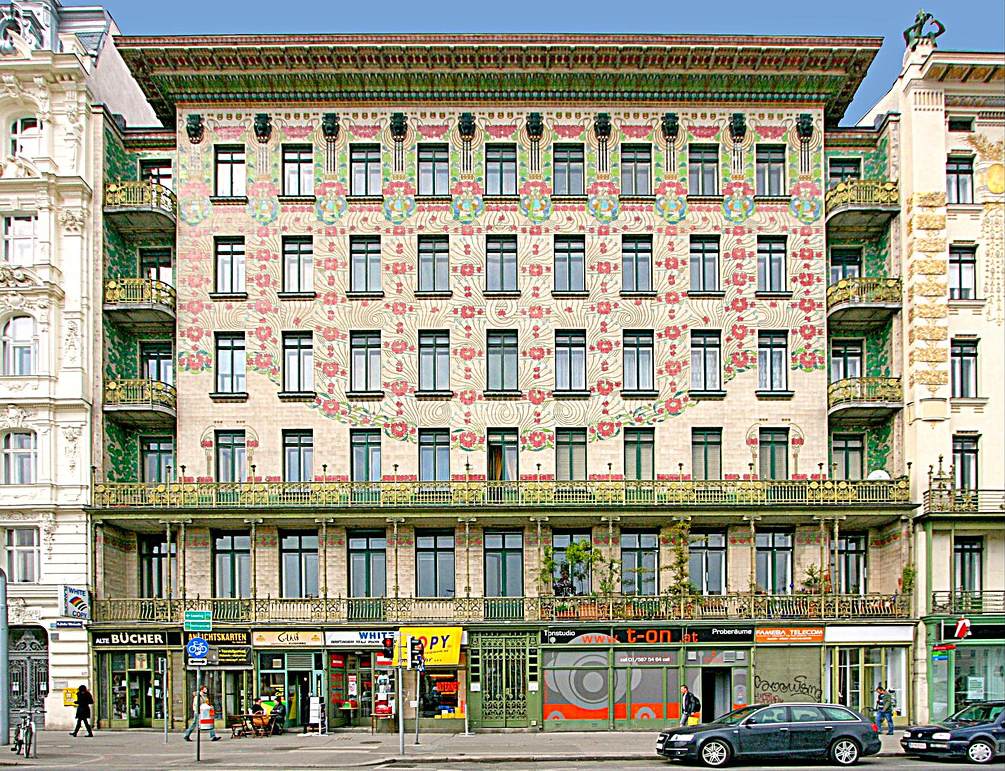
Majolica House: façade
- MEDIUM
- Photo
- TYPE
- Other
PALETTE
HOVER OR TAP A SWATCH FOR NAME, SHARE AND HEX. SAMPLED FROM THE IMAGE — INDICATIVE, NOT A PIGMENT ANALYSIS.
DEVELOPMENT BUILD — NOT FOR PUBLIC USE. CONTRIBUTE ON GITHUB.
03 — ARTWORK
PALETTE
HOVER OR TAP A SWATCH FOR NAME, SHARE AND HEX. SAMPLED FROM THE IMAGE — INDICATIVE, NOT A PIGMENT ANALYSIS.
COMMENTARY
UNDERLINED TERMS ARE DEFINED IN THE GLOSSARY.
In 1898, Wagner produced two residential blocks in Vienna, the Linke Wienzeile Buildings at Linke Wienzeile 38 and 40. Made in the Vienna Secession style, they are both lavishly decorated with colourful tiles, sculpture and wrought iron. The house at Linke Wienzeile 40, popularly known as the Majolica House, has a façadethe front or principal face of a building, especially one elaborately constructed; a blind façade is a façade that is purely decorative and does not relate to the structure of the building. covered with majolica or glazed earthenwareA ceramic product invented in England around 1720, which belongs to the category of fine stoneware. The porous white bodies are made of fired raw materials containing clay and kaolin as well as quartz, feldspar, and talc. A transparent glaze is applied upon the first or second firing. Earthenware, which is suitable for everyday use, is distinguished by its light, creamy surface. The most famous example of this category is made by the English firm of Wedgwood (since 1780). tiles in floral designs. The other at Linke Wienzeile 38 is called the MedallionIn architecture, a large ornamental plaquc or disc. House, for the bronzeAn alloy of copper (usually about 90 per cent) and tin, often also containing small amounts of other metals such as lead or zinc. Since antiquity it has been the metal most commonly used in cast sculpture because of its strength, durability, and the fact that it is easily workable - both hot and cold - by a variety of processes. It is easier to cast than copper because it has a lower melting-point, and its great tensile strength makes possible the protrusion of unsupported parts - an advantage over marble sculpture. The colour of bronze is affected by the proportion of tin or other metals present, varying from silverish to a rich, coppery red, and its surface beauty can be enhanced when it acquires a patina. medallions on the façade. It also features sculpted angels on the roof. A third building nearby, at Köstlergasse 3, was the town residence of Otto Wagner for a time.
The form of the crisp, flat, six-storey urban façade of Majolica House, with its positive cornicea molded horizontal ledge along the top of a building or wall; a decorative molding between wall and roof. and iron balconies to the lower two storeys, is reminiscent of Schinkel's work: Wagner covered the façade in faienceTin-glazed European earthenware, particularly ware made in France, Germany, Spain, and Scandinavia. It developed in France in the early 16th century, was influenced by the technique and the designs of Italian maiolica, and is named for Faenza, Italy, which was famous for maiolica. It is distinguished from tin-glazed earthenware made in Italy, which is called "maiolica," and that made in the Netherlands and England, which is called "delftware." It has no connection to the ancient objects or material also named faience, which was developed in the Near East ca. 4500 BCE. with flat, flowing patterns in pinks, blues and greens - only the ten lions' heads immediately below cornice level are in reliefA sculptural work in which all or part projects from the flat surface. There are three basic forms: low relief (bas-relief, basso rilievo), in which figures project less than half their depth from the background; medium relief (mezzo-rilievo), in which figures are seen half round; and high relief (alto rilievo), in which figures are almost detached from their background..
Although the façade is flat and rectilinear, not curvilinear like some Art Nouveau architecture, the external decoration shows the influence of Art Nouveau (or Jugendstil).
@online{wga-rc64df4033e2c15,
  author       = {Krén, Emil and Marx, Daniel},
  title        = {Majolica House: façade by WAGNER, Otto},
  organization = {{Web Gallery of Art}},
  date         = {2026-09-13},
  url          = {https://beta.wga.hu/artists/wagner-otto-rc5e878cc67b462/majolica-house-faade-rc64df4033e2c15},
  urldate      = {2026-09-13},
  langid       = {english}
}
ACCESSED 2026-09-13. REPLACE THE AUTHOR FIELD WITH THE COMMENTARY AUTHOR WHERE ONE IS NAMED.


