03 — ARTWORK
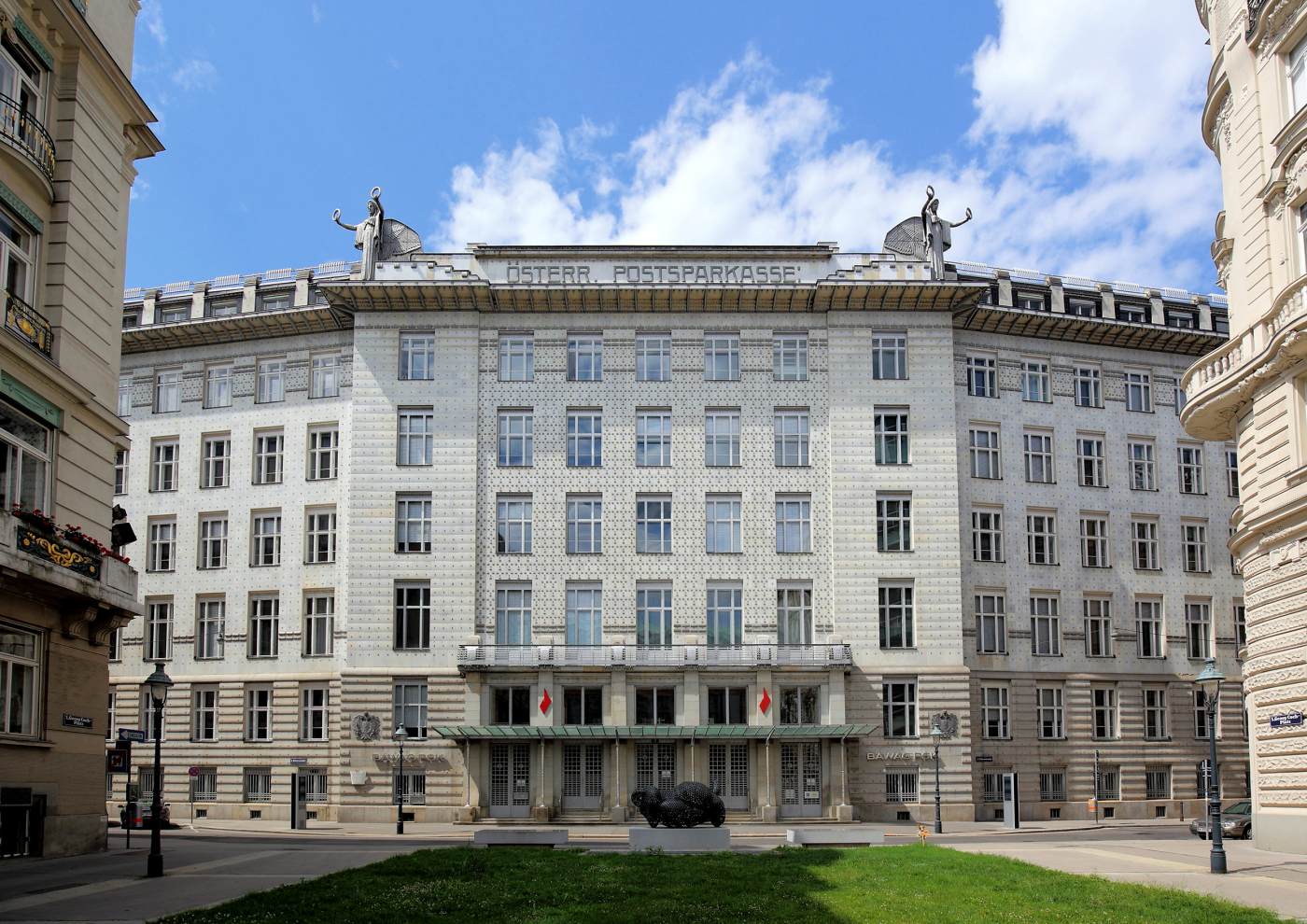
Österreichische Postsparkasse: general view
- MEDIUM
- Photo
- TYPE
- Other
PALETTE
HOVER OR TAP A SWATCH FOR NAME, SHARE AND HEX. SAMPLED FROM THE IMAGE — INDICATIVE, NOT A PIGMENT ANALYSIS.
DEVELOPMENT BUILD — NOT FOR PUBLIC USE. CONTRIBUTE ON GITHUB.
03 — ARTWORK
PALETTE
HOVER OR TAP A SWATCH FOR NAME, SHARE AND HEX. SAMPLED FROM THE IMAGE — INDICATIVE, NOT A PIGMENT ANALYSIS.
COMMENTARY
UNDERLINED TERMS ARE DEFINED IN THE GLOSSARY.
Wagner's late projects from 1903 radically continued the transformation of the work of Schinkel, Van der Nüll and Semper, as seen in his two master buildings: the sanatorium church of Kirche am Steinhof (also called Leopoldskirche), the church of the Steinhof Asylum in Penzing outside Vienna, and the Österreichische Postsparkasse (1903-12), also in Vienna. These buildings are considered his most revolutionary work; both utilized new materials - steel, glass, aluminium - and innovative modes of construction in a highly successful fusion of functional building and aesthetic vision.
The design for the Österreichische Postsparkasse (Austrian Postal Savings Bank), one of his best-known works, won a competition (1903) and is based on a logical trapezoidal plan with a banking hall at its centre. The six-storey entrance façadethe front or principal face of a building, especially one elaborately constructed; a blind façade is a façade that is purely decorative and does not relate to the structure of the building., surmounted by a simple Sezessionstil pergolaA passageway covered by a trellis on which climbing plants are grown. flanked by winged figures, has large windows set in walls faced with white marbleloosely applied to any hard limestone that can be sawn into thin slabs and will take a good polish so that it is suitable for decorative work; more strictly, it refers to metamorphosed limestones whose structure has been recrystallized by heat or pressure. Marbles are widely disseminated and occur in a great variety of colours and patterns, but certain types have been particularly prized by sculptors. The most famous of Greek white marbles in the ancient world was the close-grained Pentelic, which was quarried at Mount Pentelicon in Attica. The Elgin Marbles are carved in Pentelic. Widely used also were the somewhat coarser-grained translucent white marbles from the Aegean islands of Paros and Naxos. Parian marble was used for the celebrated Mausoleum at Halicarnassus. The pure white Carrara marble, quarried at Massa, Carrara, and Pietra Santa in Tuscany from the 3rd century BC, is the most famous of all sculptors' stones. It was used for the Apollo Belvedere, and was much favoured in the Renaissance, particularly by Michelangelo, who often visited the quarries to select material for his work. Neoclassical sculptors also favoured Carrara marble because of its ability to take a smooth, sleek surface, but it can look rather 'dead' compared with some of the finest Greek marbles. with aluminium fixings. The central space of the banking hall (modified 1980s) had a glass vaultA roof or ceiling whose structure is based on the arch. There are a wide range of forms, including the barrel (or tunnel) vault, formed by a continuous semi-circular arch; the groin vault, formed when two barrel vaults intersect; and the rib vault, consistong of a framework of diagonal ribs supporting interlocking arches. The development of the various forms was of great structural and aesthetic importance in the development of church architecture during the Middle Ages. of stilted elliptical section carried on riveted steel columns and a floor with glass lenses to light the basement below; aluminium ventilation bollards ranged around the wall added to the illusion of an industrial aesthetic. The bank owed its atmospheric effect to the impression of silver light produced by glass, aluminium and marble.
One of the earliest icons of the Modern Movement, it is contemporary with Frank Lloyd Wright's Larkin Building, pre-dates Peter Behrens's Turbinenfabrik in Berlin by several years and marks the achievement of Van der Nüll's concept of a tradition-driven modern architecture of the future.
@online{wga-r4d6210087792f1,
  author       = {Krén, Emil and Marx, Daniel},
  title        = {Österreichische Postsparkasse: general view by WAGNER, Otto},
  organization = {{Web Gallery of Art}},
  date         = {2026-09-09},
  url          = {https://beta.wga.hu/artists/wagner-otto-rc5e878cc67b462/sterreichische-postsparkasse-general-view-r4d6210087792f1},
  urldate      = {2026-09-09},
  langid       = {english}
}
ACCESSED 2026-09-09. REPLACE THE AUTHOR FIELD WITH THE COMMENTARY AUTHOR WHERE ONE IS NAMED.


