03 — ARTWORK
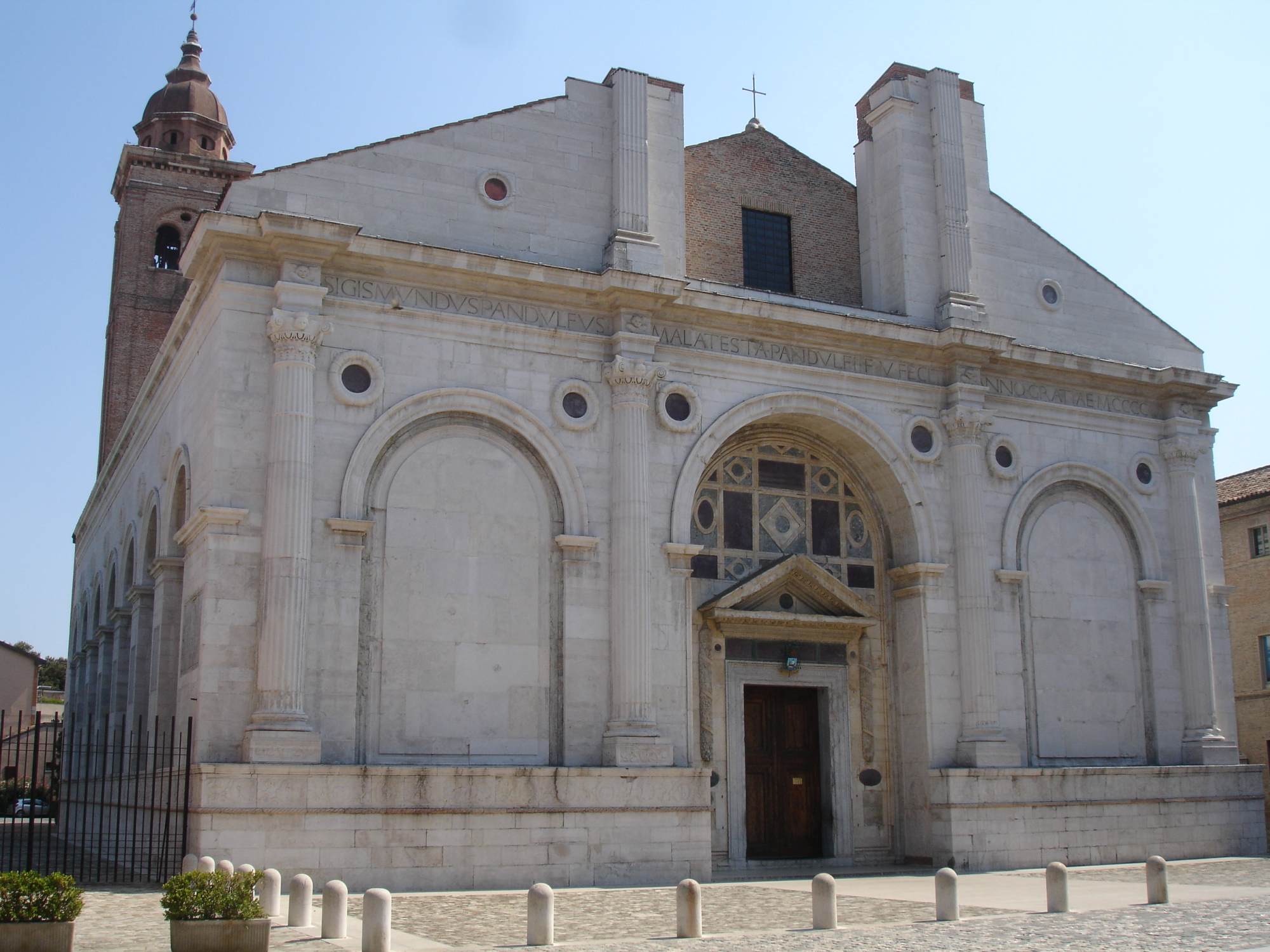
Tempio Malatestiano: Façade
ALBERTI, Leon Battista · 1450 →
- MEDIUM
- Photo
- TYPE
- Other
PALETTE
HOVER OR TAP A SWATCH FOR NAME, SHARE AND HEX. SAMPLED FROM THE IMAGE — INDICATIVE, NOT A PIGMENT ANALYSIS.
DEVELOPMENT BUILD — NOT FOR PUBLIC USE. CONTRIBUTE ON GITHUB.
03 — ARTWORK
ALBERTI, Leon Battista · 1450 →
PALETTE
HOVER OR TAP A SWATCH FOR NAME, SHARE AND HEX. SAMPLED FROM THE IMAGE — INDICATIVE, NOT A PIGMENT ANALYSIS.
COMMENTARY
UNDERLINED TERMS ARE DEFINED IN THE GLOSSARY.
In 1450 Alberti was given an opportunity to put his classicalRelating to the culture of ancient Greece and Rome (classical Antiquity). The classical world played a profoundly important role in the Renaissance, with Italian scholars, writers, and artists seeing their own period as the rebirth (the "renaissance") of classical values after the Middle Ages. The classical world was considered the golden age for the arts, literature, philosophy, and politics. Concepts of the classical, however, changed greatly from one period to the next. Roman literature provided the starting point in the 14th century, scholars patiently finding, editing and translating a wide range of texts. In the 15th century Greek literature, philosophy and art - together with the close study of the remains of Roman buildings and sculptures-expanded the concept of the classical and ensured it remained a vital source of ideas and inspiration. ideas into visible form in an ambitious structure, the San Francesco in Rimini, called Tempio Malatestiano, that, although unfinished, is known today through a medal by Matteo de' Pasti.
In its curvilinear silhouette the façadethe front or principal face of a building, especially one elaborately constructed; a blind façade is a façade that is purely decorative and does not relate to the structure of the building. has no parallel in either Florence or Rome and in this respect is sometimes regarded as an innovation. However, medieval façades of similar shape are in fact relatively common in North Italy, where Alberti had spent his youth. In the precise arrangement of the lower storey, with arches on piers, applied half-columns and roundels in the spandrels, the design is directly dependent on the nearby ancient ArchThe pointed arch is widely regarded as the main identifiable feature of Gothic architecture (distinct from the round arch of the Romanesque period). The three most common Gothic arches are the Equilateral, Lancet and Tudor. of Augustus, thus establishing a parallel between antiquity in Rimini and its revival there under Sigismondo Malatesta. Its triumphal associations are presumably deliberate and would refer both to the Christian idea of life triumphant over death and to the Classical idea of fame triumphant over oblivion. The arcaded system of the façade is continued along the sides of the building, although without the half-columna vertical structural member having a circular cross-section and usually consisting of a base, a long shaft, and a capital. articulation. This difference establishes an appropriate architectural distinction between façade and side elevation.
View the axonometric drawing of the planned Tempio Malatestiano, Rimini.
@online{wga-r3970145f7d68fa,
  author       = {Krén, Emil and Marx, Daniel},
  title        = {Tempio Malatestiano: Façade by ALBERTI, Leon Battista},
  organization = {{Web Gallery of Art}},
  date         = {2026-09-13},
  url          = {https://beta.wga.hu/artists/alberti-leon-battista-r41421c84da7d48/tempio-malatestiano-faade-r3970145f7d68fa},
  urldate      = {2026-09-13},
  langid       = {english}
}
ACCESSED 2026-09-13. REPLACE THE AUTHOR FIELD WITH THE COMMENTARY AUTHOR WHERE ONE IS NAMED.


