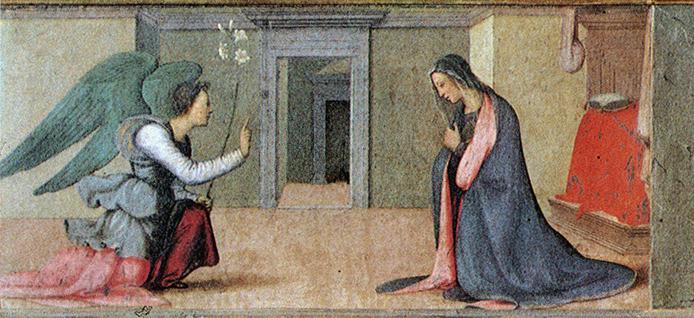
03 — ARTWORK
Annunciation
ALBERTINELLI, Mariotto · 1503 →
- MEDIUM
- Oil on wood, 23 x 50 cm
- TYPE
- Religious
PALETTE
HOVER OR TAP A SWATCH FOR NAME, SHARE AND HEX. SAMPLED FROM THE IMAGE — INDICATIVE, NOT A PIGMENT ANALYSIS.
DEVELOPMENT BUILD — NOT FOR PUBLIC USE. CONTRIBUTE ON GITHUB.
03 — ARTWORK
ALBERTINELLI, Mariotto · 1503 →
PALETTE
HOVER OR TAP A SWATCH FOR NAME, SHARE AND HEX. SAMPLED FROM THE IMAGE — INDICATIVE, NOT A PIGMENT ANALYSIS.
COMMENTARY
UNDERLINED TERMS ARE DEFINED IN THE GLOSSARY.
The predellaAn Italian word for the small strip of paintings which forms the lower edge or socle of a large altarpiece (pala). Such a polyptych consists of a principal, central panel with subsidiary side and/or top panels, and a predella: the predella usually has narrative scenes from the lives of the Saints who are represented in the panels above. Because of the small size of predelle - they are not usually more than 25-30 cm high, though often relatively very wide - they were frequently used for pictorial experiments that the painter did not wish to risk making in the larger panels. The first datable example seems to be that in Simone Martini's S. Louis of Toulouse (1317, Naples). of the altarpieceA picture or sculpture that stands on or is set up behind an altar. The term reredos is used for an ornamental screen or partition, not directly attached to the altar table but affixed to the wall behind it. A diptych is an altarpiece consisting of two panels, a triptych one of three panels, and a polyptych one of four or more panels. From the 14th to 16th century, the altarpiece was one of the most important commissions in European art; it was through the altarpiece that some of the most decisive developments in painting and sculpture came about. with the Visitation shows three stories from the life of Christ: the Annunciationthe term for the event described in the Gospel according to St. Luke, when the Angel Gabriel brings the Virgin Mary the news that she is to bear her son, Jesus Christ. The Annunciation was among the most widespread pictorial subjects of European art during the Middle Ages and the Renaissance., the Birth of Christ and the Circumcision. Despite the small size of the three compartments, Albertinelli succeeds in constructing austere, essential spaces which display a great formal balance. The small, full figures are firmly and vigorously placed in scenes which respect the most rigorous perspectiveThe method of representing three-dimensional objects on a flat surface. Perspective gives a picture a sense of depth. The most important form of perspective in the Renaissance was linear perspective (first formulated by the architect Brunelleschi in the early 15th century), in which the real or suggested lines of objects converge on a vanishing point on the horizon, often in the middle of the composition (centralized perspective). The first artist to make a systematic use of linear perspective was Masaccio, and its principles were set out by the architect Alberti in a book published in 1436. The use of linear perspective had a profound effect on the development of Western art and remained unchallenged until the 20th century. laws of the Florentine QuattrocentoThe 15th century in Italian art. The term is often used of the new style of art that was characteristic of the Early Renaissance, in particular works by Masaccio, Brunelleschi, Donatello, Botticelli, Fra Angelico and others. It was preceded by the Trecento and followed by the Cinquecento..
@online{wga-r97828c97040429,
  author       = {Krén, Emil and Marx, Daniel},
  title        = {Annunciation by ALBERTINELLI, Mariotto},
  organization = {{Web Gallery of Art}},
  date         = {2026-09-13},
  url          = {https://beta.wga.hu/artists/albertinelli-mariotto-r2b509dba9d42f1/annunciation-r97828c97040429},
  urldate      = {2026-09-13},
  langid       = {english}
}
ACCESSED 2026-09-13. REPLACE THE AUTHOR FIELD WITH THE COMMENTARY AUTHOR WHERE ONE IS NAMED.


