03 — ARTWORK
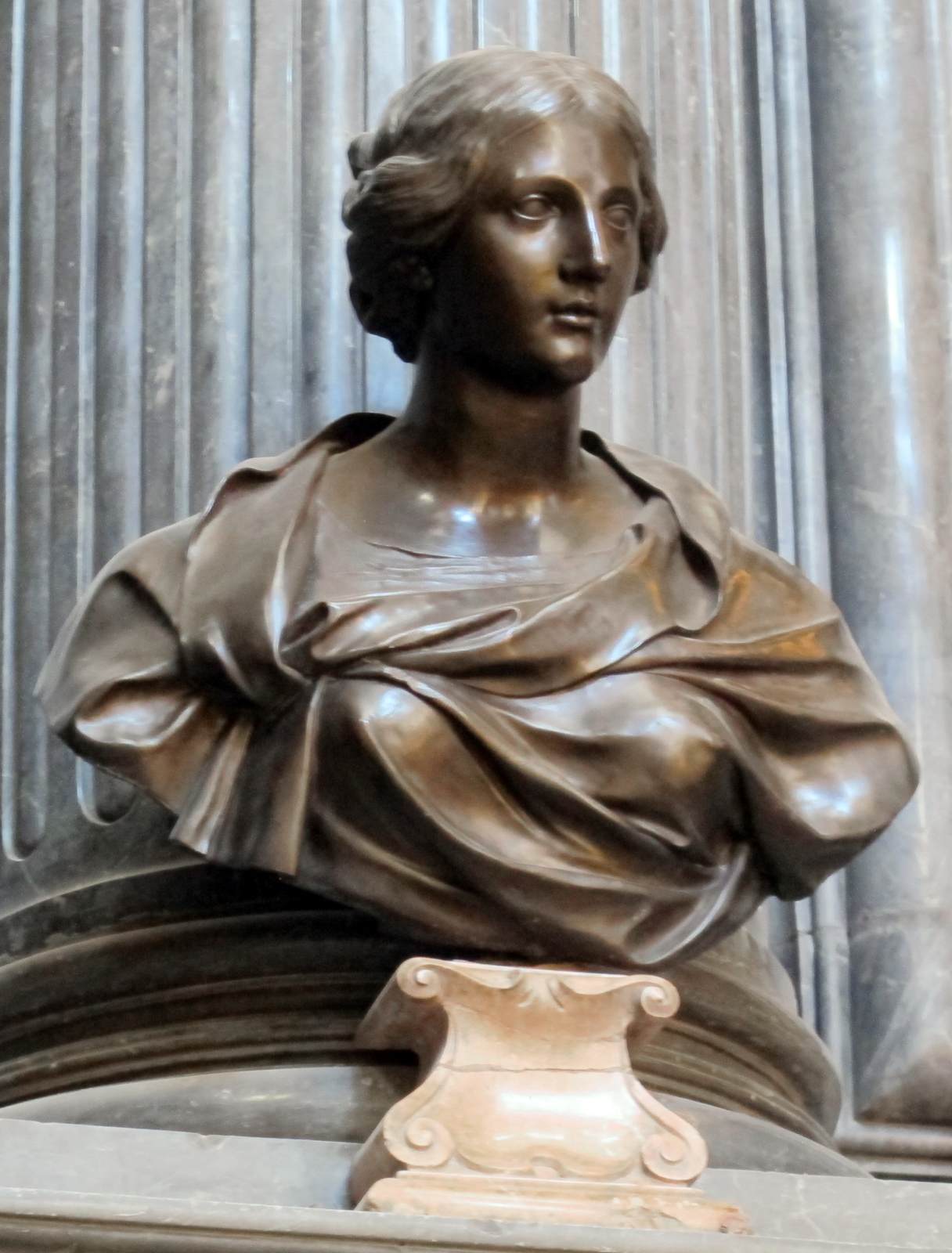
Bust of a Saint
- MEDIUM
- Bronze
- TYPE
- Portrait
PALETTE
HOVER OR TAP A SWATCH FOR NAME, SHARE AND HEX. SAMPLED FROM THE IMAGE — INDICATIVE, NOT A PIGMENT ANALYSIS.
DEVELOPMENT BUILD — NOT FOR PUBLIC USE. CONTRIBUTE ON GITHUB.
03 — ARTWORK
PALETTE
HOVER OR TAP A SWATCH FOR NAME, SHARE AND HEX. SAMPLED FROM THE IMAGE — INDICATIVE, NOT A PIGMENT ANALYSIS.
COMMENTARY
UNDERLINED TERMS ARE DEFINED IN THE GLOSSARY.
The Franzone family acquired a chapela small separate place for worship, either part of a large church or a separate building., the Cappella del Crocefisso, in the Carmelite church of San Carlo (now Santi Vittore e Carlo) in Genoa. The principal sculptural decoration of the chapel, including the marbleloosely applied to any hard limestone that can be sawn into thin slabs and will take a good polish so that it is suitable for decorative work; more strictly, it refers to metamorphosed limestones whose structure has been recrystallized by heat or pressure. Marbles are widely disseminated and occur in a great variety of colours and patterns, but certain types have been particularly prized by sculptors. The most famous of Greek white marbles in the ancient world was the close-grained Pentelic, which was quarried at Mount Pentelicon in Attica. The Elgin Marbles are carved in Pentelic. Widely used also were the somewhat coarser-grained translucent white marbles from the Aegean islands of Paros and Naxos. Parian marble was used for the celebrated Mausoleum at Halicarnassus. The pure white Carrara marble, quarried at Massa, Carrara, and Pietra Santa in Tuscany from the 3rd century BC, is the most famous of all sculptors' stones. It was used for the Apollo Belvedere, and was much favoured in the Renaissance, particularly by Michelangelo, who often visited the quarries to select material for his work. Neoclassical sculptors also favoured Carrara marble because of its ability to take a smooth, sleek surface, but it can look rather 'dead' compared with some of the finest Greek marbles. busts of the brothers Franzone, a bronzeAn alloy of copper (usually about 90 per cent) and tin, often also containing small amounts of other metals such as lead or zinc. Since antiquity it has been the metal most commonly used in cast sculpture because of its strength, durability, and the fact that it is easily workable - both hot and cold - by a variety of processes. It is easier to cast than copper because it has a lower melting-point, and its great tensile strength makes possible the protrusion of unsupported parts - an advantage over marble sculpture. The colour of bronze is affected by the proportion of tin or other metals present, varying from silverish to a rich, coppery red, and its surface beauty can be enhanced when it acquires a patina. Crucifix and bronze busts of saints, has traditionally been attributed to Algardi. The quality of these works, as well as the death of Algardi in 1654, however, have led them to be partly reattributed to Domenico Guidi, who perhaps worked from terracottaUnglazed fired clay. It is used for architectural features and ornaments, vessels, and sculptures. models by Algardi.
The twelve bronze busts of saints were not cast until after Algardi's death, using a variety of models. The picture shows one of the Three Marys. The Three Marys are women mentioned in the canonical gospel's narratives of the crucifixionAn important method of capital punishment, particularly among the Persians, Seleucids, Jews, Carthaginians, and Romans from about the 6th century BC to the 4th century AD. Constantine the Great, the first Christian emperor, abolished it in the Roman Empire in AD 337, out of veneration for Jesus Christ, the most famous victim of crucifixion. There were various methods of performing the execution. Usually, the condemned man, after being whipped, or "scourged," dragged the crossbeam of his cross to the place of punishment, where the upright shaft was already fixed in the ground. Stripped of his clothing either then or earlier at his scourging, he was bound fast with outstretched arms to the crossbeam or nailed firmly to it through the wrists. The crossbeam was then raised high against the upright shaft and made fast to it about 9 to 12 feet (approximately 3 metres) from the ground. Next, the feet were tightly bound or nailed to the upright shaft. A ledge inserted about halfway up the upright shaft gave some support to the body; evidence for a similar ledge for the feet is rare and late. Over the criminal's head was placed a notice stating his name and his crime. Death, apparently caused by exhaustion or by heart failure, could be hastened by shattering the legs (crurifragium) with an iron club, so that shock and asphyxiation soon ended his life. and resurrection of Jesus.
@online{wga-rd14731c0c87c05,
  author       = {Krén, Emil and Marx, Daniel},
  title        = {Bust of a Saint by ALGARDI, Alessandro},
  organization = {{Web Gallery of Art}},
  date         = {2026-09-09},
  url          = {https://beta.wga.hu/artists/algardi-alessandro-r9fec0959c85570/bust-of-a-saint-rd14731c0c87c05},
  urldate      = {2026-09-09},
  langid       = {english}
}
ACCESSED 2026-09-09. REPLACE THE AUTHOR FIELD WITH THE COMMENTARY AUTHOR WHERE ONE IS NAMED.


