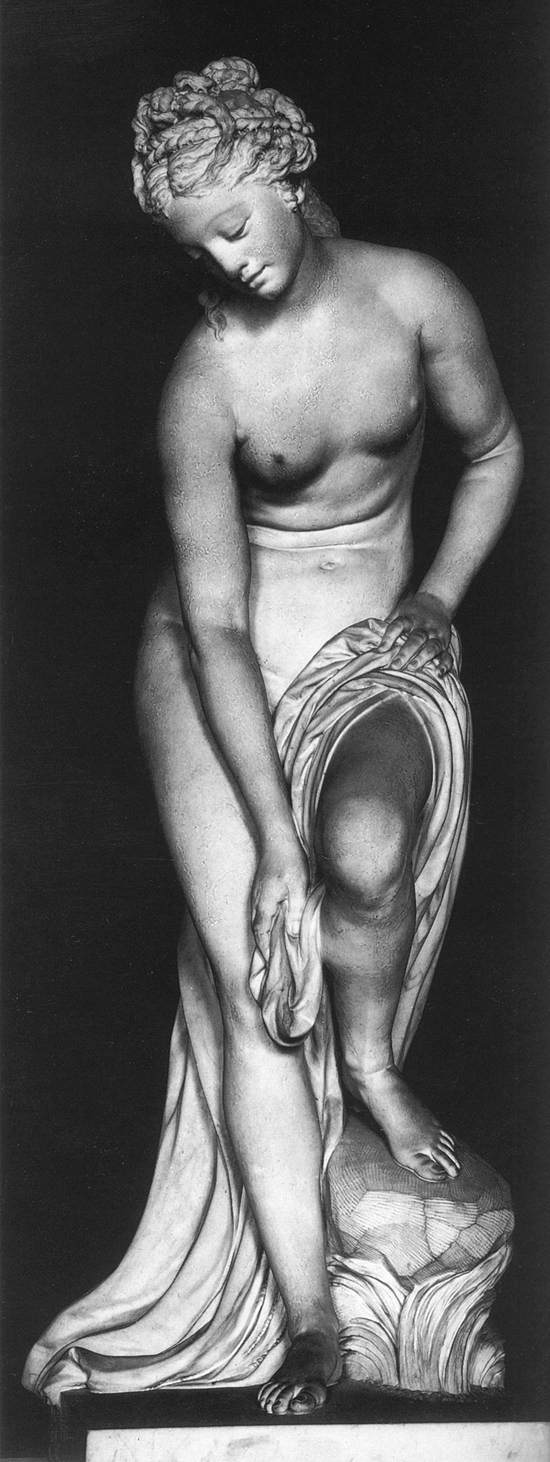
Sculptor, part of a French family of artists. Etienne Allegrain (1644-1736) was a landscape painter who worked predominantly in the tradition of classicalGLOSSARYRelating to the culture of ancient Greece and Rome (classical Antiquity). The classical world played a profoundly important role in the Renaissance, with Italian scholars, writers, and artists seeing their own period as the rebirth (the "renaissance") of classical values after the Middle Ages. The classical world was considered the golden age for the arts, literature, philosophy, and politics. Concepts of the classical, however, changed greatly from one period to the next. Roman literature provided the starting point in the 14th century, scholars patiently finding, editing and translating a wide range of texts. In the 15th century Greek literature, philosophy and art - together with the close study of the remains of Roman buildings and sculptures-expanded the concept of the classical and ensured it remained a vital source of ideas and inspiration. scenes established in the mid-17th century by Nicolas Poussin and Claude Lorrain. His brother Jean-Baptiste Allegrain (1644-before 1714) was a sculptor, while his son Gabriel Allegrain (1679-1748) was also a landscape painter, whose works can be distinguished from those of his father only with difficulty. Gabriel's son Christophe-Gabriel Allegrain was a sculptor who was much influenced by his more illustrious contemporary and brother-in-law Jean-Baptiste Pigalle. Christophe-Gabriel's own son Gabriel Allegrain II (1733-after 1779) was a sculptor who worked in the naval dockyard at Rochefort.
Christophe-Gabriel Allegrain was a pupil of one Martin, an ornamental sculptor, and by his first marriage, in 1733, became brother-in-law to Jean-Baptiste Pigalle. He was accepted (agréé) by the Académie Royale in 1748 and received (reçu) as a full member in 1751 on presentation of the statuette Narcissus Gazing at his Reflection in the Water (plaster, exh. SalonGLOSSARYIn the French language of the 18th and 19th centuries it designated an actual exhibition space, as well as the academic art exhibitions staged in the Salon d'Apollon of the Louvre since 1667. From 1737, the exhibitions took place biennially and, after the French Revolution, annually in the Salon Carré of the Louvre in Paris. Towards the end of the 19th century the official Salon jury was dissolved in order to make way for a committee of state-approved artists, i.e. former Salon members, who created the highly influential Société des Artistes Français. 1747; marbleGLOSSARYloosely applied to any hard limestone that can be sawn into thin slabs and will take a good polish so that it is suitable for decorative work; more strictly, it refers to metamorphosed limestones whose structure has been recrystallized by heat or pressure. Marbles are widely disseminated and occur in a great variety of colours and patterns, but certain types have been particularly prized by sculptors. The most famous of Greek white marbles in the ancient world was the close-grained Pentelic, which was quarried at Mount Pentelicon in Attica. The Elgin Marbles are carved in Pentelic. Widely used also were the somewhat coarser-grained translucent white marbles from the Aegean islands of Paros and Naxos. Parian marble was used for the celebrated Mausoleum at Halicarnassus. The pure white Carrara marble, quarried at Massa, Carrara, and Pietra Santa in Tuscany from the 3rd century BC, is the most famous of all sculptors' stones. It was used for the Apollo Belvedere, and was much favoured in the Renaissance, particularly by Michelangelo, who often visited the quarries to select material for his work. Neoclassical sculptors also favoured Carrara marble because of its ability to take a smooth, sleek surface, but it can look rather 'dead' compared with some of the finest Greek marbles., exh. Salon 1753; probably destroyed 1871).
His earlier career was dominated by the relationship with Pigalle, with whom he seems to have collaborated, probably in a subordinate capacity, on monuments including the mausoleum of the Maréchal de Saxe (marble, designed 1753; Strasbourg, St Thomas) and the monument to Louis XV for the Place Royale, Reims (bronzeGLOSSARYAn alloy of copper (usually about 90 per cent) and tin, often also containing small amounts of other metals such as lead or zinc. Since antiquity it has been the metal most commonly used in cast sculpture because of its strength, durability, and the fact that it is easily workable - both hot and cold - by a variety of processes. It is easier to cast than copper because it has a lower melting-point, and its great tensile strength makes possible the protrusion of unsupported parts - an advantage over marble sculpture. The colour of bronze is affected by the proportion of tin or other metals present, varying from silverish to a rich, coppery red, and its surface beauty can be enhanced when it acquires a patina., completed 1765; partially destroyed). Other works were executed to the designs of others, such as the stone female statue, the Butter-churner (untraced), commissioned in 1753 by Mme de Pompadour for her dairy at the château of Crécy and based on a drawing by François Boucher. Apart from this statue his sole court commission was the Venus at Bath (Paris, Louvre), commissioned in 1756 and completed c. 1767, which is his most famous work.
His own talents and limitations in the field of portraitGLOSSARYThe Roman portrait bust survived in the form of life-sized reliquaries of saints, but it was in 15th century Florence that the individual features and character of a contemporary sitter were accurately recorded by sculptors such as Donatello, Desiderio da Settignano, Mino da Fiesole and the Rossellino. A similar degree of realism occurs in 15th century tomb sculpture. The equestrian portrait, based on antique statues such as the Marcus Aurelius monument (Rome, Campidoglio), was revived in the 14th century. Two examples in fresco are Simone Martini's Guidoriccio (c. 1328; Siena, Palazzo Pubblico) and the posthumous portrait of Sir John Hawkwood (1436; Florence, Cathedral) by Uccello, which gives the illusion of a 3-dimensional statue seen from below. The Venetian Republic ordered imposing monuments from Donatello (1447; Gattarnelata, Padua) and Verrocchio (14799; Colleoni, Venice), whilst other statesmen ordered their own images to be erected in public places, directly relating themselves to the military heroes of ancient Rome. Another form of political portraiture derived from antiquity was the commemorative portrait medal designed by artists such as Pisanello. The carved or painted profile portrait became popular in the 1450s. The realism of the clear, flattened image, painted under the influence of Flemish examples by the Pollaiuolo brothers, Piero della Francesca and Botticelli, was superseded by the three-quarter and frontal portrait, psychologically more complex, such as Leonardo's enigmatic Mona Lisa (Paris, Louvre) with her momentary smile or Andrea del Sarto's arresting Portrait of a Man (London, National Gallery). The 16th century portrait became generalized, Lotto's Andrea Odoni (1527; Royal Collection) being an idealized concept of a collector rather than an individual. Group portraits, decorating whole rooms, include the narrative scenes of the Gonzaga court painted by Mantegna (completed 1474; Mantua, Palazzo Ducale) and the elaborate schemes commissioned by the Farnese family in Rome from Vasari (1546; Palazzo della Cancelleria) and Salviati (after 1553; Palazzo Farnese). Portraits were also incorporated into religious narratives, as in Ghirlandaio's fresco cycle painted for Giovanni Tornabuoni in S. Maria Novella, Florence (1486-90). sculpture and funerary art can be appreciated in the monument to Charles-Joseph de Pollinchove (marble, set up 1763) in the church of St Pierre, Douai.