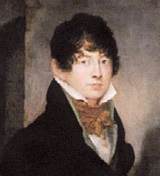
American painter and writer, considered the most important artistic personality of the first generation of RomanticismGLOSSARYA term loosely applied to literary and artistic movements of the late 18th and 19th centuries. Resulting in part from the libertarian and egalitarian ideals of the French Revolution, the romantic movements had in common only a revolt against the prescribed rules of classicism. The basic aims of romanticism were various: a return to nature and to belief in the goodness of humanity; the rediscovery of the artist as a supremely individual creator; the development of nationalistic pride; and the exaltation of the senses and emotions over reason and intellect. In addition, romanticism was a philosophical revolt against rationalism. in the USA. Samuel Taylor Coleridge, who met him in Rome and whose portraitGLOSSARYThe Roman portrait bust survived in the form of life-sized reliquaries of saints, but it was in 15th century Florence that the individual features and character of a contemporary sitter were accurately recorded by sculptors such as Donatello, Desiderio da Settignano, Mino da Fiesole and the Rossellino. A similar degree of realism occurs in 15th century tomb sculpture. The equestrian portrait, based on antique statues such as the Marcus Aurelius monument (Rome, Campidoglio), was revived in the 14th century. Two examples in fresco are Simone Martini's Guidoriccio (c. 1328; Siena, Palazzo Pubblico) and the posthumous portrait of Sir John Hawkwood (1436; Florence, Cathedral) by Uccello, which gives the illusion of a 3-dimensional statue seen from below. The Venetian Republic ordered imposing monuments from Donatello (1447; Gattarnelata, Padua) and Verrocchio (14799; Colleoni, Venice), whilst other statesmen ordered their own images to be erected in public places, directly relating themselves to the military heroes of ancient Rome. Another form of political portraiture derived from antiquity was the commemorative portrait medal designed by artists such as Pisanello. The carved or painted profile portrait became popular in the 1450s. The realism of the clear, flattened image, painted under the influence of Flemish examples by the Pollaiuolo brothers, Piero della Francesca and Botticelli, was superseded by the three-quarter and frontal portrait, psychologically more complex, such as Leonardo's enigmatic Mona Lisa (Paris, Louvre) with her momentary smile or Andrea del Sarto's arresting Portrait of a Man (London, National Gallery). The 16th century portrait became generalized, Lotto's Andrea Odoni (1527; Royal Collection) being an idealized concept of a collector rather than an individual. Group portraits, decorating whole rooms, include the narrative scenes of the Gonzaga court painted by Mantegna (completed 1474; Mantua, Palazzo Ducale) and the elaborate schemes commissioned by the Farnese family in Rome from Vasari (1546; Palazzo della Cancelleria) and Salviati (after 1553; Palazzo Farnese). Portraits were also incorporated into religious narratives, as in Ghirlandaio's fresco cycle painted for Giovanni Tornabuoni in S. Maria Novella, Florence (1486-90). Allston painted (National Portrait GalleryGLOSSARYan upper story, similar to a tribune, running along the side of a building and open on one side to the interior; in a church (basilica) above the side aisles, over the ambulatory (central-plan building) and also over the west end. The gallery was used to keep certain groups of worshippers apart (women, noblemen)., London), considered him 'a man of... high and rare geniusGLOSSARYin classical Rome, a person's invisible tutelary god. In art from the classical period onwards, the low-ranking god was depicted as a winged, usually childish figure. ... whether I contemplate him in the character of a Poet, a Painter, or a Philosophic Analyst'.
The son of a prominent South Carolina plantation owner of English descent, he began to draw around the age of six, and he moved to his uncle's home in Newport, RI, at the age of eight. While there he came into contact with the portrait painter Samuel King, but it was the exhibited portraits of Robert Edge Pine that offered him inspiring models of glazing and colouring.
Allston spent his working life in Boston apart from two lengthy visits to Europe: during the first, 1801-08, he studied under Benjamin West at the Royal Academy, subsequently visiting France with John Vanderlyn; the second stay in England was from 1811 to 1818. Up to c. 1818 his Romanticism expressed itself in the grandiose and dramatic, and his large canvases exploited the mysterious, monumental, and terrific aspects of nature {The Rising of a Thunderstorm at Sea, Museum of Fine Arts, Boston, 1804). In his later period he was a forerunner of the subjective and visionary trend in American landscape painting, which relied more upon mood and reverie than upon observation or drama, as in his famous Moonlight Landscape (Museum of Fine Arts, Boston, 1819). Through his pupil Morse this type of landscape painting became indigenous to the USA.
Allston's writing included poetry, a GothicGLOSSARYGothic, which may well have originated with Alberti as a derogatory term and which certainly corresponds to Vasari's 'maniera tedesca' ('German style'), is properly the descriptive term for an artistic style which achieved its first full flowering in the Ile de France and the surrounding areas in the period between c. 1200 and c. 1270, and which then spread throughout northern Europe. It is characterized by the hitherto unprecedented integration of the arts of sculpture, painting, stained glass and architecture which is epitomized in the great cathedrals of Chartres, Amiens, and Reims or in the Sainte Chapelle in Paris. In all the arts the predominantly planar forms of the Romanesque are replaced by an emphasis on line. There is a transcendental quality, whether in the soaring forms of the pointed arches or in the new stress on the humanity of Christ, which similarly distinguishes it from the preceding Romanesque style. In thinking of Nicola (d. c. 1284) or Giovanni Pisano (d. after 1314) there is same danger of forgetting what had happened in French sculpture half a century or more earlier, and likewise it is hard to remember that the spectacular achievements of early Renaissance art are a singularly localized eddy in the continuing stream of late gothic European art. By northern European standards few Italian works of art can be called gothic without qualification, and the story of 13th and 14th century Italian architecture is as much one of resistance to the new style as of its reception, whether directly from France or through German or central European intermediaries. In sculpture and in painting, the Italian reluctance to distort the human figure, conditioned by a never wholly submerged awareness of the omnipresent antique heritage, gives a special quality to the work of even those artists such as Giovanni Pisano or Simone Martini who most closely approached a pure gothic style. Nevertheless, the vitalizing role of Northern gothic art throughout the early Renaissance and the period leading up to it should never be underestimated. The artistic, like the cultural and commercial, interaction was continuous and much of the Italian achievement is incomprehensible if seen in isolation. It is not merely at the level of direct exchanges between one artist and another, or the influence of one building; painting, manuscript or piece of sculpture upon another, that the effects are to be felt. The streaming quality of line which is so characteristic of Brunelleschi's early Renaissance architecture surely reflects a sensitivity to the gothic contribution which is entirely independent of, and lies much deeper than, the superficial particularities of form. The counterflow of influence and inspiration from South to North must likewise not be underrated. In particular, the contribution of Italian painters from Duccio and Simone Martini onwards is central to the evolution of the so-called International Gothic style developing in Burgundy, Bohemia and north Italy in the late 14th and early 15th centuries. novel entitled Monaldi (1841), and the posthumously published Lectures on Art (1850).