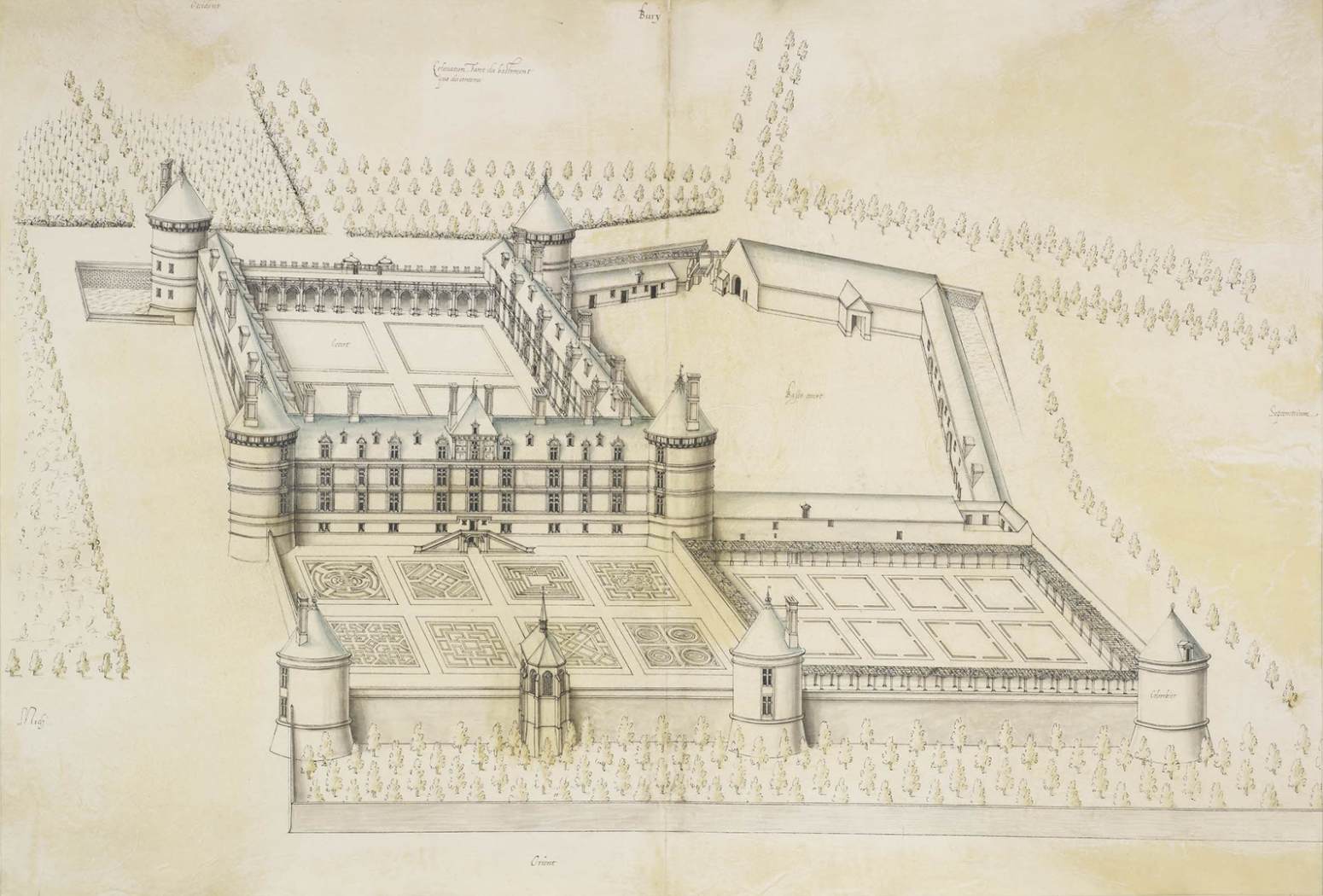
Château de Bury c. 1570 Pen and black inkColoured fluid used for writing, drawing, or printing. Inks usually have staining power without body, but printers' inks are pigments mixed with oil and varnish, and are opaque. The use of inks goes back in China and Egypt to at least 2500 BC. They were usually made from lampblack (a pigment made from soot) or a red ochre ground into a solution of glue or gums. These materials were moulded into dry sticks or blocks, which were then mixed with water for use. Ink brought from China or Japan in such dry form came to be known in the West as 'Chinese ink' or 'Indian ink'. The names are also given to a similar preparation made in Europe. on vellum, 501 x 743 mm British Museum, London
The Renaissance Château de Bury (near Blois, Loir-et-Cher) was ruined in the 17th century, it is known from engravings. It was built between 1511 and 1515, and can be considered a precursor of the great chateax of the Loire Valley built between 1515 and 1525, such as Chenonceau, Azay-le-Rideau and Chambord.
This drawing is one of the three drawings on the Château de Bury drawn by Du Cerceau for for the album 'Les plus excellents bastiments de France'. It is a bird's eye view seen from the east; in the foreground the formal gardens and at right the dovecote, and beyond the building with its circular turrets, the main courtyard at right and another courtyard at right.