03 — ARTWORK
Prophets
- MEDIUM
- Fresco
- TYPE
- Religious
PALETTE
HOVER OR TAP A SWATCH FOR NAME, SHARE AND HEX. SAMPLED FROM THE IMAGE — INDICATIVE, NOT A PIGMENT ANALYSIS.
DEVELOPMENT BUILD — NOT FOR PUBLIC USE. CONTRIBUTE ON GITHUB.
03 — ARTWORK
PALETTE
HOVER OR TAP A SWATCH FOR NAME, SHARE AND HEX. SAMPLED FROM THE IMAGE — INDICATIVE, NOT A PIGMENT ANALYSIS.
COMMENTARY
UNDERLINED TERMS ARE DEFINED IN THE GLOSSARY.
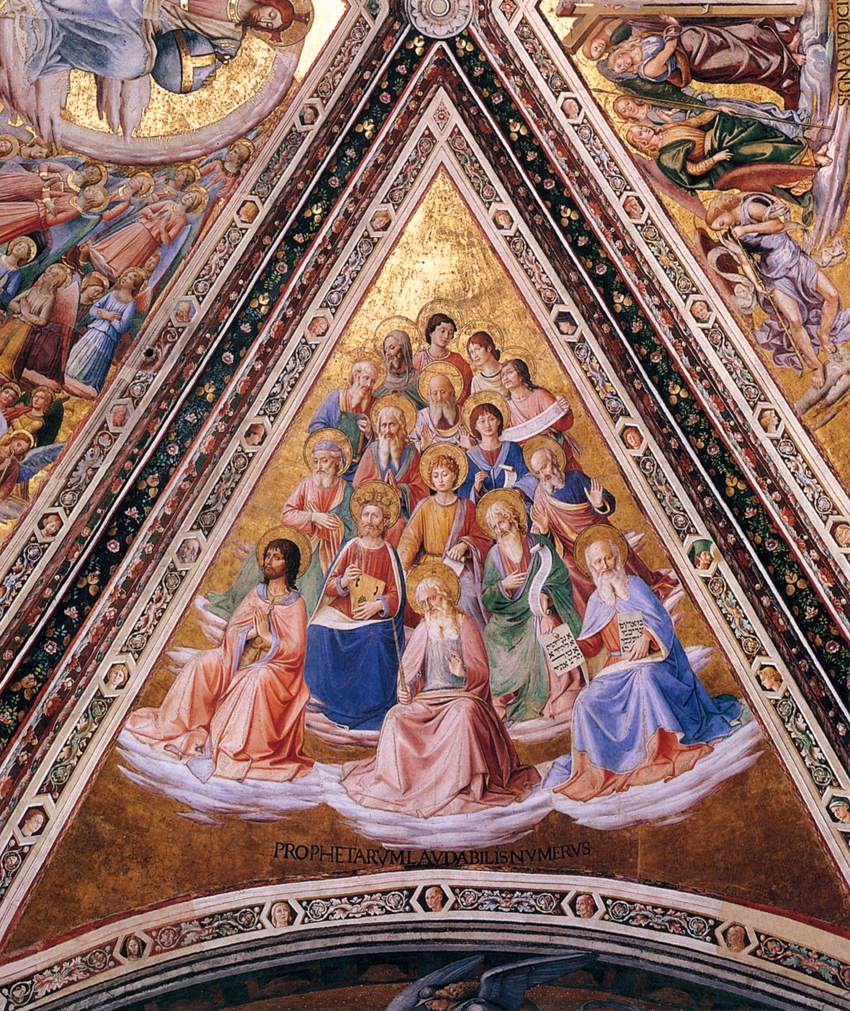
In the summer of 1447 Fra Angelico, assisted by Benozzo Gozzoli and several other minor artists, had painted a frescoWall painting technique in which pigments are applied to wet (fresh) plaster (intonaco). The pigments bind with the drying plaster to form a very durable image. Only a small area can be painted in a day, and these areas, drying to a slightly different tint, can in time be seen. Small amounts of retouching and detail work could be carried out on the dry plaster, a technique known as a secco fresco. of the Prophets in one of the triangular ceiling vaults and Christ the Judge in another in the Chapela small separate place for worship, either part of a large church or a separate building. of San Brizio, a large GothicGothic, which may well have originated with Alberti as a derogatory term and which certainly corresponds to Vasari's 'maniera tedesca' ('German style'), is properly the descriptive term for an artistic style which achieved its first full flowering in the Ile de France and the surrounding areas in the period between c. 1200 and c. 1270, and which then spread throughout northern Europe. It is characterized by the hitherto unprecedented integration of the arts of sculpture, painting, stained glass and architecture which is epitomized in the great cathedrals of Chartres, Amiens, and Reims or in the Sainte Chapelle in Paris. In all the arts the predominantly planar forms of the Romanesque are replaced by an emphasis on line. There is a transcendental quality, whether in the soaring forms of the pointed arches or in the new stress on the humanity of Christ, which similarly distinguishes it from the preceding Romanesque style. In thinking of Nicola (d. c. 1284) or Giovanni Pisano (d. after 1314) there is same danger of forgetting what had happened in French sculpture half a century or more earlier, and likewise it is hard to remember that the spectacular achievements of early Renaissance art are a singularly localized eddy in the continuing stream of late gothic European art. By northern European standards few Italian works of art can be called gothic without qualification, and the story of 13th and 14th century Italian architecture is as much one of resistance to the new style as of its reception, whether directly from France or through German or central European intermediaries. In sculpture and in painting, the Italian reluctance to distort the human figure, conditioned by a never wholly submerged awareness of the omnipresent antique heritage, gives a special quality to the work of even those artists such as Giovanni Pisano or Simone Martini who most closely approached a pure gothic style. Nevertheless, the vitalizing role of Northern gothic art throughout the early Renaissance and the period leading up to it should never be underestimated. The artistic, like the cultural and commercial, interaction was continuous and much of the Italian achievement is incomprehensible if seen in isolation. It is not merely at the level of direct exchanges between one artist and another, or the influence of one building; painting, manuscript or piece of sculpture upon another, that the effects are to be felt. The streaming quality of line which is so characteristic of Brunelleschi's early Renaissance architecture surely reflects a sensitivity to the gothic contribution which is entirely independent of, and lies much deeper than, the superficial particularities of form. The counterflow of influence and inspiration from South to North must likewise not be underrated. In particular, the contribution of Italian painters from Duccio and Simone Martini onwards is central to the evolution of the so-called International Gothic style developing in Burgundy, Bohemia and north Italy in the late 14th and early 15th centuries. construction built around 1408 in the Orvieto CathedralThe principal church of a province or diocese, where the throne of the bishop is placed. For reasons lost to time and tradition, a cathedral always faces west - toward the setting sun. The altar is placed at the east end. The main body, or nave, of the cathedral is usually divided into one main and two side aisles. These lead up to the north and south transepts, or arms of the cross, the shape in which a cathedral is usually formed.. The remaining sections of the ceiling were <A onclick="return OpenOther('/html/s/signorel/brizio/index.html')" HREF="/html/s/signorel/brizio/index.html">painted by Luca Signorelli</A> in 1499-1502.
In the quadrant adjacent to that show wing Christ the Judge, Angelico portrayed Old Testament prophets whose writings, it was believed, foretold the coming of Christ. Like Christ, they are painted against a golden ground and suspended on clouds, their garments radiant with the reflected light of his glory(1) The supernatural radiance surrounding a holy person. (2) To have the distinction of one's deeds recognized in life and to be revered for them posthumously: this was glory. The nature of true gloria was much discussed, whether it must be connected with the public good, whether the actions that led to it must conform with Christian ethics, how it differed from notoriety. The concept did not exclude religious figures (the title of the church of the Frari in Venice was S. Maria Gloriosa), but it was overwhelmingly seen in terms of secular success and subsequent recognition, as determining the lifestyles of the potent and the form of their commemoration in literature, in portraits and on tombs. As such, it has been taken as a denial of medieval religiosity ('sic transit gloria mundi'), and thus a hallmark of Renaissance individual ism; as a formidable influence on cultural patronage; and as spurring on men of action, as well as writers and artists, to surpass their rivals - including their counterparts in antiquity.. Angelico varied their ages, appearance and attributes, conveying the personality of each man, from the introspective King David, fingering his harp as he composes his psalms, to Moses, his face and azure mantleAn overcoat, worn open, popular during the second half of the 15th century and the 16th century and often lined with fur along the hem and around the collar. It reached to the knee or foot, depending on the social class of the wearer. glowing with the light of God. The tablets held by Moses are inscribed with the first of the Ten Commandments in Hebrew.
@online{wga-r4958e8bd3a2f40,
  author       = {Krén, Emil and Marx, Daniel},
  title        = {Prophets by ANGELICO, Fra},
  organization = {{Web Gallery of Art}},
  date         = {2026-09-13},
  url          = {https://beta.wga.hu/artists/angelico-fra-rf8b8fb374667eb/prophets-r4958e8bd3a2f40},
  urldate      = {2026-09-13},
  langid       = {english}
}
ACCESSED 2026-09-13. REPLACE THE AUTHOR FIELD WITH THE COMMENTARY AUTHOR WHERE ONE IS NAMED.


