02 — ARTIST
ANGUISSOLA, Sofonisba
b. 1530 Cremona · d. 1625 Palermo
DEVELOPMENT BUILD — NOT FOR PUBLIC USE. CONTRIBUTE ON GITHUB.
02 — ARTIST
b. 1530 Cremona · d. 1625 Palermo
BIOGRAPHY
Italian portrait painter from Cremona, the first woman artist to achieve international renown. She was one of six painter sisters: (1) Sofonisba, (2) Lucia (c. 1542–c. 1578), Europa (c. 1542–c. 1578), Elena (fl 1546–84), Minerva (fl 1558–69) and Anna-Maria (c. 1555–c. 1611).
Their humanist father gave the sisters extraordinary classical educations. He promoted them and their work shamelessly, sending Sofonisba's drawings to Michelangelo and eventually securing her service as lady-in-waiting to the queen of Spain, Elizabeth of Valois (1454-68), a position that gave her opportunities for painting formal court portraits that followed the norms for that type of imagery. While in Spain she married the brother of the Viceroy of Sicily. Upon hes death she remarried and moved to Genoa and finally to Palermo in Sicily where she retired and was famously visited by Van Dyck in 1623, when she was in her nineties.
Sofonisba was the best known of the sisters, she was trained, with Elena, by Bernardino Campi and Gatti. Most of Vasari's account of his visit to the Anguissola family is devoted to Sofonisba, about whom he wrote: 'Anguissola has shown greater application and better grace than any other woman of our age in her endeavours at drawing; she has thus succeeded not only in drawing, colouring and painting from nature, and copying excellently from others, but by herself has created rare and very beautiful paintings'. Sofonisba's privileged background was unusual among woman artists of the 16th century, most of whom, like Lavinia Fontana, Fede Galizia and Barbara Longhi, were daughters of painters. Her social class did not, however, enable her to transcend the constraints of her sex. Without the possibility of studying anatomy, or drawing from life, she could not undertake the complex multi-figure compositions required for large-scale religious or history paintings. She turned instead to the models accessible to her, exploring a new type of portraiture with sitters in informal domestic settings.
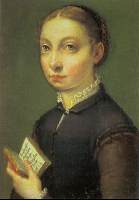
The influence of Campi, whose reputation was based on portraiture, is evident in her early works, such as the Self-portrait (Florence, Uffizi). Her work was allied to the worldly tradition of Cremona, much influenced by the art of Parma and Mantua, in which even religious works were imbued with extreme delicacy and charm. From Gatti she seems to have absorbed elements reminiscent of Correggio, beginning a trend that became marked in Cremonese painting of the late 16th century. This new direction is reflected in Lucia, Minerva and Europa Anguissola Playing Chess (1555; Poznan, Muzeum Narodowe) in which portraiture merges into a quasi-genre scene, a characteristic derived from Brescian models.
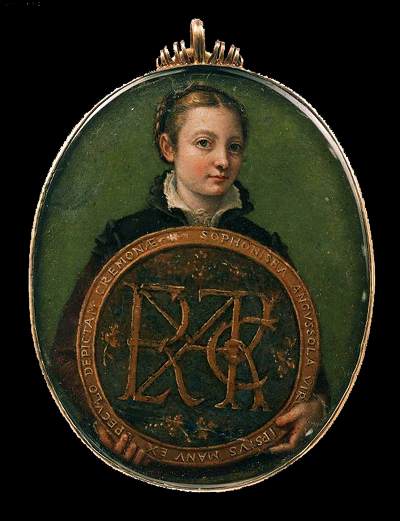
Aristocratic, intelligent, extraordinarily well-connected, she amazed all her contemporaries. Her self-portraits and portraits of her family are considered her finest works; they are somewhat stiff, but can have great charm.
12 RECORDS




@online{wga-anguissola-sofonisba,
  author       = {Krén, Emil and Marx, Daniel},
  title        = {ANGUISSOLA, Sofonisba},
  organization = {{Web Gallery of Art}},
  date         = {2026-09-08},
  url          = {https://beta.wga.hu/artists/anguissola-sofonisba-ra18e87a5d9cbe7},
  urldate      = {2026-09-08},
  langid       = {english}
}
ACCESSED 2026-09-08. REPLACE THE AUTHOR FIELD WITH THE COMMENTARY AUTHOR WHERE ONE IS NAMED.