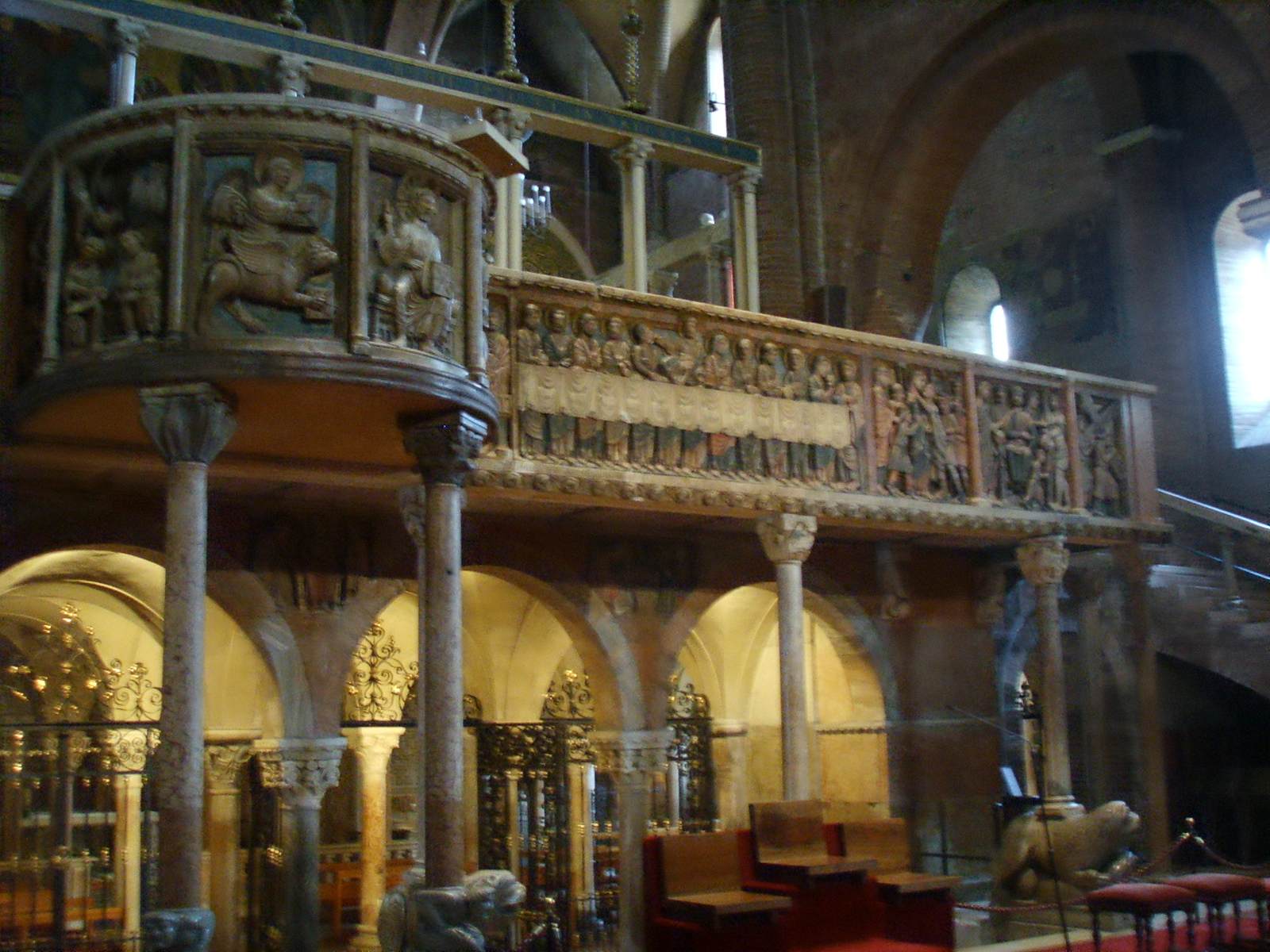
03 — ARTWORK
Parapet
- MEDIUM
- Marble
- TYPE
- Religious
PALETTE
HOVER OR TAP A SWATCH FOR NAME, SHARE AND HEX. SAMPLED FROM THE IMAGE — INDICATIVE, NOT A PIGMENT ANALYSIS.
DEVELOPMENT BUILD — NOT FOR PUBLIC USE. CONTRIBUTE ON GITHUB.
03 — ARTWORK
PALETTE
HOVER OR TAP A SWATCH FOR NAME, SHARE AND HEX. SAMPLED FROM THE IMAGE — INDICATIVE, NOT A PIGMENT ANALYSIS.
COMMENTARY
UNDERLINED TERMS ARE DEFINED IN THE GLOSSARY.
The group of sculptors and architects, who were active in northern Italy and elsewhere from the mid-12th century to the late 14th and originated from Campione (Campigliono) di Lugano, has been termed "Campionesi" in the 19th century.
The earliest document mentioning the masters from Campione is a contract dated 30 November 1244 between Ubaldino, Director (Massaro) of the CathedralThe principal church of a province or diocese, where the throne of the bishop is placed. For reasons lost to time and tradition, a cathedral always faces west - toward the setting sun. The altar is placed at the east end. The main body, or nave, of the cathedral is usually divided into one main and two side aisles. These lead up to the north and south transepts, or arms of the cross, the shape in which a cathedral is usually formed. Works of Modena from 1230 to 1263, and Enrico di Ottavio da Campione, who undertook, on behalf of himself and his heirs, to work for the cathedral in perpetuum. This contract was a renewal of an earlier one drawn up between Alberto, Director from 1190 to 1208, and Anselmo, the grandfather of Enrico. The names of Anselmo's three sons, Alberto, Jacopo, and Ottavio (father of Enrico), are also cited in the document. From the chronology it can be deduced that in the second half of the 12th century a master from Campione named Anselmo was installed as Master of the Works at the Cathedral, which was consecrated in 1184.
A document dated 1261 mentions that the workshop of the Campionesi was situated on cathedral property between the church and the Ghirlandina bell-tower, but there are no documents allocating responsibility for particular works within the cathedral to a specific master. The marbleloosely applied to any hard limestone that can be sawn into thin slabs and will take a good polish so that it is suitable for decorative work; more strictly, it refers to metamorphosed limestones whose structure has been recrystallized by heat or pressure. Marbles are widely disseminated and occur in a great variety of colours and patterns, but certain types have been particularly prized by sculptors. The most famous of Greek white marbles in the ancient world was the close-grained Pentelic, which was quarried at Mount Pentelicon in Attica. The Elgin Marbles are carved in Pentelic. Widely used also were the somewhat coarser-grained translucent white marbles from the Aegean islands of Paros and Naxos. Parian marble was used for the celebrated Mausoleum at Halicarnassus. The pure white Carrara marble, quarried at Massa, Carrara, and Pietra Santa in Tuscany from the 3rd century BC, is the most famous of all sculptors' stones. It was used for the Apollo Belvedere, and was much favoured in the Renaissance, particularly by Michelangelo, who often visited the quarries to select material for his work. Neoclassical sculptors also favoured Carrara marble because of its ability to take a smooth, sleek surface, but it can look rather 'dead' compared with some of the finest Greek marbles. parapet between the central navethe main interior space of a church building. It may have parallel aisles on each side, often separated from it by pillars, and is intersected by the transept, which cuts across it at the point where the choir begins. and the cryptunderground chamber beneath the altar in a church, usually containing a saint's relics. Though the chamber is underneath the choir, it can extend as far as the crossing. It is not always completely underground, so that the choir and altar sometimes considerably higher than the nave and aisles; as a result, very impressive flights of steps were built to connect nave and choir. (also considered as rod screen) is unanimously attributed to Anselmo and his collaborators; Anselmo himself is credited with the PassionThe events leading up to Good Friday, beginning with Christ's arrest and ending with his burial. Portrayals of the Passion, which focus on the Suffering Christ, include depictions of Judas betraying Christ with a kiss, Peter cutting off Malchus's ear, the crown of thorns, and so on. scenes, from Christ Washing the Feet of the Disciples to Christ Carrying the Cross. The work of four collaborators can also be identified on the screen. Other works at the cathedral attributed to Anselmo's followers are the pulpit (erected under Bozzalino, Director from 1208 to 1225), the altar, the crypt capitals, work on the façadethe front or principal face of a building, especially one elaborately constructed; a blind façade is a façade that is purely decorative and does not relate to the structure of the building., including the rose windowa circular window, usually large, filled with tracery., and the Porta Regia (1209–31) on the south flank of the nave, which has a porch supported by two columns of ophite, one twisted and the other hexagonal, a characteristic feature of later works by the Campionesi. The last of these masters active at Modena was Enrico II, who completed the Ghirlandina bell-tower (1319) and the free-standing pulpit in the nave (1322).
@online{wga-rbe89960174e9a0,
  author       = {Krén, Emil and Marx, Daniel},
  title        = {Parapet by ANSELMO DA CAMPIONE},
  organization = {{Web Gallery of Art}},
  date         = {2026-09-12},
  url          = {https://beta.wga.hu/artists/anselmo-da-campione-r0bf38e7938cfd5/parapet-rbe89960174e9a0},
  urldate      = {2026-09-12},
  langid       = {english}
}
ACCESSED 2026-09-12. REPLACE THE AUTHOR FIELD WITH THE COMMENTARY AUTHOR WHERE ONE IS NAMED.


