03 — ARTWORK
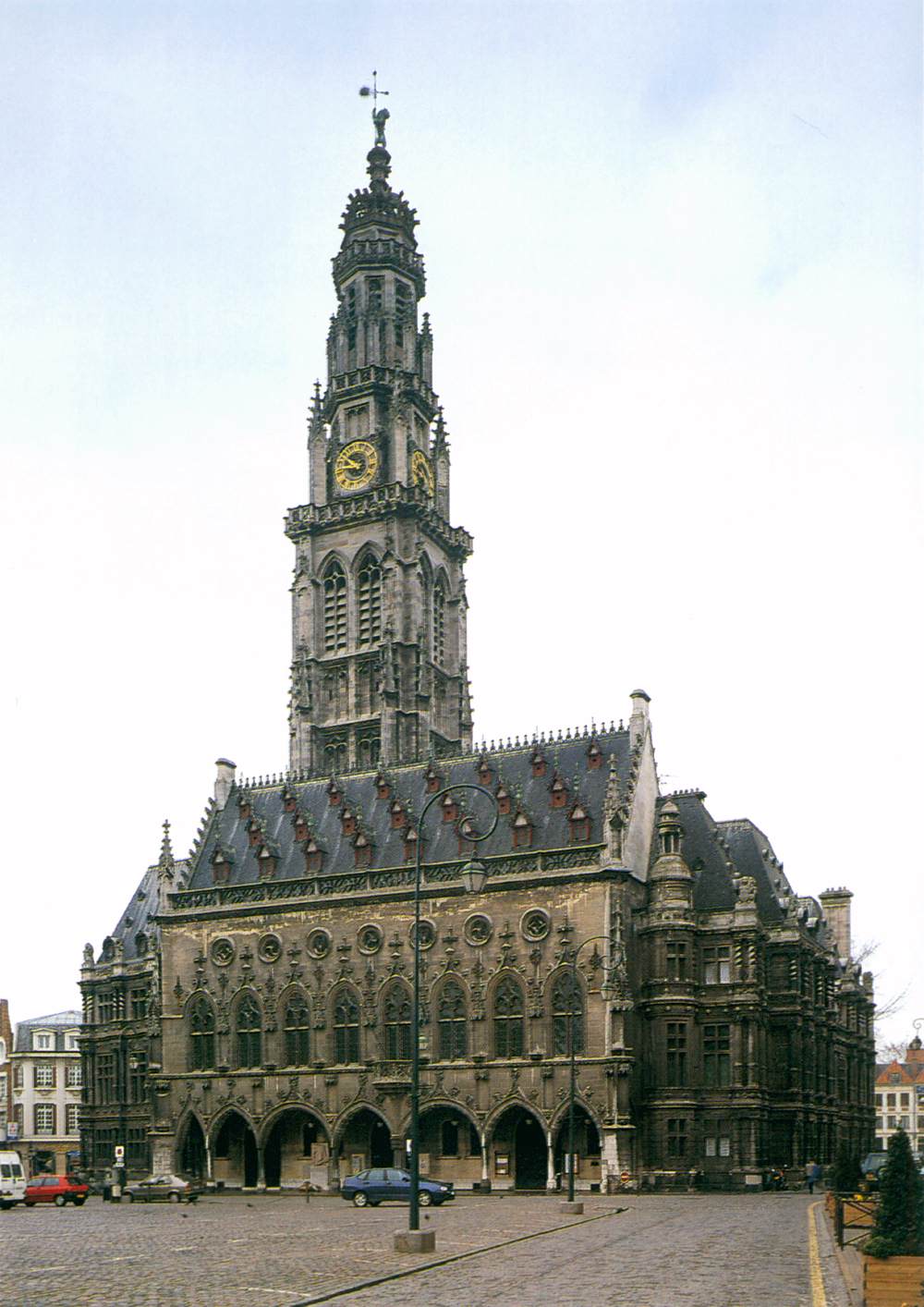
Exterior view
- MEDIUM
- Photo
- TYPE
- Other
PALETTE
HOVER OR TAP A SWATCH FOR NAME, SHARE AND HEX. SAMPLED FROM THE IMAGE — INDICATIVE, NOT A PIGMENT ANALYSIS.
DEVELOPMENT BUILD — NOT FOR PUBLIC USE. CONTRIBUTE ON GITHUB.
03 — ARTWORK
PALETTE
HOVER OR TAP A SWATCH FOR NAME, SHARE AND HEX. SAMPLED FROM THE IMAGE — INDICATIVE, NOT A PIGMENT ANALYSIS.
COMMENTARY
UNDERLINED TERMS ARE DEFINED IN THE GLOSSARY.
In the 16th century Arras was part of the Spanish Netherlands. The large communal building projects of towns in the Netherlands were the "halls" and town halls. The halls had a dual function as warehouses and as meeting rooms for the community. In addition, they were often also town halls in the modern sense, in other words administrative centres. As the expression of civic pride often took the widely visible form of huge towers in the Netherlands, these hall towers acquired more or less the same function as church towers and became more and more like them in appearance.
There is no fundamental difference between the cathedralThe principal church of a province or diocese, where the throne of the bishop is placed. For reasons lost to time and tradition, a cathedral always faces west - toward the setting sun. The altar is placed at the east end. The main body, or nave, of the cathedral is usually divided into one main and two side aisles. These lead up to the north and south transepts, or arms of the cross, the shape in which a cathedral is usually formed. towers of Utrecht or Antwerp and the towers of the Bruges cloth halls or the town halls of Brussels and Arras. The main architectural problem was the same: how to create a harmonic balance between the square basemolded foot of a pillar or column providing the transition from the plinth to the shaft. and the octagonal crown.
The photo shows the Town Hall in Arras, which was started in the 1450s and completed in the 16th century. The conclusion of the compact octagoneight-sided central plan building, or any building with eight sides; occurred frequently in the Middle Ages, not just in architecture, but also in the design of crowns, as eight was considered to be a perfect number. is in the form of a stirrup crown.
@online{wga-r8a53e05846554a,
  author       = {Krén, Emil and Marx, Daniel},
  title        = {Exterior view by ARCHITECT, Flemish},
  organization = {{Web Gallery of Art}},
  date         = {2026-09-13},
  url          = {https://beta.wga.hu/artists/architect-flemish-rb134fba63573a0/exterior-view-r8a53e05846554a},
  urldate      = {2026-09-13},
  langid       = {english}
}
ACCESSED 2026-09-13. REPLACE THE AUTHOR FIELD WITH THE COMMENTARY AUTHOR WHERE ONE IS NAMED.


