03 — ARTWORK
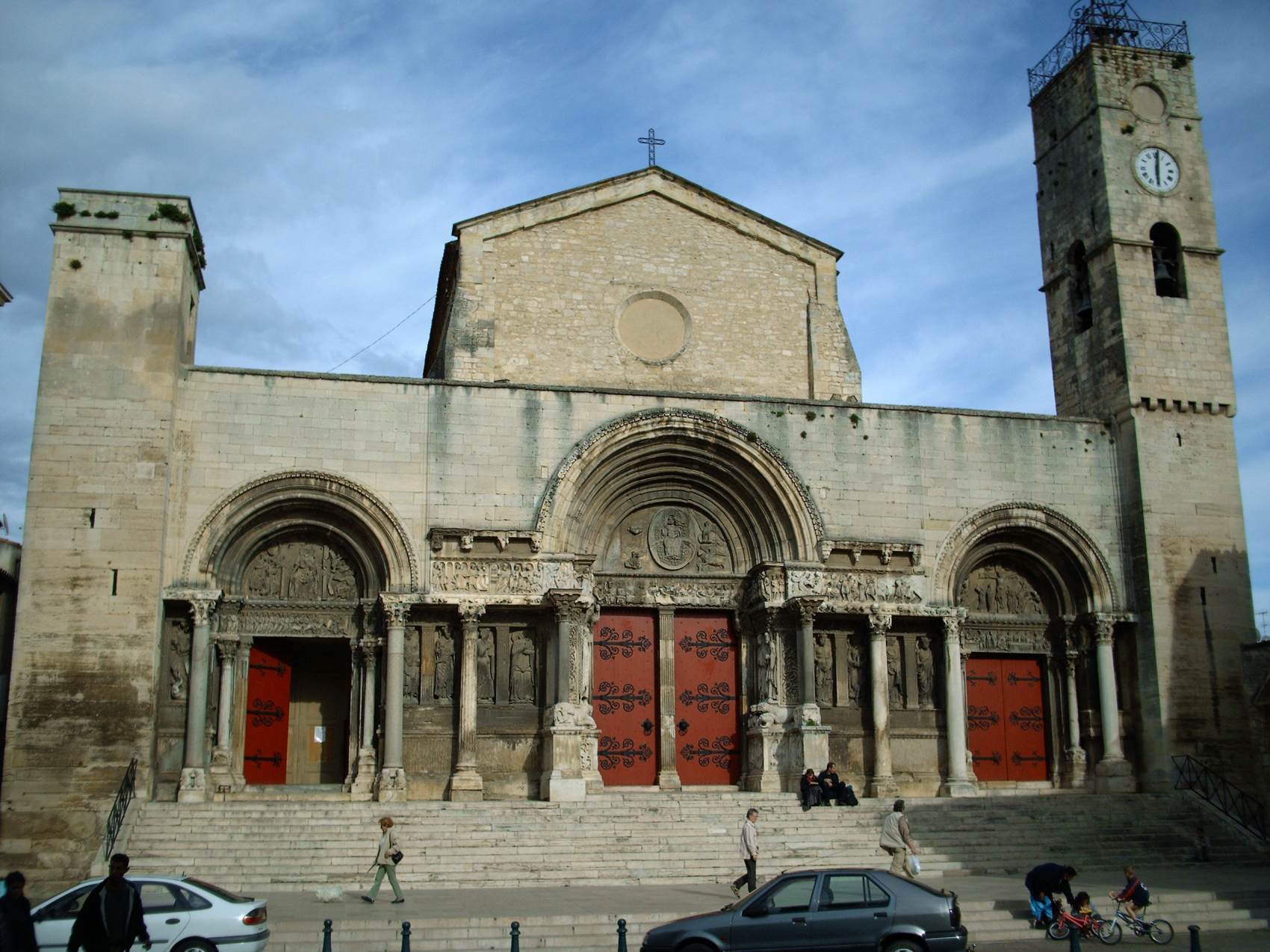
Exterior view
- MEDIUM
- Photo
- TYPE
- Other
PALETTE
HOVER OR TAP A SWATCH FOR NAME, SHARE AND HEX. SAMPLED FROM THE IMAGE — INDICATIVE, NOT A PIGMENT ANALYSIS.
DEVELOPMENT BUILD — NOT FOR PUBLIC USE. CONTRIBUTE ON GITHUB.
03 — ARTWORK
PALETTE
HOVER OR TAP A SWATCH FOR NAME, SHARE AND HEX. SAMPLED FROM THE IMAGE — INDICATIVE, NOT A PIGMENT ANALYSIS.
COMMENTARY
UNDERLINED TERMS ARE DEFINED IN THE GLOSSARY.
The abbey church of Saint-Gilles belongs to a former Cluniac monasterythe complex of buildings used by a community of monks. Among the main elements of the complex are the church, cloister, chapter house (used by the governing body), refectory (dining room) and dormitory (sleeping quarters). in the département of Gard in southern France, 16 km west of Arles. The present building was begun in the first half of the 11th century, when the shrine of the saint became a place of international pilgrimage. Constructed over three centuries and never completed, it consists of a large cryptunderground chamber beneath the altar in a church, usually containing a saint's relics. Though the chamber is underneath the choir, it can extend as far as the crossing. It is not always completely underground, so that the choir and altar sometimes considerably higher than the nave and aisles; as a result, very impressive flights of steps were built to connect nave and choir. or lower church surmounted by an equally large upper church. The earliest work is in the crypt; the latest, dating from the early 13th century, is in the unfinished east end of the upper church. The sculpted façadethe front or principal face of a building, especially one elaborately constructed; a blind façade is a façade that is purely decorative and does not relate to the structure of the building., executed in white marbleloosely applied to any hard limestone that can be sawn into thin slabs and will take a good polish so that it is suitable for decorative work; more strictly, it refers to metamorphosed limestones whose structure has been recrystallized by heat or pressure. Marbles are widely disseminated and occur in a great variety of colours and patterns, but certain types have been particularly prized by sculptors. The most famous of Greek white marbles in the ancient world was the close-grained Pentelic, which was quarried at Mount Pentelicon in Attica. The Elgin Marbles are carved in Pentelic. Widely used also were the somewhat coarser-grained translucent white marbles from the Aegean islands of Paros and Naxos. Parian marble was used for the celebrated Mausoleum at Halicarnassus. The pure white Carrara marble, quarried at Massa, Carrara, and Pietra Santa in Tuscany from the 3rd century BC, is the most famous of all sculptors' stones. It was used for the Apollo Belvedere, and was much favoured in the Renaissance, particularly by Michelangelo, who often visited the quarries to select material for his work. Neoclassical sculptors also favoured Carrara marble because of its ability to take a smooth, sleek surface, but it can look rather 'dead' compared with some of the finest Greek marbles. and limestone, is also unfinished. It suffered extensive damage and restoration in the 17th century as a result of the Wars of Religion, and further restoration was carried out in the 19th century. It still preserves one of the largest ensembles of RomanesqueStyle of art and architecture prevailing throughout most of Europe in the 11th and 12th centuries, the first style to achieve such international currency. The dominant art of the Middle Ages was architecture, and 'Romanesque', like 'Gothic', is primarily an architectural term that has been extended to the other arts of the period. As the name suggests, it indicates a derivation from Roman art, and sometimes Romanesque is used to cover all the developments from Roman architecture in the period from the collapse of the Roman Empire until the flowering of the Gothic roughly AD 500-1200. More usually, however, it is applied to a distinctive style that emerged, almost simultaneously, in several countries - France, Germany, Italy, Spain - in the 11th century. It is characterized most obviously by a new massiveness of scale, reflecting the greater political and economic stability that followed a period when Christian civilization seemed in danger of extinction. Romanesque painting and sculpture are generally strongly stylized, with little of the naturalism and humanistic warmth of classical or later Gothic art. The forms of nature are freely translated into linear and sculptural designs which are sometimes majestically calm and severe and at others are agitated by a visionary excitement that can become almost delirious. Because of its expressionistic distortion of natural form, Romanesque art, as with other great non-naturalistic styles of the past, has had to wait for the revolution in sensibility brought about by the development of modern art in order to be widely appreciated. sculpture, however, and is one of the most famous and controversial of medieval monuments. Approached by a flight of steps, the façade consists of three portals with tympana, an extensive friezea horizontal band of architectural decoration; in a classical entablature, the horizontal member band between the architrave and the cornice., and large figures of the Twelve Apostles and two angels, set in niches. The articulation is provided by free-standing columns, some of which are reused Roman work, with Corinthian capitals and other ornamental detail of ClassicalRelating to the culture of ancient Greece and Rome (classical Antiquity). The classical world played a profoundly important role in the Renaissance, with Italian scholars, writers, and artists seeing their own period as the rebirth (the "renaissance") of classical values after the Middle Ages. The classical world was considered the golden age for the arts, literature, philosophy, and politics. Concepts of the classical, however, changed greatly from one period to the next. Roman literature provided the starting point in the 14th century, scholars patiently finding, editing and translating a wide range of texts. In the 15th century Greek literature, philosophy and art - together with the close study of the remains of Roman buildings and sculptures-expanded the concept of the classical and ensured it remained a vital source of ideas and inspiration. form.
Discussion of the sculpture of façade the has centred on two issues: the date and the original form of the façade. As for the date, the opinion, which has gained ground more recently, is that most of the façade sculpture dates from the mid-12th century.
The façade of the church bears witness to the presence of Roman temples in the vicinity.
@online{wga-r154a28f9f30209,
  author       = {Krén, Emil and Marx, Daniel},
  title        = {Exterior view by ARCHITECT, French},
  organization = {{Web Gallery of Art}},
  date         = {2026-09-13},
  url          = {https://beta.wga.hu/artists/architect-french-rdae55df3ad7702/exterior-view-r154a28f9f30209},
  urldate      = {2026-09-13},
  langid       = {english}
}
ACCESSED 2026-09-13. REPLACE THE AUTHOR FIELD WITH THE COMMENTARY AUTHOR WHERE ONE IS NAMED.


