03 — ARTWORK
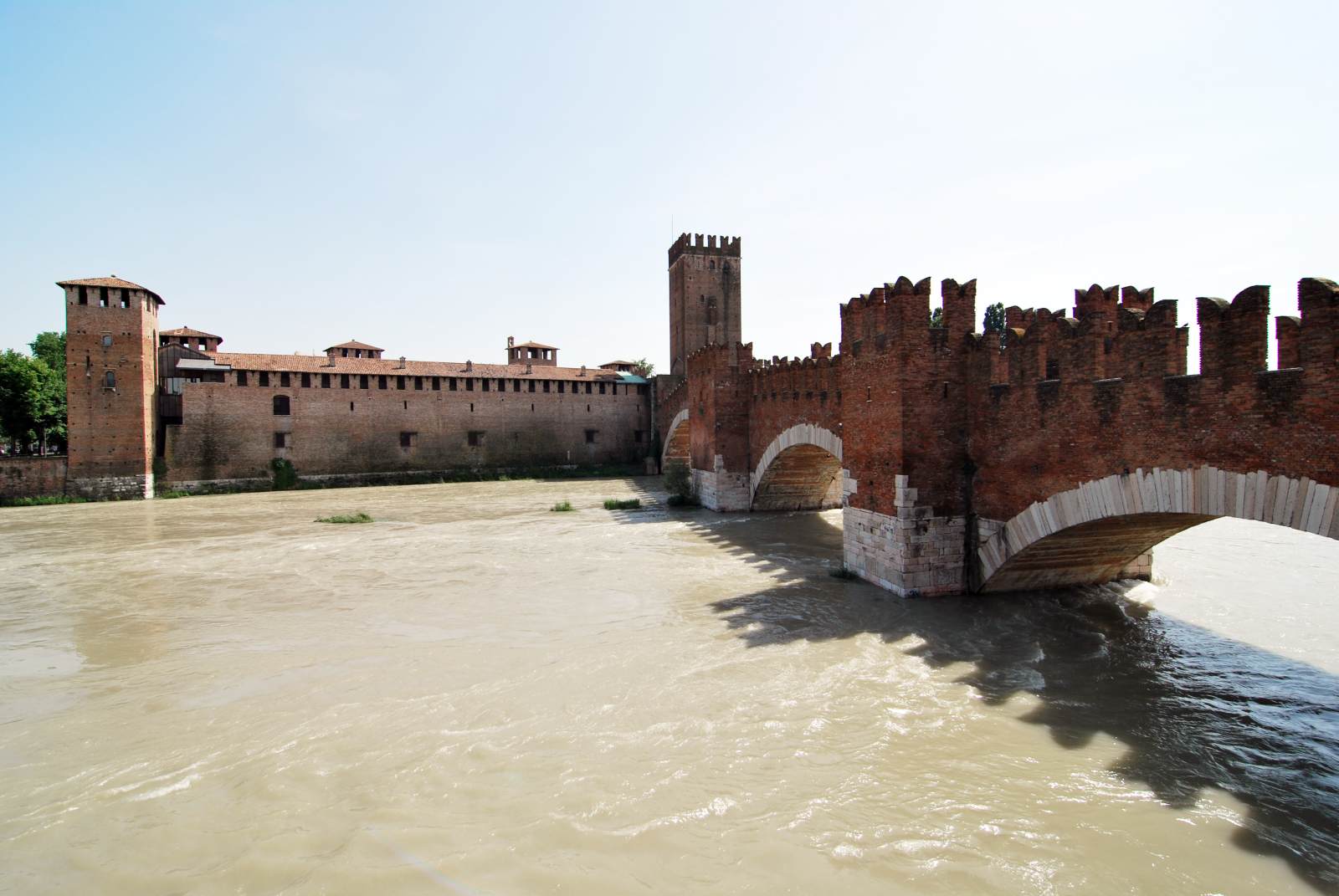
Exterior view
- MEDIUM
- Photo
- TYPE
- Other
PALETTE
HOVER OR TAP A SWATCH FOR NAME, SHARE AND HEX. SAMPLED FROM THE IMAGE — INDICATIVE, NOT A PIGMENT ANALYSIS.
DEVELOPMENT BUILD — NOT FOR PUBLIC USE. CONTRIBUTE ON GITHUB.
03 — ARTWORK
PALETTE
HOVER OR TAP A SWATCH FOR NAME, SHARE AND HEX. SAMPLED FROM THE IMAGE — INDICATIVE, NOT A PIGMENT ANALYSIS.
COMMENTARY
UNDERLINED TERMS ARE DEFINED IN THE GLOSSARY.
The Castelvecchio (Old Castle) in Verona is the most important military construction of the Scaliger dynasty that ruled the city in the Middle Ages. Most of the castle and the Ponte Scaligero, a fortified bridge which links the central fortress with the far side of the river Adige, were constructed for Cangrande II della Scala (1332-1359)between 1354 and 1356. The completion of the castle seems to have occurred c. 1375.
The castle is powerful and compact in its size with very little decoration - one square compound built in red bricks, one of the most prominent examples of GothicGothic, which may well have originated with Alberti as a derogatory term and which certainly corresponds to Vasari's 'maniera tedesca' ('German style'), is properly the descriptive term for an artistic style which achieved its first full flowering in the Ile de France and the surrounding areas in the period between c. 1200 and c. 1270, and which then spread throughout northern Europe. It is characterized by the hitherto unprecedented integration of the arts of sculpture, painting, stained glass and architecture which is epitomized in the great cathedrals of Chartres, Amiens, and Reims or in the Sainte Chapelle in Paris. In all the arts the predominantly planar forms of the Romanesque are replaced by an emphasis on line. There is a transcendental quality, whether in the soaring forms of the pointed arches or in the new stress on the humanity of Christ, which similarly distinguishes it from the preceding Romanesque style. In thinking of Nicola (d. c. 1284) or Giovanni Pisano (d. after 1314) there is same danger of forgetting what had happened in French sculpture half a century or more earlier, and likewise it is hard to remember that the spectacular achievements of early Renaissance art are a singularly localized eddy in the continuing stream of late gothic European art. By northern European standards few Italian works of art can be called gothic without qualification, and the story of 13th and 14th century Italian architecture is as much one of resistance to the new style as of its reception, whether directly from France or through German or central European intermediaries. In sculpture and in painting, the Italian reluctance to distort the human figure, conditioned by a never wholly submerged awareness of the omnipresent antique heritage, gives a special quality to the work of even those artists such as Giovanni Pisano or Simone Martini who most closely approached a pure gothic style. Nevertheless, the vitalizing role of Northern gothic art throughout the early Renaissance and the period leading up to it should never be underestimated. The artistic, like the cultural and commercial, interaction was continuous and much of the Italian achievement is incomprehensible if seen in isolation. It is not merely at the level of direct exchanges between one artist and another, or the influence of one building; painting, manuscript or piece of sculpture upon another, that the effects are to be felt. The streaming quality of line which is so characteristic of Brunelleschi's early Renaissance architecture surely reflects a sensitivity to the gothic contribution which is entirely independent of, and lies much deeper than, the superficial particularities of form. The counterflow of influence and inspiration from South to North must likewise not be underrated. In particular, the contribution of Italian painters from Duccio and Simone Martini onwards is central to the evolution of the so-called International Gothic style developing in Burgundy, Bohemia and north Italy in the late 14th and early 15th centuries. architecture of the age, with imposing M-shaped merlons running along the castle and bridge walls. It has seven towers, a superelevated keeptall, strong tower in medieval castles, used as an observation post and last refuge for those living in the castle, an, unlike the donjon, not designed for permanent habitation. (maschio) with four main buildings inside. The castle is surrounded by a ditch, now dry, which was once filled with waters from the nearby Adige. The castle is characterized by its long, low profile. There is litttle attempt at symmetry or at maintaining any abstract geometric pattern in the plan.
The bridge was completely but accurately reconstructed in 1949-51 after its destruction by the retreating German army in 1945. The three unequal spans of the bridge are fully castellated and are guarded by two successive drawbridges. The defences at the city end include another drawbridge and a tall, massive tower which flanks the road and acts as the main keep of the castle.
View the plan of Castelvecchio, Verona.
@online{wga-r980c77cfe0a57f,
  author       = {Krén, Emil and Marx, Daniel},
  title        = {Exterior view by ARCHITECT, Italian},
  organization = {{Web Gallery of Art}},
  date         = {2026-09-14},
  url          = {https://beta.wga.hu/artists/architect-italian-rba53e875123939/exterior-view-r980c77cfe0a57f},
  urldate      = {2026-09-14},
  langid       = {english}
}
ACCESSED 2026-09-14. REPLACE THE AUTHOR FIELD WITH THE COMMENTARY AUTHOR WHERE ONE IS NAMED.


