03 — ARTWORK
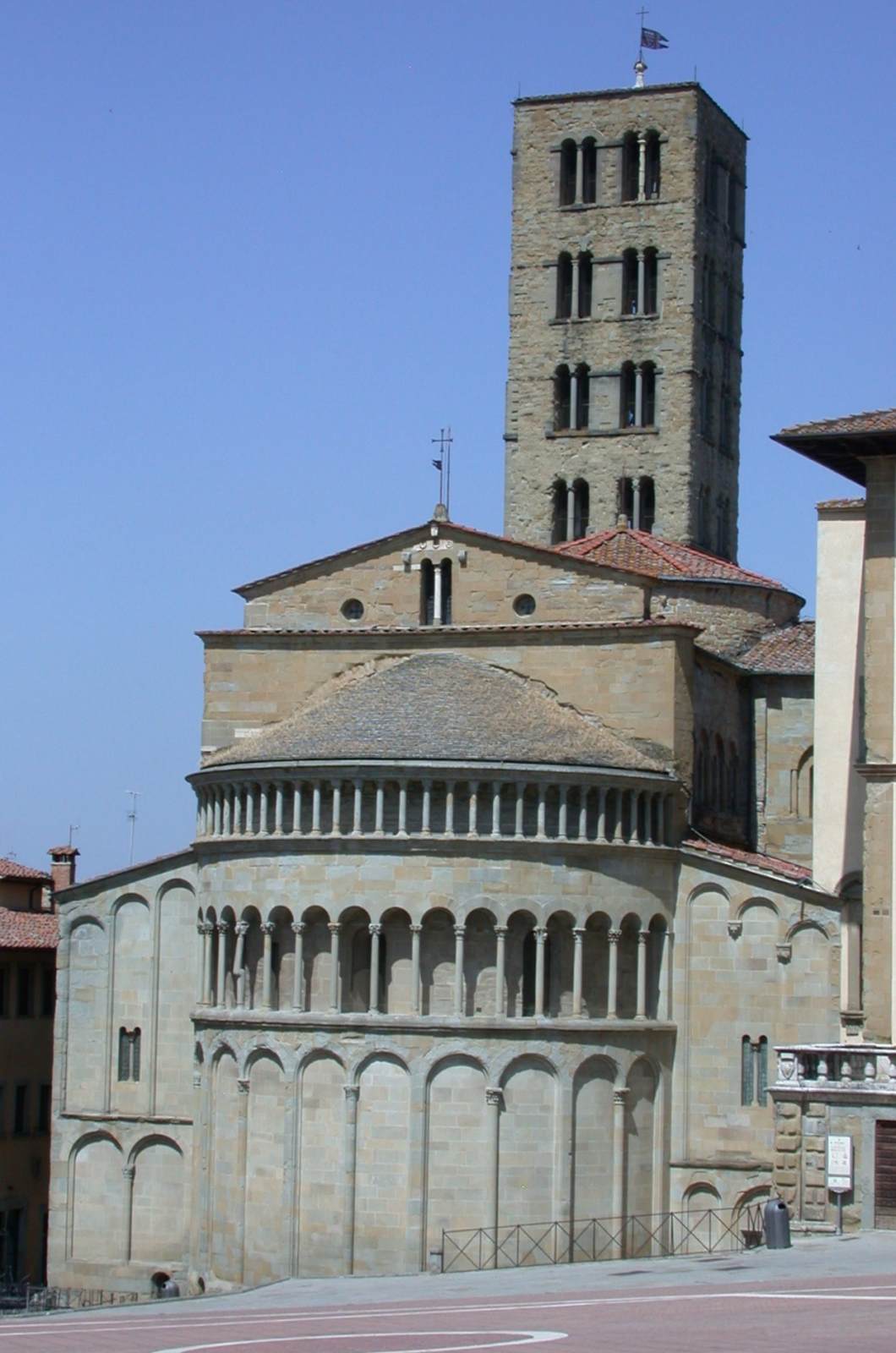
Exterior view
- MEDIUM
- Photo
- TYPE
- Other
PALETTE
HOVER OR TAP A SWATCH FOR NAME, SHARE AND HEX. SAMPLED FROM THE IMAGE — INDICATIVE, NOT A PIGMENT ANALYSIS.
DEVELOPMENT BUILD — NOT FOR PUBLIC USE. CONTRIBUTE ON GITHUB.
CURRENT LOCATION · Santa Maria della Pieve
03 — ARTWORK
PALETTE
HOVER OR TAP A SWATCH FOR NAME, SHARE AND HEX. SAMPLED FROM THE IMAGE — INDICATIVE, NOT A PIGMENT ANALYSIS.
COMMENTARY
UNDERLINED TERMS ARE DEFINED IN THE GLOSSARY.
The church is documented since as early as 1008, and, during the communal period of Arezzo, it was the stronghold of the city's struggle against its bishops. It was rebuilt in the 12th century. The bell tower was finished in 1330.
The church adopted a flattened porticoUsually open porch supported by columns or pillars on the main entrance side of a buildings. Frequently supports a pediment. entry similar to that at Pisa CathedralThe principal church of a province or diocese, where the throne of the bishop is placed. For reasons lost to time and tradition, a cathedral always faces west - toward the setting sun. The altar is placed at the east end. The main body, or nave, of the cathedral is usually divided into one main and two side aisles. These lead up to the north and south transepts, or arms of the cross, the shape in which a cathedral is usually formed.. Although geographically closer to Florence where a similar blindan arch or arcade with no opening, usually as decoration on a wall. porch frames three portals, the high reliefA sculptural work in which all or part projects from the flat surface. There are three basic forms: low relief (bas-relief, basso rilievo), in which figures project less than half their depth from the background; medium relief (mezzo-rilievo), in which figures are seen half round; and high relief (alto rilievo), in which figures are almost detached from their background. of the Pieve's second- and third-level arcades and fourth-level galleryan upper story, similar to a tribune, running along the side of a building and open on one side to the interior; in a church (basilica) above the side aisles, over the ambulatory (central-plan building) and also over the west end. The gallery was used to keep certain groups of worshippers apart (women, noblemen). shows a stronger debt to Pisa. The same applies to the treatment of architectural details, where the builders relied exclusively on sculpture for their articulation, abandoning polychromatic intarsiaInlaid cabinetwork composed of various woods. or the planar harmonic subdivision of San Miniato or the Florentine baptistry.
However dominant Pisa and Florence were at the time of the Pieve's interior and new façadethe front or principal face of a building, especially one elaborately constructed; a blind façade is a façade that is purely decorative and does not relate to the structure of the building., which were executed in the twelfth and early thirteenth century, the flat-roofed elevation and the later, early-fourteenth-century show traces from one of the earliest sources of Italian RomanesqueStyle of art and architecture prevailing throughout most of Europe in the 11th and 12th centuries, the first style to achieve such international currency. The dominant art of the Middle Ages was architecture, and 'Romanesque', like 'Gothic', is primarily an architectural term that has been extended to the other arts of the period. As the name suggests, it indicates a derivation from Roman art, and sometimes Romanesque is used to cover all the developments from Roman architecture in the period from the collapse of the Roman Empire until the flowering of the Gothic roughly AD 500-1200. More usually, however, it is applied to a distinctive style that emerged, almost simultaneously, in several countries - France, Germany, Italy, Spain - in the 11th century. It is characterized most obviously by a new massiveness of scale, reflecting the greater political and economic stability that followed a period when Christian civilization seemed in danger of extinction. Romanesque painting and sculpture are generally strongly stylized, with little of the naturalism and humanistic warmth of classical or later Gothic art. The forms of nature are freely translated into linear and sculptural designs which are sometimes majestically calm and severe and at others are agitated by a visionary excitement that can become almost delirious. Because of its expressionistic distortion of natural form, Romanesque art, as with other great non-naturalistic styles of the past, has had to wait for the revolution in sensibility brought about by the development of modern art in order to be widely appreciated. architecture, Ravenna.
The photo shows the apseA semicircular projection, roofed with a half-dome, at the east end of a church behind the altar. Smaller subsidiary apses may be found around the choir or transepts. Also known as an exedra. The adjective is apsidal. and the bell tower.
View the <a href="#" onClick="w=window.open ('/support/plans/zzzarchi/12c/3/pieve.html', 'newWin', 'scrollbars=yes,status=no,dependent=yes,screenX=0,screenY=0,width=400,height=600');w.opener=this;w.focus();return false">ground plan</a> of Santa Maria della Pieve, Arezzo.
@online{wga-rfb0659d9bbef50,
  author       = {Krén, Emil and Marx, Daniel},
  title        = {Exterior view by ARCHITECT, Italian},
  organization = {{Web Gallery of Art}},
  date         = {2026-09-13},
  url          = {https://beta.wga.hu/artists/architect-italian-rba53e875123939/exterior-view-rfb0659d9bbef50},
  urldate      = {2026-09-13},
  langid       = {english}
}
ACCESSED 2026-09-13. REPLACE THE AUTHOR FIELD WITH THE COMMENTARY AUTHOR WHERE ONE IS NAMED.


