03 — ARTWORK
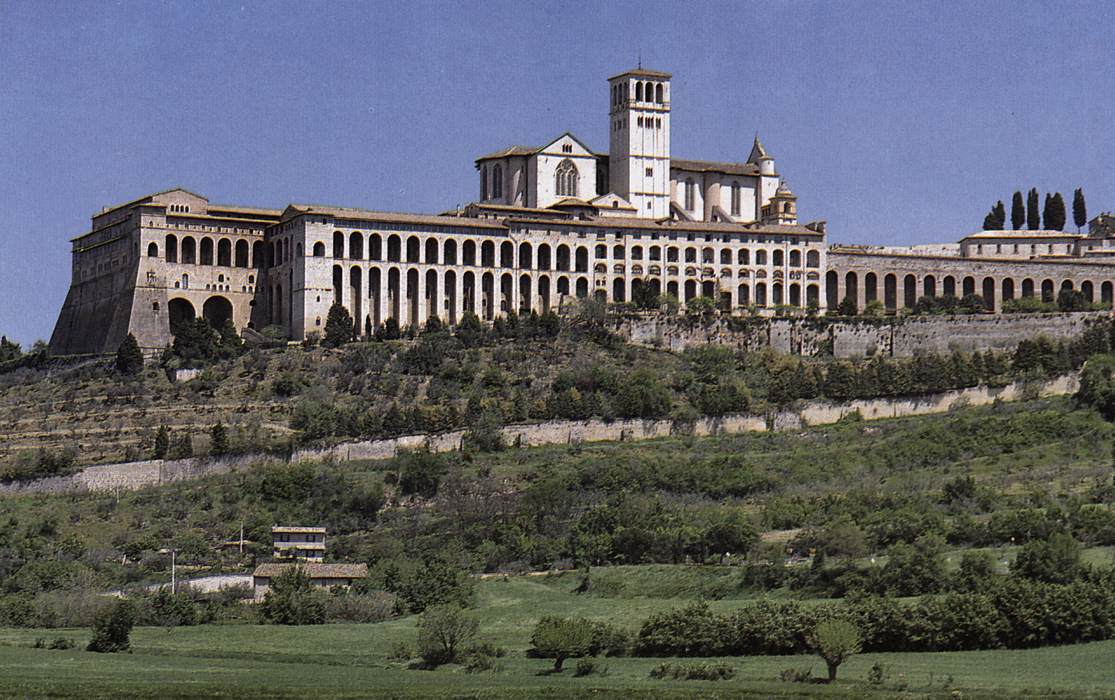
General view
- MEDIUM
- Photo
- TYPE
- Other
PALETTE
HOVER OR TAP A SWATCH FOR NAME, SHARE AND HEX. SAMPLED FROM THE IMAGE — INDICATIVE, NOT A PIGMENT ANALYSIS.
DEVELOPMENT BUILD — NOT FOR PUBLIC USE. CONTRIBUTE ON GITHUB.
03 — ARTWORK
PALETTE
HOVER OR TAP A SWATCH FOR NAME, SHARE AND HEX. SAMPLED FROM THE IMAGE — INDICATIVE, NOT A PIGMENT ANALYSIS.
COMMENTARY
UNDERLINED TERMS ARE DEFINED IN THE GLOSSARY.
San Francesco at Assisi consists of two superimposed churches, upper and lower churches. The first stone of the Lower Basilicaa church building, usually facing east, with a tall main nave and two or four side aisles of lesser height. There may also be a transept between the nave and the choir, which is reserved for the clergy. Originally, the basilica was an ancient Greek administrative building, and the Romans used this form for markets and law courts; it then became a place of assembly for the early Christians, and thus a church. was laid by Pope Gregory IX the day after the canonisation of St Francis, on July 17th 1228. Two years later the saint's body, that had been resting in the church of San Giorgio was brought here in secret for fear of looting by tomb raiders and buried in the unfinished church. No date has been recorded concerning the start of works on the Upper Basilica, but it must have been after the abdication from the order of Brother Elia in 1239, who had hitherto directed the works on the RomanesqueStyle of art and architecture prevailing throughout most of Europe in the 11th and 12th centuries, the first style to achieve such international currency. The dominant art of the Middle Ages was architecture, and 'Romanesque', like 'Gothic', is primarily an architectural term that has been extended to the other arts of the period. As the name suggests, it indicates a derivation from Roman art, and sometimes Romanesque is used to cover all the developments from Roman architecture in the period from the collapse of the Roman Empire until the flowering of the Gothic roughly AD 500-1200. More usually, however, it is applied to a distinctive style that emerged, almost simultaneously, in several countries - France, Germany, Italy, Spain - in the 11th century. It is characterized most obviously by a new massiveness of scale, reflecting the greater political and economic stability that followed a period when Christian civilization seemed in danger of extinction. Romanesque painting and sculpture are generally strongly stylized, with little of the naturalism and humanistic warmth of classical or later Gothic art. The forms of nature are freely translated into linear and sculptural designs which are sometimes majestically calm and severe and at others are agitated by a visionary excitement that can become almost delirious. Because of its expressionistic distortion of natural form, Romanesque art, as with other great non-naturalistic styles of the past, has had to wait for the revolution in sensibility brought about by the development of modern art in order to be widely appreciated. Lower Basilica. Both churches were consecrated by Pope Innocent IV in 1253.
The construction of San Francesco in Assisi marked the start of a new era not only in Italian architecture but also in Italian cultural history. The architecture and furnishing embody a new ideal of piety which St Francis formulated in his self-imposed solitude: an industrious life lived in total poverty and humility, compassion for all creatures, and renunciation of worldly power. Giotto and his colleagues depicted Francis's life in an unique fresco cycle in the Upper Church.
View the ground plans of the Upper Church and Lower Church in San Francesco, Assisi.
@online{wga-rb522f90be0ac8e,
  author       = {Krén, Emil and Marx, Daniel},
  title        = {General view by ARCHITECT, Italian},
  organization = {{Web Gallery of Art}},
  date         = {2026-09-13},
  url          = {https://beta.wga.hu/artists/architect-italian-rba53e875123939/general-view-rb522f90be0ac8e},
  urldate      = {2026-09-13},
  langid       = {english}
}
ACCESSED 2026-09-13. REPLACE THE AUTHOR FIELD WITH THE COMMENTARY AUTHOR WHERE ONE IS NAMED.


