03 — ARTWORK
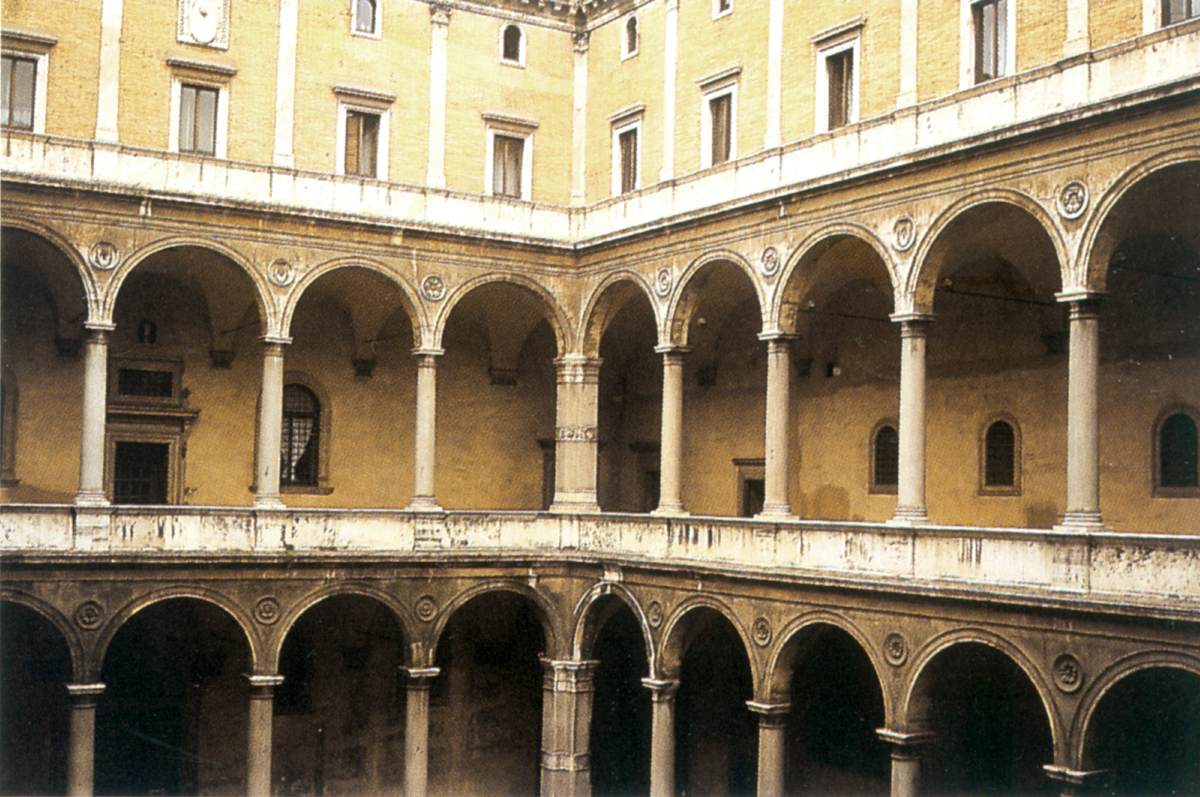
Interior view
- MEDIUM
- Photo
- TYPE
- Interior
PALETTE
HOVER OR TAP A SWATCH FOR NAME, SHARE AND HEX. SAMPLED FROM THE IMAGE — INDICATIVE, NOT A PIGMENT ANALYSIS.
DEVELOPMENT BUILD — NOT FOR PUBLIC USE. CONTRIBUTE ON GITHUB.
CURRENT LOCATION · Palazzo della Cancelleria
03 — ARTWORK
PALETTE
HOVER OR TAP A SWATCH FOR NAME, SHARE AND HEX. SAMPLED FROM THE IMAGE — INDICATIVE, NOT A PIGMENT ANALYSIS.
COMMENTARY
UNDERLINED TERMS ARE DEFINED IN THE GLOSSARY.
This palace was commissioned by Cardinal Raffaele Riario. It was designed before 1489, the façadethe front or principal face of a building, especially one elaborately constructed; a blind façade is a façade that is purely decorative and does not relate to the structure of the building. was probably completed by 1495, the palace was completed c. 1511. It is a colossal building, with a principal façade of about 90 m long. It is regarded as the earliest Renaissance palace in Rome. The architect of the palace is not known, the names of Bramante, Andrea Bregno, Francesco di Giorgio Martini and Baccio Pontelli are often connected with the building of the palace.
The photo shows the inner courtyard of the palace. The remarkable resolution of the interior corners with double corner piers suggest some involvement of Bramante, freshly arrived in Rome from Milan. The formal convergence of palace courtyard with church cloisterquadrilateral enclosure surrounded by covered walkways, the centre of activity for the inhabitants of a monastery. indicates how far classicalRelating to the culture of ancient Greece and Rome (classical Antiquity). The classical world played a profoundly important role in the Renaissance, with Italian scholars, writers, and artists seeing their own period as the rebirth (the "renaissance") of classical values after the Middle Ages. The classical world was considered the golden age for the arts, literature, philosophy, and politics. Concepts of the classical, however, changed greatly from one period to the next. Roman literature provided the starting point in the 14th century, scholars patiently finding, editing and translating a wide range of texts. In the 15th century Greek literature, philosophy and art - together with the close study of the remains of Roman buildings and sculptures-expanded the concept of the classical and ensured it remained a vital source of ideas and inspiration. architecture had begun to penetrate domestic design.
@online{wga-rb465594ba4bd75,
  author       = {Krén, Emil and Marx, Daniel},
  title        = {Interior view by ARCHITECT, Italian},
  organization = {{Web Gallery of Art}},
  date         = {2026-09-13},
  url          = {https://beta.wga.hu/artists/architect-italian-rba53e875123939/interior-view-rb465594ba4bd75},
  urldate      = {2026-09-13},
  langid       = {english}
}
ACCESSED 2026-09-13. REPLACE THE AUTHOR FIELD WITH THE COMMENTARY AUTHOR WHERE ONE IS NAMED.


