03 — ARTWORK
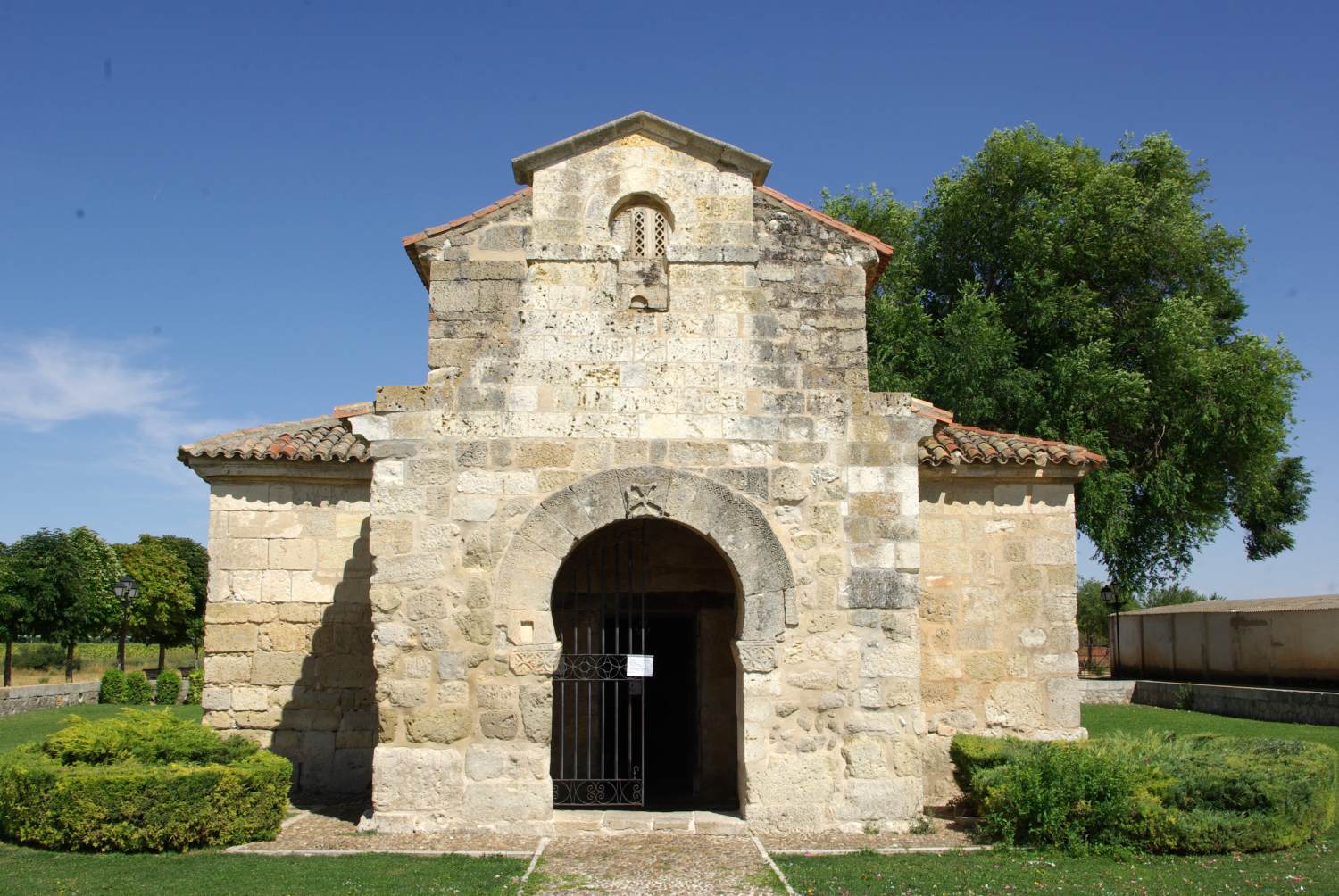
Exterior view
- MEDIUM
- Photo
- TYPE
- Religious
PALETTE
HOVER OR TAP A SWATCH FOR NAME, SHARE AND HEX. SAMPLED FROM THE IMAGE — INDICATIVE, NOT A PIGMENT ANALYSIS.
DEVELOPMENT BUILD — NOT FOR PUBLIC USE. CONTRIBUTE ON GITHUB.
03 — ARTWORK
PALETTE
HOVER OR TAP A SWATCH FOR NAME, SHARE AND HEX. SAMPLED FROM THE IMAGE — INDICATIVE, NOT A PIGMENT ANALYSIS.
COMMENTARY
UNDERLINED TERMS ARE DEFINED IN THE GLOSSARY.
At the beginning of the 5th century, Spain was invaded by several waves of Germanic tribes, but it was the Visigoths who established supremacyHistorically, the supremacy of the English king over the English Church, i.e. the king not the Pope is acknowledged as the supreme head of the Church of England. Established legally by the Act of Supremacy in 1534. and, after their conversion to Catholicism by King Recaredo in 589, went on in the 7th and 8th centuries to develop an original art and architecture that was closely linked to Hispano-Roman aesthetics.
A surviving votive offering by the Visigothic King Recceswinth (reg 649–72) is a small church, San Juan Bautista, at Baños de Cerrato, in the province of Palencia. As the name implies, Baños was once a Roman establishment where people sought cures from the waters. The King, healed of some malady, fulfilled his vow of building a church on this spot, appropriately to St John the Baptist. It is a low ashlarA block of hewn stone with straight edges for use in building building with a three-aisled navethe main interior space of a church building. It may have parallel aisles on each side, often separated from it by pillars, and is intersected by the transept, which cuts across it at the point where the choir begins. and originally three square-ended chapels with barrel vaults; the outer apses have been destroyed.
The building is now devoid of all church trappings. Enlivening the archThe pointed arch is widely regarded as the main identifiable feature of Gothic architecture (distinct from the round arch of the Romanesque period). The three most common Gothic arches are the Equilateral, Lancet and Tudor. over the small entrance porch is some carved decoration, an even-armed cross in a circle from which descend traditional chip-carved motifs, in which the flat planes of the carving meet at sharp angles. Chip-carving was not an invention of the Visigoths, but they seem to have favoured it, at least in the 7th-century monuments. The same type of decoration can be seen along the extrados of the main apseA semicircular projection, roofed with a half-dome, at the east end of a church behind the altar. Smaller subsidiary apses may be found around the choir or transepts. Also known as an exedra. The adjective is apsidal. arch, and the technique was used for the nave capitals. Derived from the Early Christian interpretation of the Corinthian order, they are smaller in scale than their prototypes, the acanthusa thistle species very common in the Mediterranean. Its large, jagged leaves, curving in slightly at the tips, have been a favorite ornamental pattern since classical antiquity. leaves are less three-dimensional in appearance, and they are much more 'colouristic', dependent on light rather than on surface modelling to create form.
View the <a href="#" onClick="w=window.open ('/support/plans/zzzarchi/07c/5/cerrato1.html', 'newWin', 'scrollbars=yes,status=no,dependent=yes,screenX=0,screenY=0,width=400,height=600');w.opener=this;w.focus();return false">ground plan</a> of the building.
@online{wga-rb754bff72e5850,
  author       = {Krén, Emil and Marx, Daniel},
  title        = {Exterior view by ARCHITECT, Spanish},
  organization = {{Web Gallery of Art}},
  date         = {2026-09-13},
  url          = {https://beta.wga.hu/artists/architect-spanish-reb57f7cda3b22d/exterior-view-rb754bff72e5850},
  urldate      = {2026-09-13},
  langid       = {english}
}
ACCESSED 2026-09-13. REPLACE THE AUTHOR FIELD WITH THE COMMENTARY AUTHOR WHERE ONE IS NAMED.


