03 — ARTWORK
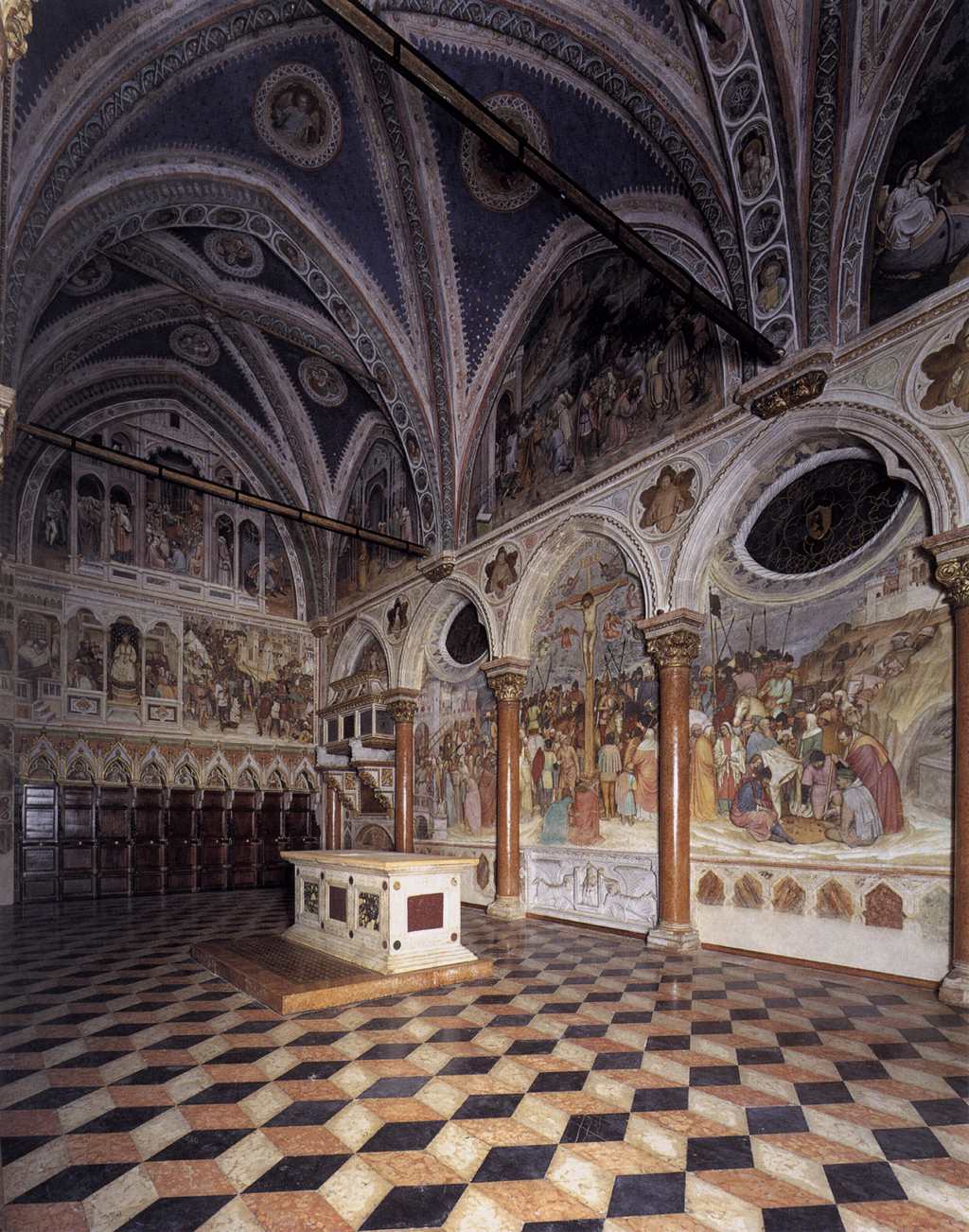
View of the Cappella di San Giacomo
- MEDIUM
- Fresco
- TYPE
- Interior
PALETTE
HOVER OR TAP A SWATCH FOR NAME, SHARE AND HEX. SAMPLED FROM THE IMAGE — INDICATIVE, NOT A PIGMENT ANALYSIS.
DEVELOPMENT BUILD — NOT FOR PUBLIC USE. CONTRIBUTE ON GITHUB.
03 — ARTWORK
PALETTE
HOVER OR TAP A SWATCH FOR NAME, SHARE AND HEX. SAMPLED FROM THE IMAGE — INDICATIVE, NOT A PIGMENT ANALYSIS.
COMMENTARY
UNDERLINED TERMS ARE DEFINED IN THE GLOSSARY.
The frescoes in the Cappella di San Giacomo (Chapela small separate place for worship, either part of a large church or a separate building. of St James) were commissioned by Bonifacio Lupi di Soragno and his wife, Caterina dei Franceschi. The architecture, designed by the Venetian sculptor and architect Andriolo de' Santi was commissioned in 1372.
The painting school of Padua can be ranked as the most vigorous of the northern Italian schools: the painters of Padua built upon Giotto's achievements. The prolific Paduan frescoWall painting technique in which pigments are applied to wet (fresh) plaster (intonaco). The pigments bind with the drying plaster to form a very durable image. Only a small area can be painted in a day, and these areas, drying to a slightly different tint, can in time be seen. Small amounts of retouching and detail work could be carried out on the dry plaster, a technique known as a secco fresco. painters added striking naturalistic observations of their own in landscape, in the painting of animals, and in portraiture. The most successful painters of the period came to Padua from outside - Jacopo Avanzi from Bologna and Altichiero da Zevio from Verona. In the Chapel of St James, to Avanzi have been attributed most of the lunettes of the Life of St James, painted about 1374, while to Altichiero has been assigned the huge CrucifixionAn important method of capital punishment, particularly among the Persians, Seleucids, Jews, Carthaginians, and Romans from about the 6th century BC to the 4th century AD. Constantine the Great, the first Christian emperor, abolished it in the Roman Empire in AD 337, out of veneration for Jesus Christ, the most famous victim of crucifixion. There were various methods of performing the execution. Usually, the condemned man, after being whipped, or "scourged," dragged the crossbeam of his cross to the place of punishment, where the upright shaft was already fixed in the ground. Stripped of his clothing either then or earlier at his scourging, he was bound fast with outstretched arms to the crossbeam or nailed firmly to it through the wrists. The crossbeam was then raised high against the upright shaft and made fast to it about 9 to 12 feet (approximately 3 metres) from the ground. Next, the feet were tightly bound or nailed to the upright shaft. A ledge inserted about halfway up the upright shaft gave some support to the body; evidence for a similar ledge for the feet is rare and late. Over the criminal's head was placed a notice stating his name and his crime. Death, apparently caused by exhaustion or by heart failure, could be hastened by shattering the legs (crurifragium) with an iron club, so that shock and asphyxiation soon ended his life. and some of the other lunettes.
@online{wga-r4e8e045c0a014d,
  author       = {Krén, Emil and Marx, Daniel},
  title        = {View of the Cappella di San Giacomo by AVANZI, Jacopo},
  organization = {{Web Gallery of Art}},
  date         = {2026-09-09},
  url          = {https://beta.wga.hu/artists/avanzi-jacopo-rb9cc8206c449e8/view-of-the-cappella-di-san-giacomo-r4e8e045c0a014d},
  urldate      = {2026-09-09},
  langid       = {english}
}
ACCESSED 2026-09-09. REPLACE THE AUTHOR FIELD WITH THE COMMENTARY AUTHOR WHERE ONE IS NAMED.
The archive catalogues no further works by this artist.
TRY SAME COLLECTION →